
Counties Energy second-life EV battery tests get good results
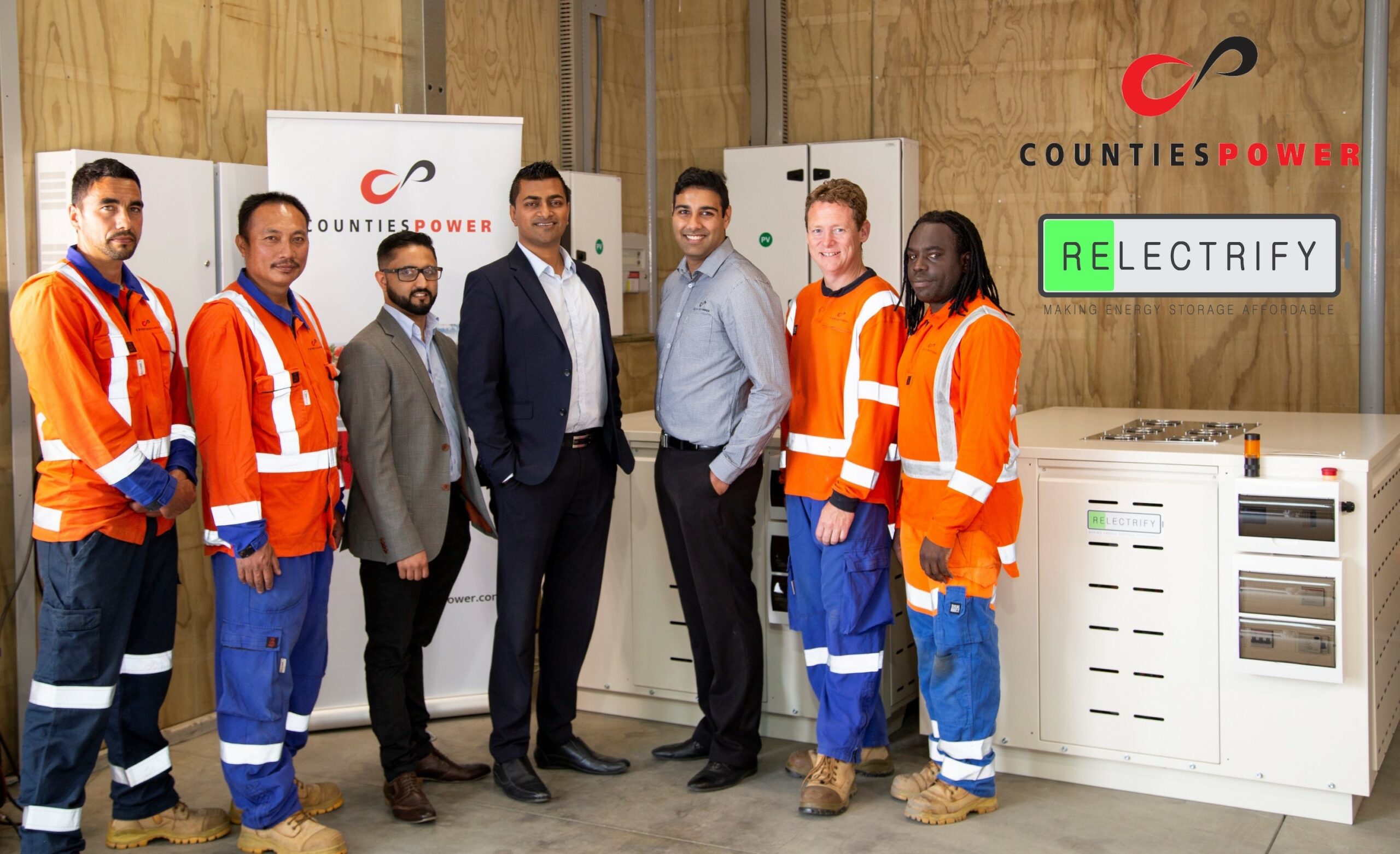
Electricity distributor Counties Energy and Australian battery technology company Relectrify say successful milestone results have been achieved from their joint deployment of New Zealand’s largest battery system using repurposed second-life EV batteries.
First announced in December 2020, the energy storage unit has undergone robust testing in the last year. The battery system, now upgraded and referred to as the ReVolve battery system, combines Relectrify’s BMS+Inverter technology with batteries from nine Nissan Leaf EVs to store more than 120kWh of energy.
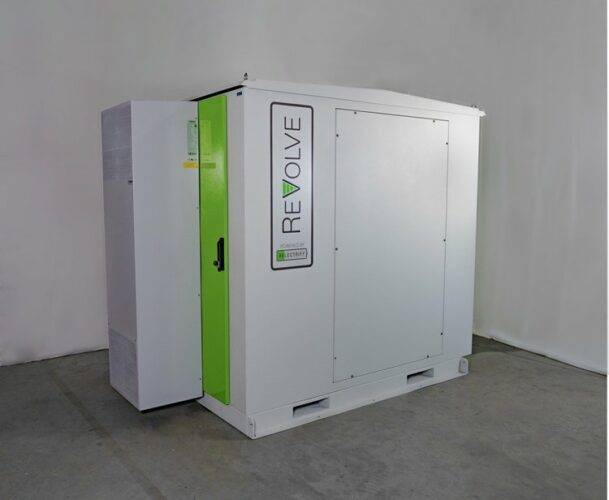
In its new outdoor enclosure and following the successful existing validation, this and other ReVolve systems will be deployed on Counties Energy’s network once certification is complete.
The results are based on 500 usage cycles of accelerated lifetime testing, equating to 50MWh throughput. A usage cycle here is when a battery discharges from around 90% charged to around 10% charged, and then charges from around 10% back to around 90%. This is also described as an 80% depth-of-discharge.
A key result is that 20% extra capacity is unlocked.
The capacity of a standard passive battery management system is usually limited by the lowest performing series battery cell in a series system. However, the ReVolve battery system is not constrained by this. Instead, Relectrify’s BMS+Inverter cell-level control technology was able to unlock an estimated 20% extra capacity in the second-life batteries during Counties Energy and Relectrify’s joint testing.
This was achieved by Relectrify’s BMS+Inverter hardware and smart algorithms taking a much more optimised approach; stronger battery segments with a higher state-of-health (SoH) contributed additional energy to the system, while gentler demands were placed on weaker battery segments with a lower state-of-health.
The result is an orchestra of each segment of the battery contributing at its own optimal performance, leading to higher-performing and longer-lived battery solutions.
Another key result was achieving 88% average efficiency.
Relectrify’s BMS+Inverter enables a grid-compatible AC output as used in homes, industry, and the grid, without needing a separate costly inverter. Throughout the 500 cycles of testing, the full battery system achieved a round-cycle efficiency averaging about 88% AC-to-AC, including charge and discharge of the BMS+Inverter and of the second-life batteries.
This efficiency compares favourably with real-life efficiencies of new industrial storage systems, such as 84.5% round-cycle efficiency for a Tesla Powerpack installation with the University of Queensland.
Thirdly, the result is on track to validate the ReVolve technical lifespan of 3000 cycles.
The ReVolve battery system is projected to have a technical lifespan of 3000 full charge and discharge cycles; this can be between five and 10 years of usage depending on how the battery system is used.
After 500 cycles at around 80% depth-of-discharge in accelerated lifetime testing, the battery continued to retain far higher capacity than a standard BMS would have been able to provide with the same batteries.
It has been great to see our extensive testing confirm that these batteries controlled by Relectrify’s BMS+Inverter meet the core technical and functional requirements required from battery storage, in a wide variety of applications relevant to Counties Energy as an electricity distribution utility,” says Counties Energy technology and digital general manager Moonis Vegdani.
Relectrify co-founder and chief executive Valentin Muenzel says working with Counties Energy to understand their industrial and utility use cases for battery storage is “outstanding”, and to demonstrate in practice that battery systems powered by Relectrify technology meet their functional and performance requirements.
Counties Energy will deploy one ReVolve to a rural location on its network to solve power quality issues on the low voltage network, and two further ReVolve units as an energy buffer system for high-power EV charging at Mercer on the Waikato Expressway as part of an Energy Efficiency and Conservation Authority (EECA) supported project.


Join the conversation