
End-of-life EV batteries to recharge EVs

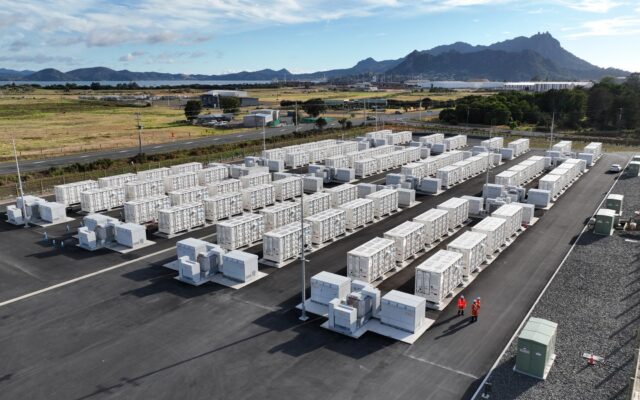
Counties Energy has launched its “berm battery” energy storage system using 18 repurposed Nissan Leaf batteries for recharging EVs.
The berm battery’s journey to become New Zealand’s first second-life battery system follows a comprehensive planning and certification process which began in 2020 and included two years of testing, also featuring in a ‘real world’ environment. It was commissioned in October 2023.
The low voltage berm battery system is based at a strategic state highway location at Mercer, Waikato.
Electricity taken from the network at lower demand periods is stored by the berm battery to use for higher demand EV power charging.
Working with Australian battery energy storage developer Relectrify and its CellSwitch technology, the ReVolve system stores 240kWh of energy or around 10 times the storage capacity of a typical home battery storage unit.
The Pukekohe-based company says it is excited to launch this high-powered EV charging solution for drivers, offering extremely fast and convenient charging to keep EV drivers on the move with an innovative sustainable solution.
The innovative project epitomises the future of energy and “flexible infrastructure” at work right now in New Zealand, says Counties Energy chief group strategy and transformation officer Moonis Vegdani.
“By making the connections between the network and berm battery storage we are able to meet high demand loads such as EV charging and, at the same time, reduce stress on the network, smooth the network load, decrease connection times and avoid or defer costly infrastructure upgrades,” he says.
Additional benefits to EV drivers include faster charging and resiliency, Vegdani says.
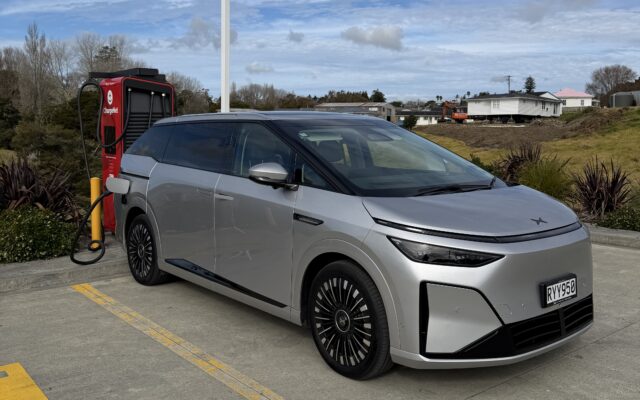
EV drivers can now charge their vehicles at a faster charge rate – previously this was 120kW, due to network constraint at the local transformer – now with the support of the battery this can be up to 180kW, says Counties Energy.
The berm battery can also run EV chargers in a power outage or grid emergency.
The project demonstrates sustainable driving technology and how battery energy solutions can manage peak demand electricity usage cost effectively, ultimately benefiting the company, local electricity consumers, EV drivers and the environment, says Counties Energy.
“This initiative showcases how our CellSwitch technology can help reimagine the lifecycle of EV batteries to revolutionise energy storage and distribution,” says Relectrify partnerships vice president Juergen Barth.
The project is an example of Counties Energy’s distributed systems operator (DSO) strategy as it works sustainably towards decarbonisation and reimagining New Zealand’s energy future.
By unlocking smart meter data, real time network information, usage and generation data enables the company to actively orchestrate energy, creating “flex and stretch” in their network to allow for customers’ changing needs.
“We’re huge supporters of promoting electric vehicle usage within our region and beyond with our EV charging platform OpenLoop, while also investigating how we prepare for the future of electricity distribution using smarter energy technologies,” says Vegdani.
“These projects achieve both outcomes, and we’re grateful to EECA (Energy Efficiency and Conservation Authority) and the fund (low emission vehicles contestable fund) for supporting us in our vision to deliver enhanced energy solutions to our community.”
Counties Energy installed two high-power EV chargers at Mercer Service Centre on the Waikato Expressway in October 2022.
Together with the new 240kWh second-life EV battery system (commissioned in 2023) it now optimises the use of electricity capacity and demand on the electricity network during peak power usage times, the company says.
While the Mercer EV chargers are co-funded by EECA ($112,000), the berm battery storage project is fully funded by Counties Energy.
The company earlier announced the completion of a major DSO milestone on a project collaborating with OpenLoop, Europe-based Plexigrid and Taranaki-based Ara Ake.
The programme’s next milestone will go further to use the intelligent DSO platform in an in-field pilot later this year, the core of which is based on learnings from South Australia Power Network’s and their implementation of Dynamic Operating Envelopes (DOEs) using the IEEE 2030.5 protocol.
Once the project is completed, Counties Energy plans to offer DSO services via distributed energy resource (DER) aggregators and use flexibility management as an effective energy orchestration solution.
Join the conversation