
Toyota NZ announces Auckland hydrogen fleet partnership

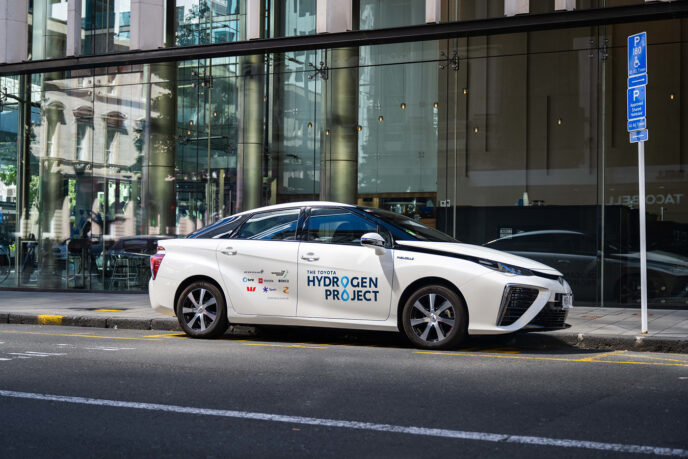
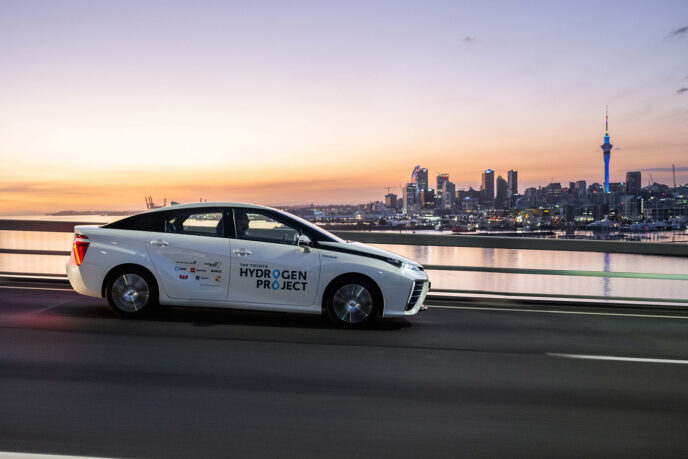
Toyota New Zealand has announced what it describes as the first commercial application of hydrogen fuel-cell technology in the country, in the form of a Toyota Mirai fleet partnership with eight of New Zealand’s largest companies.
The companies taking part in the programme are The Warehouse, Air New Zealand, Saatchi & Saatchi, TVNZ, Beca, Westpac NZ, Spark, and Z Energy; each sharing a fleet of hydrogen-powered vehicles.
Toyota is working with multiple partners on the hydrogen refuelling of these vehicles throughout Auckland.
“Hydrogen fuel cell technology is another step in the journey to a zero-emissions transport eco-system. The commercial application of this technology is vast and Toyota has the means to explore new technologies,” says Toyota New Zealand CEO Neeraj Lala.
“These Kiwi companies have joined together to demonstrate the commercial possibilities of hydrogen technology in a real-world car-sharing trial. Toyota and our Hydrogen Project members are committed to a carbon-neutral future.”
The news comes amid prime minister Jacinda Ardern’s trade mission to Singapore and Japan. Lala is among those in the PM’s delegation, confirming that presenting “the hydrogen opportunity” and growing “the hydrogen economy” in New Zealand are on the agenda.
Numerous companies, including Meridian Energy and Contact Energy, are keen to see New Zealand become a producer of green hydrogen.
Toyota boasts that the model can travel 500km in urban environments with 4.6kg of hydrogen on board. Its only tailpipe emissions are water. The project is set to make use of both outgoing Mirai models, and the nameplate’s current iteration.
Lala notes that Toyota remains committed to supporting numerous low-emission solutions on the road to emissions reduction, stating that the hydrogen push “is not a distraction from BEV application”, adding that it’s difficult to predict the future.
“The use of green hydrogen as a fuel for transport is also about having cleaner air to breathe in our cities by reducing other gases and polluting particles from combustion engines,” he says.
“It is more important to adapt to changes in the future than trying to predict the future. With the pace of change accelerating due to technological innovation, predicting the future becomes increasingly difficult.”
The chief executive also notes that the programme is also about the merits of large corporates sharing fleets with each other.
“This trial also showcases the ability for large companies to join together to share their fleets, which in the future could lead to larger reduction in carbon emissions when you are talking about sharing say 100 cars,” he says.
“Car-sharing with hydrogen cars is not common anywhere in the world and we are all keen to see how this will work in practice, and how we can utilise this technology further.”

Join the conversation