
Wireless Ev Charging Studied for State Highway 1
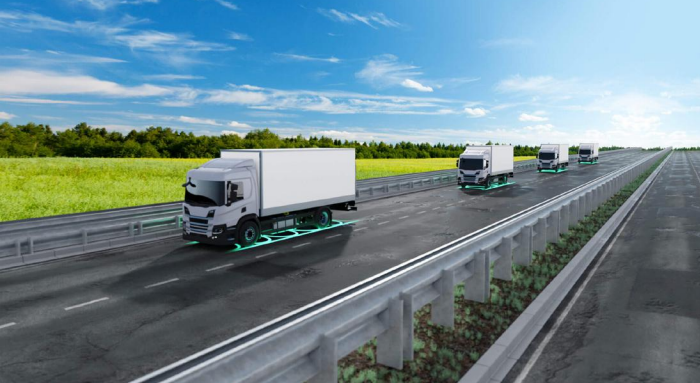
The feasibility of wireless in-lane charging for EVs is being investigated by University of Auckland researchers.
The impact of charging pads on a section of Auckland motorway, including economic feasibility, charging lane length, effects on traffic flow and energy consumption, are included in the research.
Engineering PhD candidate Ramesh Majhi, engineering senior lecturer Dr Prakash Ranjitkar and Dr Selena Sheng developed a traffic simulation framework and a state of charge model to evaluate the impacts of dynamic wireless charging (DWC) on a 90km section of State Highway 1.
DWC pads are embedded in the road and use electromagnetic induction to charge EVs while they’re moving.
The researchers investigated the economic feasibility of the wireless system in terms of the total cost associated with a section of SH1 by comparing it to the cost associated with using plug-in charging stations within 1km of the highway.
It found that the total investment cost of a DWC in the corridor for a system with a 50kW inductive power transfer capacity is $1.59 million per year when traffic flows freely compared to $1.42 million per year in the case of peak hour traffic.
The cost variation results from faster speeds when traffic moves freely; hence, more charging length is required to satisfy the demand, the researchers found.
Without considering the time it would take to drive to a static plug-in charging station, a wireless charging lane would only be less costly at 125kW and above, according to the paper.
However, when comparing the feasibility of both charging facilities in terms of the total cost, the researchers say it’s imperative to consider the value of time (travel time, delay, and charging time), which is substantially more for plug-in charging stations compared to in-road wireless charging.
And at a higher inductive power transfer capacity, such as 75kW and above, wireless in-road charging becomes less costly compared to the typical plug-in set-up under peak-hour conditions while taking the cost of travel time into account, the study adds.
Meanwhile, as the EV population increases, the time costs tend to become more significant to utilise plug-in charging stations, which will make DWC more feasible and competitive in the future, say the researchers.
“As the existing plug-in stations can handle only limited EVs at a given time, with the increase in charging demand, the wireless in-road facility will soon become more competitive compared to the current plug-in charging stations due to savings in costs associated with travel time, delay, and charging time,” says Majhi.
“Moreover, with advanced research in dynamic wireless charging system components, the construction cost of a wireless charging lane will eventually decrease, making it more feasible than existing plug-in charging.” The work, published in the international journal Sustainable Cities and Societies, used various scenarios and measures, including four different inductive power transfer capacities (50, 75, 100, and 125kW), real traffic data and two types of traffic conditions – peak hour and free flow, to evaluate the performance of DWC systems.

Join the conversation