
Schneider Electric launches new EVLink Home charger

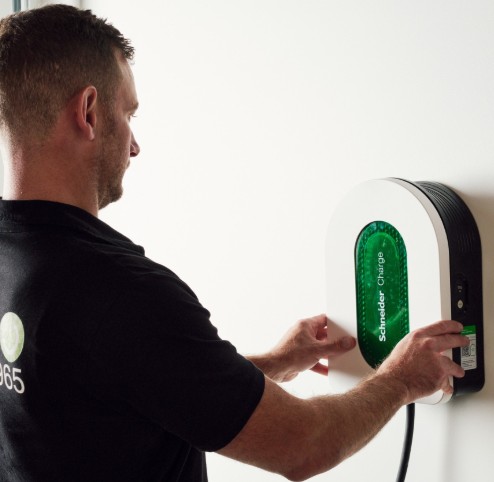
Schneider Electric has launched a new, easy-to-use and cost-effective EVlink Home charger and is providing it here.
New Zealand electricians wanting to offer customers a safer and typically faster way of charging their vehicle than a standard three-pin plug can supply the EVlink Home charger which Schneider Electric says is easy-to-install with an in-built RDC-DD, which helps to optimise switchboard space in retrofit or new builds.
It can go inside or outside the home with its IP54 rating.
Complementing the EVlink Home charger is the optional EVlink Home Anti-tripping system, a power load management system which adapts continuously the power delivered by the charger to the EV according to power available at home.
Communication between the Home Anti-tripping system and EVlink Home charger is via power line communication, so there is no need to add a communication cable, Schneider Electric explains.
Other features include 1Phase 7.4kW and 3Phase 11kW options, an attached five metre cable or Type 2 socket, certification IEC 61851-1 Ed. 3.0, and RCM GMA-513376.
Schneider Electric New Zealand points to a 2021 survey of EV owners as indicative of the need for home-based EV technology.
The Energy Efficiency and Conservation Authority (EECA) survey of 932 EV owners found that although 82% of people commonly charge at home, most lack the right hardware for optimal safety and performance.
More than three-quarters (77%) were using a standard three-pin domestic power socket and charging cable (known as Mode 2) to charge at home, while only 30% had dedicated wall-mounted EV home chargers (Mode 3, the ideal for function and safety, with some respondents having access to both).
Among those with 2018 or earlier EVs, an even higher number (84%) were using a domestic Mode 2 socket and cable, and 70% of respondents had cars in that age range.
“There is huge demand for EVs – by 2030, it is estimated 30% of passenger vehicles globally will be fully electric, and this could be even higher in New Zealand,” says Schneider Electric national e-mobility manager Liam Vink.
“We also know this is a reasonably new area of expertise for many electrical businesses, which is why we have an excellent support network across the country in our sales, technical support team and on-demand online training opportunities in place.
“This version of the charger is not a ‘smart’ model – so it is ideal for homeowners who just want to plug in, charge and go.”
Electricians wanting to upskill in EV charging can contact their Schneider representative to access free digital on-demand training on the EV charging market.

Meanwhile, Schneider Electric NZ has promoted Jack Brown to its e-mobility and home and distribution team, working with Vink.
Brown did a Bachelor of Science in astrophysics at the University of Canterbury, founded and operated a Christchurch clothing store and a recording studio, plays music and is a keen golfer and surfer.
His background in science and interest in sustainable energy and clean energy production led him to the Schneider Electric sales academy in 2021, then a marketing role in the company’s Christchurch office.
He drives an EV and says clean energy production is one of the largest challenges faced.
“Much of my role is focused on education – helping electricians understand the new technology, working with them so that they are confident in installing and maintaining the product to safety standards and in turn educating the end user.
“We also help from start to finish on the entire design of the solution for the bigger projects, working closely with the contractor to make the process go smoothly.”


Join the conversation