
10k EV chargers by 2030 proposed by National Party

National says it will deliver 10,000 EV chargers nationwide by 2030.
It reckons the network will allow more Kiwis to make the switch and that National will invest $257 million over four years to provide the public EV chargers, which it says is nearly 10 times more than currently.
National continues to confirm it will scrap the Labour Government’s “ute tax” (aka Clean Car Discount) and instead accelerate public charging infrastructure roll-out while reviving the ultra-fast broadband model to ensure the EV chargers are built where drivers need them in underserved areas.
Funding for the cost of winding up the CCD scheme will come from ending Auckland’s light rail, saving about $178 million from unspent funds for land acquisition and planning, says National, which also intends setting aside other funds.
About $281.5 million in outstanding loans from taxpayers to Waka Kotahi NZ Transport Agency is a one-off cost which needs to be met, says National, adding it will “turbo-charge” new renewable energy projects (including wind, solar and geothermal) by requiring decisions on resource consents within one year and consents to last 35 years.
Consents for infrastructure upgrades would be eliminated, says National which intends cutting red tape holding back EV infrastructure investment.
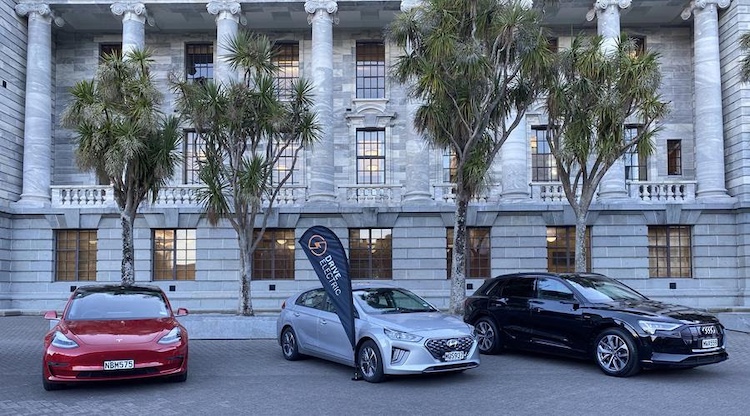
Drive Electric chair Mark Gilbert says National’s new EV policy will bring fewer emissions, cheaper transport and energy independence from fossil fuels.
“Transport is 18% of our GHG emissions, and 90% of these emissions are from road transport,” he explains.
“Decarbonising transport is the low-hanging fruit in our response to climate change and critical to hitting our first and second emissions budgets.
“New Zealand’s public charging infrastructure is lagging behind the world, and so we strongly support any additional investment to create a world class network of chargers for EV drivers today and tomorrow. Eventually almost all New Zealanders will come to depend on this network, directly or indirectly.”
Gilbert says public investment can spark private sector investment many times over.
“There are a range of players in New Zealand ready to deploy networks, including Jolt,ChargeNet, Tesla, Meridian, BP and Z Energy.
“There are many barriers to investment in public charging. It is challenging for national charging providers to connect through 29 EDBs across the country with different approaches to pricing and making connections.
“Public chargers are asking for more consistency in approach. This is crucial.
“Ultimately to make public charging investment economic and to decarbonise transport, we need more people in EVs sooner rather than later.
“We continue to believe there is an important role for both the Clean Car Discount and Clean Car Standard, because it is a policy that has delivered results,” says Gilbert.
“At the end of 2020 EVs had 2.3% market share of light vehicle sales, by the end of 2022 they made up 10.67%. This year that figure will be higher still. But, in total EVs are not yet quite 2% of the total light fleet.
“We should see sticker prices come down to meet those of ICE over the next couple of years, which would be the time to consider phasing out incentives.”
Gilbert says a secondhand fleet is needed to give more people the opportunity to go electric.
ChargeNet says National’s policy will strengthen charging networks and electrification of transport
It will “supercharge” EV infrastructure by investing $257 million over four years into building 10,000 EV charging points, and enable a greater strategic focus from private investors on where infrastructure is needed by removing red tape while maintaining co-investment, says ChargeNet. “With both National and Labour offering support to the emerging EV charging industry, the bipartisan support to decarbonise the transport sector is an encouraging sign for investors and New Zealand drivers,” ChargeNet adds.
Efforts to strengthen and diversify EV market growth, as well as charging infrastructure in New Zealand, must be maintained as the cost of an EV approaches price parity with internal combustion vehicles within the next five years, says ChargeNet chief executive Danusia Wypych.
“I have recently returned from a European market insights tour, where there is a public charger for approximately every 10 EVs on the road,” she adds.
“In New Zealand, that ratio is closer to one charger for every 100 EVs.
“The demand is already there. Earlier this year, when we paired a new hyper-rapid 300kW charger alongside our hard-working 50kW charger in Bulls, the new charger hit more than 10% utilisation in the first month, in line with international utilisation rates,” says Wypych.
“We have been investing heavily in the ChargeNet network for seven years – for any dollar the Government has invested with us in charging infrastructure, we invested a further three dollars.
The announcement of greater funding and the freedom for private investors to be more targeted with their funding will ensure that infrastructure is being built in step with EV market uptake and using data-based insights to ensure it’s going into the areas where it’s most needed,” she says.
“Increasing the availability of multiple points at sites where drivers need them is a priority.”
ChargeNet has recently approved investment for a proposed site with up to five 150kW chargers being installed, with a total 750kW capacity available – the site equivalent to 15 of ChargeNet’s original national network sites.
Installations and upgrades at the new Pak’nSave Warkworth supermarket, Tamahere in the Waikato, and at Pakn’Save Paraparaumu have been confirmed by ChargeNet.
“Our business is data-driven, and we know that our customers have two or three ‘favourite’ places to charge – they are already incorporating EV charging into their everyday activities,” says Wypych.
ChargeNet has increased its network to more than 300 charging points during the past year.
“We currently have a baseline plan with over 20 sites to deliver in the next nine months,” says Wypych.
“That’s 34 chargers committed to new sites, with the capacity to deliver charging sessions at a rate that is equivalent to 100 of our current 50kW sites.
“We have just placed an order for 100 charging units, which will start landing in New Zealand in the next three months.”
ChargeNet suggests National’s proposed removal of the Clean Car Discount (CCD) could be delayed to optimise the support for individuals and industry.
“While we’re now at a point where EVs are a mainstream purchasing consideration, there is still a few years to go before EVs reach price parity with internal combustion vehicles,” Wypych explains. “The removal of the Clean Car Discount is premature, as it may deter some drivers from making the switch, and slow down the growth of the market,” she says, adding ChargeNet is confident EV adoption will continue even if the CCD is


Join the conversation