
100 EV chargers for national network
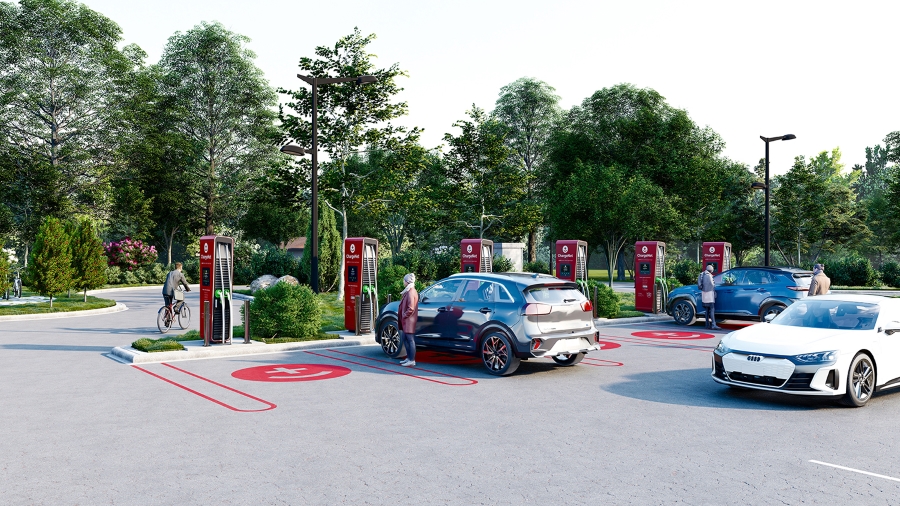
About 100 more EV chargers will be added to the public network across New Zealand in coming months, with 19 locations on popular holiday routes targeted.
Destination charging will also be provided at convenient places like shopping centres.
Government co-funding has been announced for more than 100 EV chargers – with at least 200 charging ports altogether – many planned to be up and running on key holiday routes by Christmas.
The focus is on major highways, throughfares, and places New Zealanders regularly visit while out and about, such as shopping.
“Our EV sales keep increasing month-on-month, so we’re working with the industry to ensure charging capacity grows, and in front of demand,” says energy and resources minister Megan Woods.
“We have hit the previous EV charging target of one charger each 75km on our state highways, but our new vision is that New Zealanders should be able to charge where and when they need to,” she explains.
Energy Efficiency and Conservation Authority (EECA) research shows that while 80% of people do more than half of their charging at home, Kiwis also need a range of options available to them while out and about, especially on longer journeys.
“New chargers will be situated at places like shopping centres where people may be parked for up to a couple of hours,” says Woods.
“To help with longer journeys, the government is co-funding high-speed chargers on main highways at 19 popular holiday routes including Bombay, Turangi and Wanaka.
“Also included are the country’s first charging ‘hubs’ where up to 10 high-speed chargers will sit alongside amenities like food options and toilets.”
The government’s draft National EV Charging Strategy – Charging our Future – proposed a target for hubs to be situated about every 150-200km across the state highway network.
The announced projects come from three rounds of the Low Emission Transport Fund (LETF), administered by EECA.
Altogether, 16 projects will receive $11 million in government co-funding, matched by $13.5 million in private investment.
ChargeNet chief executive Danusia Wypych says that when partnering with EECA, ChargeNet leverages data-driven insights and valuable customer feedback to strategically invest co-funding into communities that will support current and future EV drivers.
“We are excited to bring eight new electric vehicle charging sites across New Zealand’s regional centres,” says Wypych.
‘Our focus is on providing fast charging in the right place, at the right time and at the right speed.
“The co-funding will support improving charging capacity ahead of the anticipated summer demand and build network coverage in regional areas and holiday hotspots throughout the country.”
WEL networks’ We.EV head Craig Marshall says the LETF funding has been instrumental in enabling both the viability and speed to market of new public charging stations and is key to meeting the future charging demand.
“These sites are not necessarily economic from day one, however we need to build out the infrastructure to meet increasing demand and the funding assists business to bridge that gap.
“The size of the chargers we are looking to install now has increased enabling faster charge times and allowance for future upgrades.”
Z Energy EV charging head Kieran Turner says the support will enable Z to deliver more charging bays sooner at key locations for drivers.
“This includes the ability to put in more capacity ahead of the curve at some of our busiest locations, as well as plugging some of the gaps on people’s longer journeys.
“As part of this work, Z is excited to be partnering with Red Phase Technologies to bring innovation to the industry for our larger sites that will reduce the demand on the electricity grid while enhancing the overall customer experience.”
Woods points out the investment will help ensure the government is in a good position to reduce transport emissions.
“This is critical to hitting New Zealand’s net zero goal and avoiding the worst of climate change.
“We are starting to bend the curve on transport emissions; the latest data shows that emissions from household vehicle use fell 2.5% in the December 2022 quarter,” she adds.
“We want to not only continue that downward trend but accelerate its pace.”
Click here for more information.

Join the conversation