
Video: BYD Dolphin – Torture Tested
Kiwis have long had the habit of buying cars for the rare occasions when they need them. They might only tow a boat twice a year, but their daily driver better be capable of towing a small ship.
Once every three years they might dust off an old set of skis and head for the mountain – total justification to own a vehicle capable of crossing the Andes.
I have always believed in buying for your daily needs and renting for the rest. But to humour the masses, we decided to put the new BYD Dolphin Extended Range to a proper test. A torture test, if you will.
The plan… take a small, city-focused hatchback, and take it on the famous- in-this-magazine semi-annual holiday to Ohakune.
We have done it with the Audi E-tron, Tesla Model X, Tesla Model 3, and now pretty much the smallest EV on the NZ market.
That is not entirely true. The Dolphin is a smidge longer than an MG4 – a comparison between the two is in the works – and our specific vehicle for this trip is the Extended Range, not the Standard Range we drove last month.
Accordingly, we are not going into any great detail on the car other than the differences. For a detailed walkthrough of the Dolphin, check out the August issue, or visit our YouTube channel.
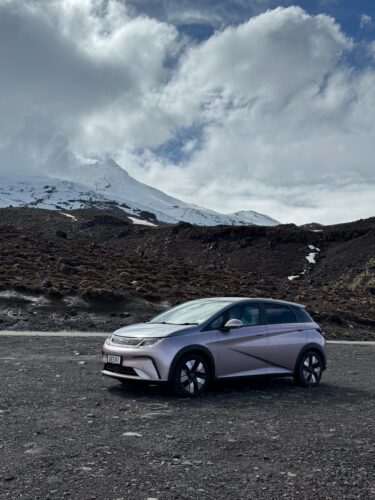
So what is different? ‘Aside from a $6000 difference in price – the extended coming in at $55,990.’ To the eye, and in terms of comfort and safety specifications, virtually nothing.
The Extended gets a two-tone paint scheme, wheels go up an inch, and the tyres (still the Linglongs) are 10mm wider.
Under the skin, the rear suspension is a more advanced and compliant multi-link setup; the motor is uprated to 150kW and 310Nm, while the weight – courtesy of the bigger 60.5kWh LFP battery – is up by 10% or around 150kg to 1658kg. This is marginally heavier than an MG4.
Still, with a 0-100km/h time of 7 seconds, it feels reasonably quick. In fact, that matches the Cupra Born, which markets itself as a sports EV. Handling is focused more on comfort than sportiness, but it’s overall a nice thing to drive.
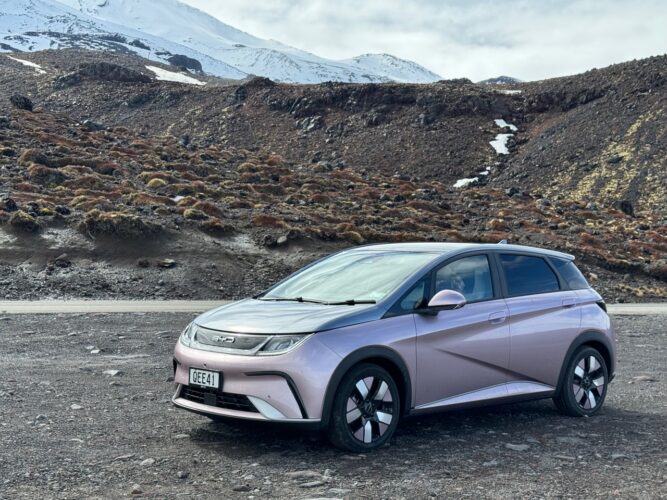
Adding a few people and filling it to the gunnels with luggage didn’t seem to impact its stability either, meaning that multi-link setup is earning its keep.
We had only driven the Standard Range briefly at the time of our Extended Range test, and have since found the base model is the crisper handler of the pair, likely trading a little comfort, though mostly down to the lower weight and stiffer rear setup.
I had been warned the driver assistance systems; lane keep, adaptive cruise, etc., had not been calibrated yet on the Dolphin, but found on the open highway that they were… fine. Not great, not annoying like some Chinese systems.
The interior design may be a little polarising, but it works well enough and is screwed together exceptionally well. There is lots of storage, and even a handy roll-out bag hook on the passenger side.
As per our earlier test, the Start/Stop button is in an annoying location, and the transmission shifter is not ideally placed, but muscle memory was kicking in on these near the end of the trip.
We reviewed the infotainment last month, and it’s solid – though easier access to temperature controls when in CarPlay would be nice, as would a wireless connection. The high-powered front and rear USB C ports are brilliant for kids’ iPads, while the VTL adaptor comes free!
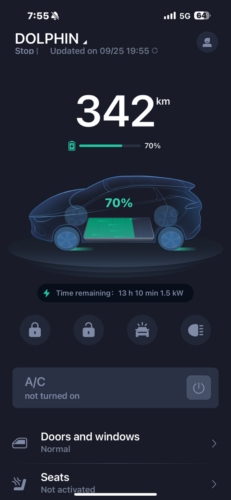
The BYD app is simple, but does the trick, particularly for monitoring charging. Charging itself is ok, at 7kW AC, 90kW DC.
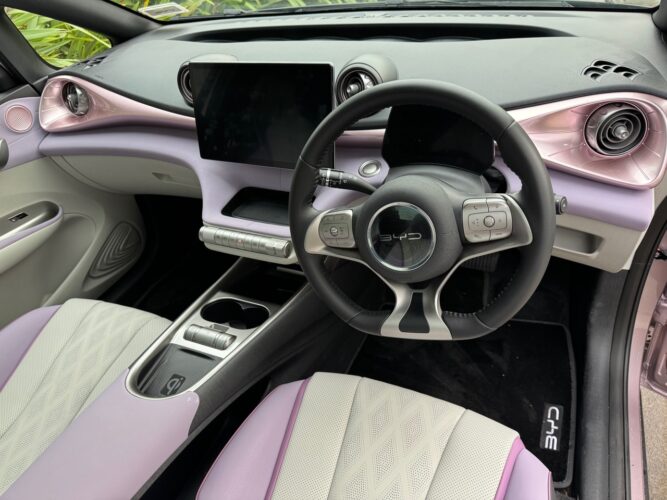
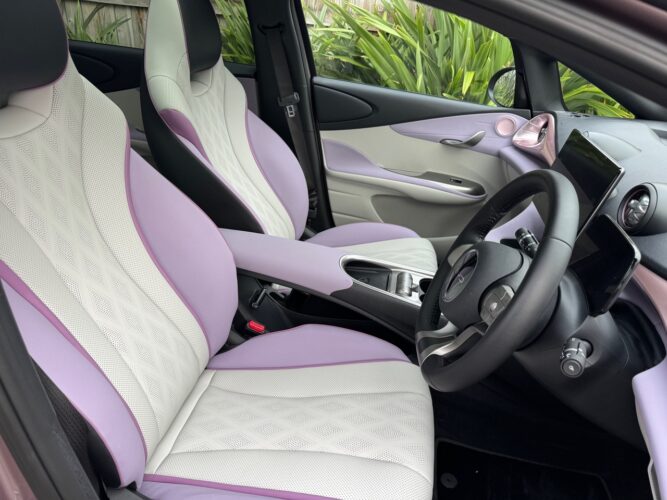
Coming off a butt-damaging trip in another EV, I was a little concerned the small pews in the Dolphin would leave me crippled. They didn’t – and I was able to do long stints without fault, and both front seats being electric makes driver swaps easy. Memory on the drivers might be a nice touch.
I have previously criticised the boot for being a bit small and poorly shaped, and well, it is, but I was surprised at what I could stuff in there, and we survived by using the back seat as well.
When we moved from the Dolphin to an Audi Q4 e-tron, it was impressive to see how much the Dolphin had carried when placed in a larger car. It didn’t feel like there was that much more luggage capacity.
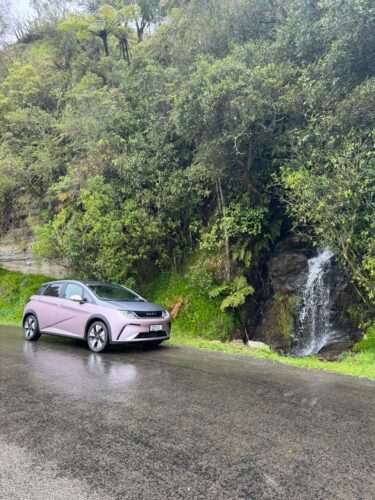
So, where is the torture? Well, as destructive as 3-4-year-old girls can be, the car made the trip down without a mark and with everyone happy. Filming didn’t go so well, with heavy rain and snow coming up from the south. Won’t somebody think of the content!
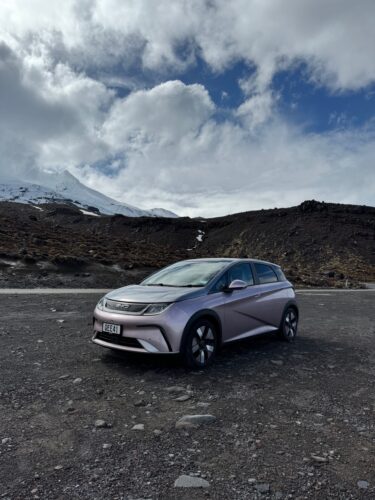
So, for the return trip we decided to max out what we thought the Dolphin could do. With a WLTP range of 427km, we mapped a trip from our accommodation to Auckland, via, well, the top of a mountain.
To be precise, the car park of Turoa – around 1600 meters of elevation in some chilly weather. And not starting up there either, going up, and back down.
Adding to consumption was our heavy onboard load, the need to keep heating and air-conditioning on, 110km/h Waikato motorways, and rain for most of the day. We made it to Bombay before calling it – over 350km from our start point. That is, to my mind, exceptional considering the conditions.
The 352km final tally gives an average consumption of 16.48kWh per 100km, and a potential range should we have kept going of 376km.
That is very solid in its own right, but leads me to believe that with one person on board and better conditions, I could smash the WLTP and get closer to 500km.
For all its bright colours and interesting looks, the Dolphin has grown on me as a very sophisticated, solid, and mature engineering effort from BYD.

Join the conversation