
Electric hydrofoiling vessel for Auckland
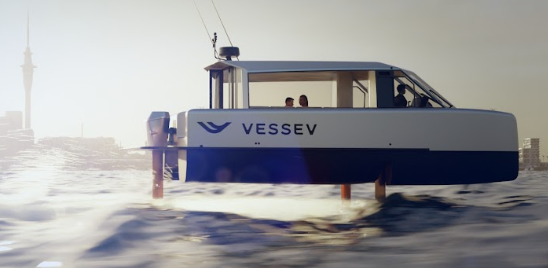
Revolutionary electric hydrofoiling vessel the VS-9 has been revealed by Vessev (formerly Seachange) which says it is set to unlock new opportunities in marine passenger transport.
The VS-9, which carries up to 10 people and has a 92.6km (52 nautical mile) range will be used by Fullers360 in Auckland after sea trials and expected certification this year, says Vessev chief executive Eric Laakmann.
He says state-of-the-art America’s Cup foiling technology maximises efficiency and that the super smooth experience is akin to travelling on a quiet waterborne airplane.
The technology – under advanced development – scales up to much larger passenger vessels, says Vessev.
The company says the VS-9 will become the first fully electric passenger vessel to operate in Auckland and the first hydrofoiling tourism vessel to operate in the world with Fullers360’s specialist maritime green technology and innovation team, NetZero Maritime, having a pivotal role in the adoption of this new type of vessel.
Designed and built by Vessev, the nine-metre VS-9 will have a service speed of 25 knots. “We are in the earliest stage of a global transition to sustainable energy use,” says Laakmann.
“Our partnership with NetZero Maritime is one of the most powerful in the world in accelerating the adoption of new technologies,” he says, adding that hydrofoiling is expected to play a key role.
“Our partnership integrates New Zealand’s largest ferry transport and tourism operator with one of the country’s foremost sustainable marine technology providers.
“Traditionally, larger vessels are required to deliver a comfortable passenger experience as they can handle the impact of waves and wake,” says Laakmann.
“By flying above the waves the VS-9 delivers a large vessel experience on an agile platform that can be berthed and charged in nearly any marina.”
Laakmann expects the electric hydrofoiling vessels will cost substantially less to run than comparable fossil fuel vessels.
He says Vessev is already working to develop the VS-18, a 100-passenger vessel using the same technology and design of the VS-9, which will have additional seakeeping capability.
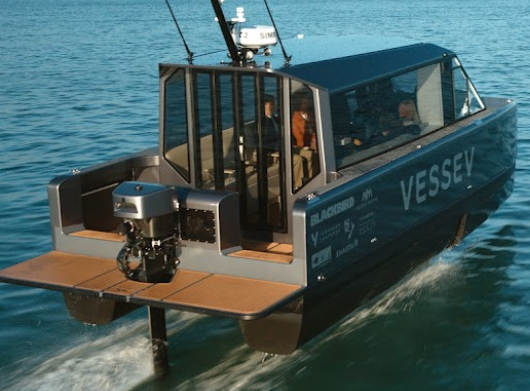
The VS-9’s foils change shape using high precision flaps under the water to optimise efficiency, enabling it to handle adverse weather and provide far better seakeeping than other technologies, says Laakmann.
“We use techniques similar to America’s Cup vessels which provide very high control authority when compared to other systems. That means we can handle more wind and bigger seas,” he says.
“The VS-9 is so efficient that we are able to use very safe and longer lasting battery technologies when compared to other vessels of this type”.
Vessev’s technology reduces energy consumption by up to 95% and allows faster charging.
“To put it into perspective, the VS-9 is undergoing on-water testing with a petrol-powered chase boat following, doing the same motions and distance,” says Laakmann. “At the end of each day, the cost of the petrol fuelling the chase boat is 25 times the cost of the electricity used to charge the VS-9.”
Fullers360 chief executive Mike Horne says: “It’s our intention for Fullers360 to be 100% electric or hydrogen operated by 2040 and foiling is absolutely a part of that vision for us.
“The establishment of NetZero Maritime has enabled us to dedicate a team to enabling zero emissions projects with the VS-9 being the first fully electric passenger vessel to operate in Auckland.”
The VS-9, constructed using carbon fibre laminates, takes off at 18-19 knots, transitioning from foil assist to full foiling mode, and cruises with optimum efficiency between 22-25 knots, says Vessev.
The foil stabilisation systems enter operation at 12 knots – actively reducing pitch and roll motion, even when not fully on foils and ‘flying’, and the foils are fully retractable which allows the vessel to operate in shallow water and protect the foils so the vessel can be transported on a trailer.
Once highspeed DC charging is in place, recharge times will be up to 0.8 nautical miles of range per minute of charging.
“Our objective is to break down the barriers to adopting electric vessels,” says Laakmann.


Join the conversation