
Mercedes-Benz opens Europe’s first battery recycling plant
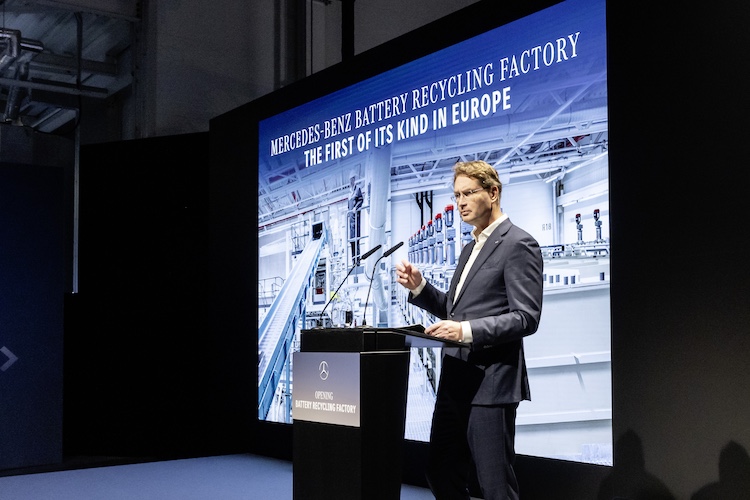
Mercedes-Benz has opened Europe’s first battery recycling plant with an integrated mechanical-hydrometallurgical process, making it the first car manufacturer to close the battery recycling loop with an in-house facility.
It says the recycling plant in Kuppenheim, southern Germany, creates a genuine circular economy, as Mercedes-Benz strives to reduce the consumption of valuable primary resources significantly.
Materials such as lithium, nickel, and cobalt can be recovered in a way suitable for new batteries for future all-electric Mercedes-Benz vehicles.
Unlike established processes, the expected recovery rate of the mechanical-hydrometallurgical recycling plant is more than 96%.
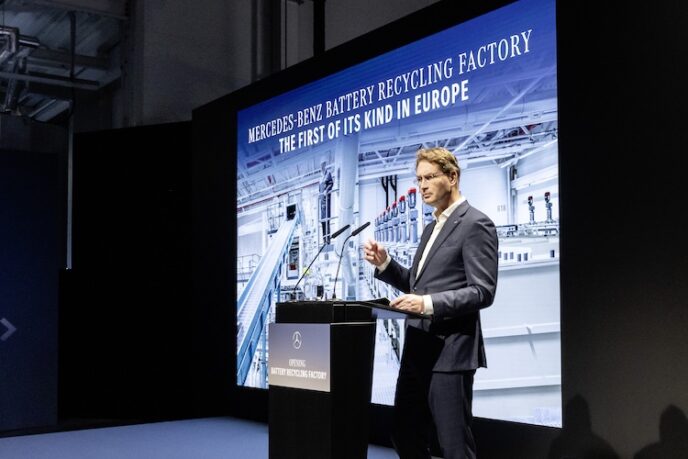
The company has invested tens of millions of euros in constructing the new battery recycling plant.
“Mercedes-Benz has set itself the goal of sustainably building the most desirable cars,” Mercedes-Benz Group AG chair Ola Källenius says.
As a pioneer in automotive engineering, Europe’s first integrated mechanical-hydrometallurgical battery recycling factory marks a key milestone towards enhancing raw-materials sustainability. Together with our partners from industry and science, we are sending a strong signal of innovative strength for sustainable electric mobility and value creation in Germany and Europe.”
Mercedes-Benz’s technology partner for the battery recycling factory is Primobius, a joint venture between German plant and mechanical engineering company SMS group and Australian process technology developer Neometals.
The plant receives funding from the German Federal Ministry for Economic Affairs and Climate Action for a scientific research project with three German universities. The project examines the entire recycling process chain, including logistics and reintegration concepts. Thus, the partners are making an important contribution to the future scaling of the battery recycling industry in Germany.
Integrated recycling
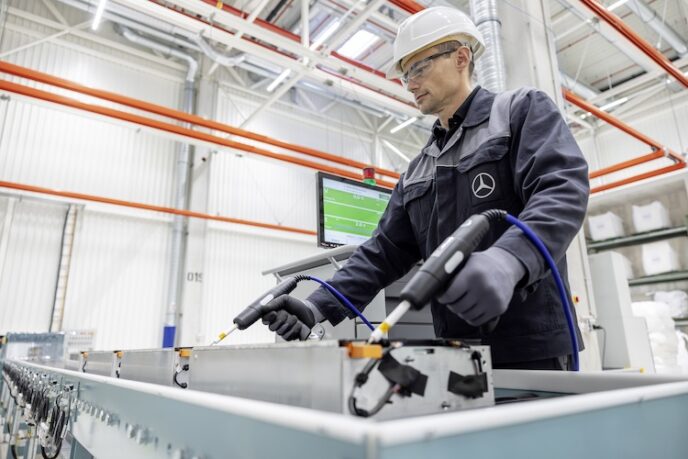
For the first time in Europe, the Mercedes-Benz battery recycling plant covers everything from shredding battery modules to drying and processing active battery materials. The mechanical process sorts and separates plastics, copper, aluminium and iron in a complex, multi-stage process.
The downstream hydrometallurgical process is dedicated to the so-called black mass. These are the active materials that make up the electrodes of the battery cells. The valuable metals cobalt, nickel and lithium are extracted individually in a multi-stage chemical process. Therefore, these recyclables are of battery quality and suitable for producing new battery cells.
Unlike the pyrometallurgy established in Europe today, the hydrometallurgical process is less intensive regarding energy consumption and material waste. Its low process temperatures of up to 80 degrees Celsius mean it consumes less energy. In addition, like all Mercedes-Benz production plants, the recycling plant operates net carbon-neutral. It is supplied with 100% green electricity. The roof area of the 6800 square-metre building is equipped with a photovoltaic system with a peak output of more than 350 kilowatts.
The Mercedes-Benz battery recycling plant in Kuppenheim has an annual capacity of 2,500 tonnes. The recovered materials are used to produce more than 50,000 battery modules for new all-electric Mercedes-Benz models. The knowledge gained could help scale up production volumes in the medium to long term.
Holistic approach
Mercedes-Benz takes a holistic approach to the circularity of battery systems and considers three core topics: circular design, value retention, and closing the material loop. With its Design for Circularity approach, the company considers the entire battery technology value chain from the outset.
Circular thinking flows into developing new battery cells at the Mercedes-Benz eCampus in Stuttgart-Untertürkheim, which opened in 2024. Battery production for electric Mercedes-Benz vehicles is net carbon-neutral in battery factories on three continents.
Local battery production is a critical factor in the success of Mercedes-Benz’s sustainable business strategy. In line with circular thinking and to conserve resources, the company offers reconditioned batteries as spare parts for all its electric vehicles.
In addition, its Mercedes-Benz Energy subsidiary has established a successful business model with large-scale stationary storage applications. Batteries that are no longer suitable for vehicle use, can enjoy a second life as part of an energy storage system.


Join the conversation