
Taranaki green hydrogen project begins after years of legal delays
Construction is set to begin on the long-delayed Kapuni Wind Farm and Green Hydrogen Project in South Taranaki, with Regional Development Minister Shane Jones confirming work is now under way.
The project, supported by $19.9 million from the previous government’s Provincial Growth Fund, will integrate utility-scale wind generation with industrial renewable electricity supply and large-scale green hydrogen production.
“We’ve waited more than five years for this project to begin, after it was delayed by years of red tape and appeals under the previous Resource Management Act consent process,” Jones says.
The development will supply renewable electricity to Ballance Agri-Nutrients’ Kapuni facility for site operations and produce green hydrogen for emissions-free transport through Hiringa Energy’ refuelling network.
“A delay like this, for a project so important to a regional economy, shouldn’t have happened. I welcome the economic benefits, jobs, and alternative energy source this initiative will bring to Taranaki,” Jones says.
Around 50 jobs are expected during construction, with seven permanent roles once the facility is operational.
“This will be one of the first projects in New Zealand to integrate wind, industrial renewable electricity supply and zero-carbon green hydrogen fuel production at scale.
“The initiative unlocks significant local investment and will be a vital contributor to long-term development in the region and will help diversify the Taranaki economy by supporting new, innovative clean energy industries,” Jones says.
The full project cost is expected to be up to $112.3 million, with co-funding from partners.

The project is led by Hiringa Energy in partnership with Ballance Agri-Nutrients, Nova Energy, Parininihi Ki Waitotara Incorporation (PKW) and the Ministry of Business, Innovation and Employment. Westpac New Zealand is providing non‑recourse project financing.
Once operational in 2027, the project is expected to generate about 100 gigawatt-hours of renewable electricity annually from four 6.4MW wind turbines and produce up to two tonnes of green hydrogen per day via a 5MW electrolyser.
The hydrogen will initially be used as a feedstock gas for Ballance’s urea production and to supply Hiringa’s hydrogen refuelling network. A portion of the wind-generated electricity will be exported to the national grid.
The project was first proposed in 2019 and has faced legal and commercial challenges.
In 2022, Greenpeace and South Taranaki hapū appealed High Court approval, arguing the consenting panel breached the Covid-19 Recovery Fast-Track Consenting Act by failing to set conditions on when and how the project would transition from fertiliser feedstock production to hydrogen fuel production.
In December 2023, the Court of Appeal dismissed the opposition, clearing the way for construction. Hiringa says the legal action had delayed progress and increased costs.
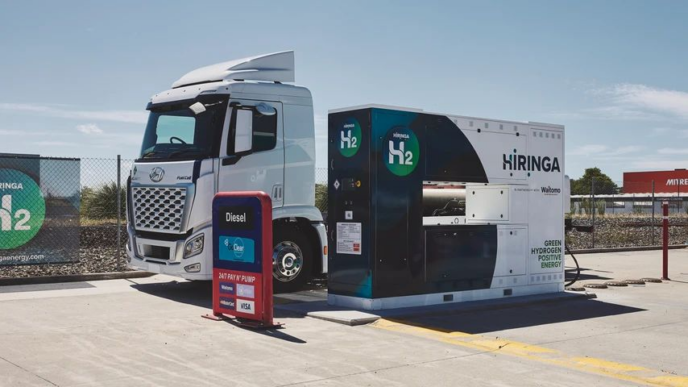
The development forms part of Hiringa’s wider hydrogen strategy, which includes a $16 million government-backed loan supporting a hydrogen refuelling network with sites in Auckland, Palmerston North and Hamilton, and a fourth under construction in Tauranga.
Hiringa is also overseeing the roll-out of more than 20 hydrogen-powered trucks through transport partner TR Group, including vehicles from Hyundai and Christchurch-based Global Bus Ventures. NZ Post already operates one hydrogen truck.
“Heavy transport plays a vital role in our economy, but it’s also a significant contributor to our national emissions,” Hiringa chief executive Andrew Clennett says.
“As a first-of-its-kind across Australasia and one of the first networks set up globally to service heavy transport, the initiative addresses this major challenge by providing operators with the infrastructure they need to switch to zero-emission transport in an efficient, scalable and commercially viable manner.”
The Kapuni development aims to remove emissions equivalent to up to 30,000 cars per year and is being positioned as a cornerstone of Taranaki’s transition toward low-emissions energy and industrial diversification.




Join the conversation