
Air NZ aims high with zero emission aircraft

Air New Zealand wants to hasten the arrival of zero-emissions aircraft, planning to include them in its fleet by 2030.
Starting with electric and hydrogen aircraft as an option for shorter domestic and regional flights, Air New Zealand says it’s working with aircraft manufacturers including Airbus.
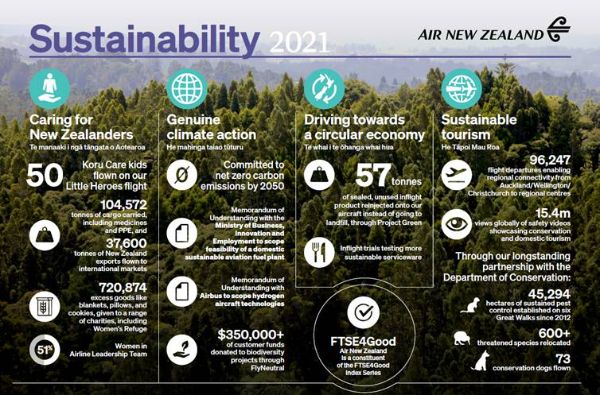
E-aircraft are included in the airline’s newly released 2021 Sustainability Report which lays out the airline’s path to net zero carbon emissions by 2050.
“In spite of the COVID-19 pandemic grinding our business to a halt, we believe climate change is the biggest crisis facing our airline,” Air New Zealand chief executive Greg Foran says.
“And, if anything, our commitment to take real action has only strengthened,” he adds.
“It has never been more important for airlines to take bold steps to ramp up the pace and scale of genuine climate action. We want our customers to know that not only do we have a clear plan, but we already have multiple runs on the board on our journey to becoming a more sustainable airline.”
The report’s four main levers to reduce gross emissions as much as technology will allow before utilising offsetting include zero emissions aircraft, sustainable aviation fuel (SAF), operational efficiency, and fleet renewal.
By far the biggest contribution to decarbonisation will come from the airline accessing SAF, Air New Zealand says.
The Sustainability Report outlines good progress made this year, including taking steps towards making SAF a reality in New Zealand. In July, Air New Zealand signed a memorandum of understanding (MoU) with the Ministry of Business, Innovation and Employment to determine the feasibility of producing SAF here.
The national airline’s new sustainability framework is focused on bold action as it aspires to lead the aviation industry globally in sustainability and decarbonisation.
Four key focus areas include caring for New Zealanders, genuine climate action, driving towards a circular economy, and sustainable tourism.
Meanwhile, a one-stop global hydrogen aircraft concept has been unveiled by the Aerospace Technology Institute (ATI) which says passengers could one day fly anywhere in the world with no carbon emissions.
Up to 279 passengers could fly between London and San Francisco, USA direct or Auckland with the same speed and comfort as today’s aircraft yet having just the one stop, ATI says.
Developed by a team of aerospace and aviation experts from across the United Kingdom collaborating on the government backed FlyZero project, the concept with a 54-metre wingspan demonstrates the huge potential of green liquid hydrogen for air travel not just regionally or in short haul flight but for global connectivity.
Liquid hydrogen is a lightweight fuel which has three times the energy of kerosene and 60 times the energy of batteries per kilogramme and emits no CO2 when burned, ATI explains.
Realising a larger, longer-range aircraft also allows the concentration of new infrastructure to fewer international airports, accelerating the rollout of a global network of zero-carbon emission flights and tackling emissions from long haul flights.
“At a time of global focus on tackling climate change our midsize concept sets out a truly revolutionary vision for the future of global air travel keeping families, businesses and nations connected without the carbon footprint,” FlyZero project director Chris Gear says.
With other sectors also moving towards hydrogen energy, an increased demand is expected to lead to lower supply costs and hydrogen-powered aircraft with low fuel costs are forecast to have superior operating economics than conventional aircraft from the mid-2030s.
FlyZero has identified on-board technologies which, together with the infrastructure and ground equipment for refuelling, require rapid development to deliver zero-carbon emission flight. These technologies include wings without fuel tanks (dry wings), hydrogen tanks, cryogenic fuel systems, fuel cells and electrical power systems and hydrogen gas turbines.
Findings from the FlyZero project will be published in early 2022, including three final aircraft concepts (regional, narrowbody and midsize), technology roadmaps, market and economic reports and a sustainability assessment.
With a range of 5250 nautical miles (NM), destinations including San Francisco (4664NM), Delhi (3642NM), Beijing (4414NM), Vancouver (4105NM), Mexico City (4815NM) and Rio De Janeiro (4983NM) are within reach from London.
Destinations including Auckland (9911NM), Sydney (9188NM) and Honolulu (6289NM) are accessible with just one stop.

Join the conversation