
Battery swapping steps up

Traditional cable-based EV charging is now being complemented by another solution – battery swapping.
Various swap-enabled vehicles across different segments are now entering the market, says IDTechEx in its latest report Battery Swapping for Electric Vehicles 2022-2032: Technology, Players and Forecasts.
In 2021, 8% of all Chinese EVs were swap capable, the report says.
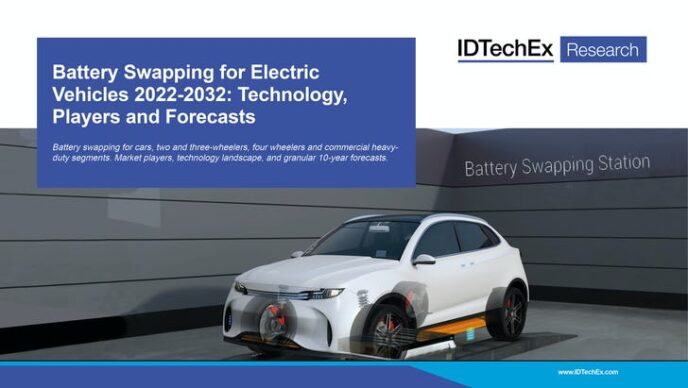
“They all have one thing in common – a rechargeable, replaceable, and upgradeable battery pack. As opposed to fixed battery EVs, such swap-capable vehicles can get a fully charged battery in three to five minutes.”

Report author Shazan Siddiqi examines the current market landscape for swapping in cars, two and three-wheelers, and commercial heavy-duty segments.
A breakdown is included of the mechanical componentry within swap stations by market leaders such as Nio and Aulton, as well as some emerging players such as Ample and Power Swap.
There’s a lot to like about battery swapping, says Siddiqi.
It reverses the standard time trade-off between EVs and gasoline-powered vehicles. Many EV owners plug in overnight and charge for hours.
In general, fast chargers can now charge a battery to 80% in a little under half an hour. But in that time, some battery swap stations could charge dozens of cars to 100%.
In the case of cars, trucks, and buses it requires no user intervention so the driver can sit comfortably inside their EV and not worry about handling heavy cables.
Centrally trickle charging batteries in a swap station also eliminates the degradation associated with DC fast charging, the report explains.
It also highlights new opportunities for utilities, battery pack manufacturers, vehicle OEMs, and battery recycling companies along the swapping value chain.
Battery as a Service (BaaS) is the latest in a series of buzzwords surrounding the hype of EVs and the future of battery technology, says the report.
This is enabled by battery swapping, which aims to decouple the cost of the battery from the vehicle itself, it adds.
The maintenance, health, and cost of the battery ownership fall on the company offering the swapping service, and EV buyers simply pay for the usage based on their requirements.
Empty batteries that are swapped out can be charged when electricity is cheap, or demand is low. Whoever owns those batteries can then sell that electricity to motorists at a premium or even sell it back into the grid when prices are high, and supplies are tight.
Banks of batteries waiting to be swapped can soak up extra energy and feed it back during peak hours.
The report finds a growing network of swap stations may be one of the most economical ways to build out the large stationary energy storage necessary to support the world’s growing renewable energy supplies.
IDTechEx believes that swapping has great promise for the commercial fleet and micromobility segments.
The global battery swapping infrastructure market value per year will be over US$22 billion by 2032, according to IDTechEx forecasts.
The report includes a cost comparison of swapping to AC/DC charging, total cost of ownership analysis, and a comprehensive profitability study for this new business model.


Join the conversation