
Drones and uncrewed air taxis aided by government changes

The Government is introducing a “light-touch” regulatory approach to advanced aviation as it moves to give businesses certainty and boost productivity, says space minister Judith Collins and transport minister Simeon Brown.
“Novel aviation technologies, such as drones and uncrewed aircraft, are set to revolutionise aviation, as well as have global impacts on communications, emergency management and advancing science,” Collins told the New Zealand Aerospace Summit 2024 in Christchurch (September 23 and 24).
“We have committed to having a world-class regulatory environment by the end of 2025. To do that we’re introducing a light-touch regulatory approach that will significantly free up innovators to test their technology and ideas,” she says.
“We’re also removing the requirement for them to have to go through the whole approvals process each time they tweak their technology,” says Collins, adding New Zealand is an attractive place for aerospace-related business.
Brown says the Government is also establishing restricted airspaces where tests can be held -– known as a “sandbox”.
“This provides innovators with much improved flexibility, while maintaining safety and separation from other aviation users,” he says.
Collins has also released the New Zealand Space and Advanced Aviation Strategy, which outlines the ambitions for these interlinked sectors, and the actions to realise that ambition.
“The Government is focused on creating the right environment to unlock the significant economic growth offered by the high-tech, high-productivity aerospace sector,” Collins says.
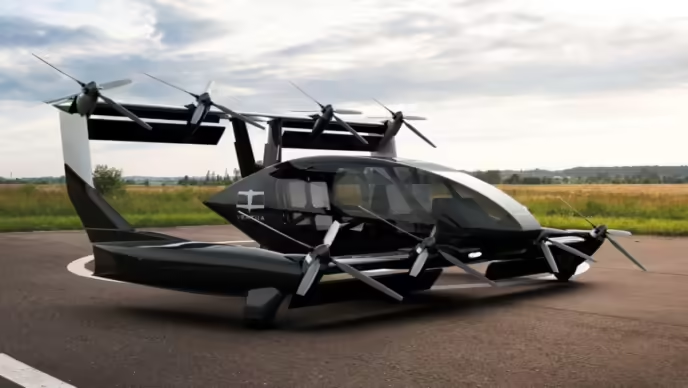
Meanwhile, Life Flight New Zealand has partnered with Sydney-based zero emissions aircraft designer and manufacturer AMSL Aero for future Australasia aeromedical operations using AMSL Aero’s Vertiia hydrogen-electric vertical take-off and landing (eVTOL) aircraft.
Vertiia has up to 1000km range and can cruise at 300km/h.
Aviation Logistics signed a deal in Australia earlier this year for up to 20 eVTOLs.
“This has been a big year for AMSL Aero as we continue to test-fly the aircraft,” says AMSL Aero chief executive Max York.
“We are thrilled that our first New Zealand development partner for Vertiia is Life Flight because of the important, life-saving work carried out by this organisation.”
Life Flight chief executive Mark Johnston says it had more than a 20% jump in aeromedical mission numbers last year and is on track for a further 25% increase this year.
“Most of our aeromedical flights are generally within 45 minutes flying time from our two bases, potentially providing an ideal flight profile for alternative fuel sources, particularly hydrogen fuel cells,” Johnston says.
“Hydrogen powered aircraft such as AMSL Aero’s Vertiia offer air ambulance operators the potential to significantly reduce our emissions footprint, complementing New Zealand’s existing fleet of air ambulances with state-of-the-art aircraft that are both cheaper to operate and kinder to the environment.”
Life Flight soon commemorates 50 years, flying nearly 50,000 Kiwis since it was founded in Wellington.


Join the conversation