
Editorial – Online corrosion discussion ‘clickbait’
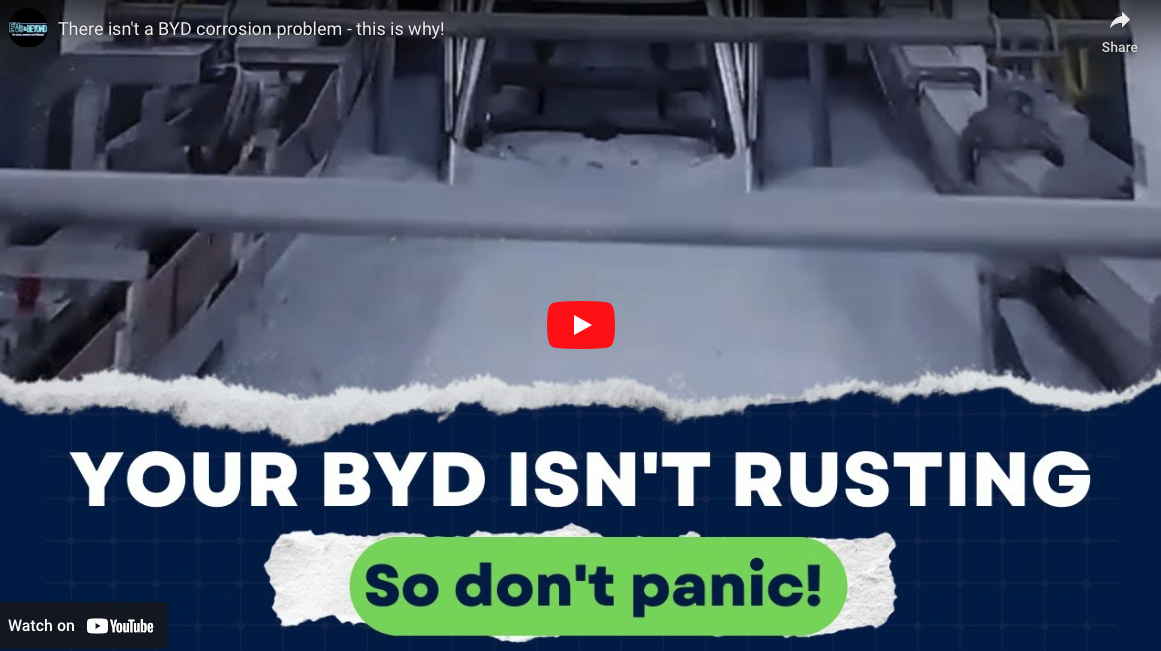
There’s been an awful lot of discussion online in the last week about the BYD Atto 3 and corrosion.
I had avoided doing anything on this issue, as to be honest, in nearly 25 years’ reporting on the automotive industry I’ve seen lots of minor corrosion on a range of vehicles.
But with a few stories out there best described as click bait, I figured I should wade into the BYD issue.
I’ll start out by making it very clear: if you have an Atto 3, your car is fine, your car is safe. I have no concerns about my wife and daughter getting in our Atto 3 and driving down the road.
Nor do I expect the car to be an issue in the years to come.
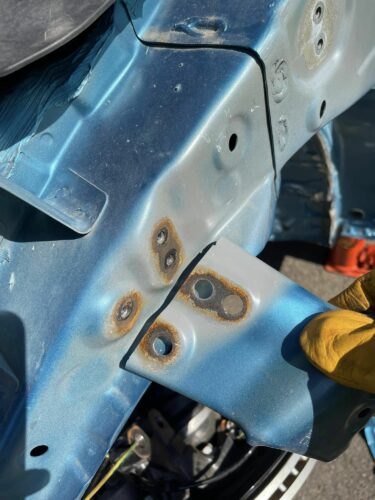
Having said that, let’s break down the issue. It all started with a Facebook post by Juan Cito Perez about a crashed car he had bought and begun disassembling. Juan posted pictures of some light oxidation around the circumference of the holes of the tabs the BYD’s front guards are bolted to.
The rings of oxidation are bright, making them probably newish or undeveloped. The car had been bought a month and a half after the crash, and the post came more than a month after that.
I believe this oxidation is real, but it’s more complicated than that. We should also note the bonnet hinges and door hinges, which were less exposed in the crash, showed no corrosion when unbolted.
So, if it’s real, why is it there and is it a problem? To answer that we need to discuss how oxidation can occur.
Rust is a type of corrosion that occurs when iron or an alloy containing iron (such as steel) is exposed to water and oxygen. It’s a chemical process in which the iron in the metal reacts with oxygen in the air to form iron oxide (rust).
The reaction that causes rust is known as oxidation. When iron is exposed to air and water, it undergoes a series of chemical reactions. First, the iron reacts with oxygen in the air to form iron oxide, also known as rust. This process is accelerated by water, as it allows the oxygen and iron to react more easily.
It can occur on any iron-containing material, but is seen most commonly on metals that are exposed to moisture or saltwater. For example, cars and boats are often susceptible to rust after their exposure to rain, salt, and other environmental factors.
To prevent this exposure, most vehicles, including the Atto 3, are galvinised. Galvanizing involves coating the metal with a layer of zinc, which acts as a sacrificial anode. This means that if the metal is exposed to moisture and begins to rust, the zinc will corrode instead of the underlying metal, providing protection and extending the life of the part.
BYD uses electro-galvanising , which though arguably not as good as hot-dip galvanising, is now by-far the industry standard.
Before painting, the car is immersed in an electrolyte solution containing zinc ions. An electric current is passed through the solution, causing the zinc ions to be attracted to the metal substrate and deposited on to its surface.
The thickness of the zinc coating can be controlled by adjusting the duration and intensity of the current.
Electro-galvanising produces a thin, uniform layer of zinc coating that provides excellent corrosion resistance to the underlying metal. It’s a more environmentally friendly process than other methods, as it produces less waste and uses less energy.
Where this issue has occurred is in one of a very small number of areas where that galvinisation doesn’t occur. That’s because the car is largely assembled at this point, so surfaces bolted together don’t get a coat.
This isn’t normally an issue, as the two surfaces are clamped together, not allowing in any substances that will trigger corrosion. BYD uses a wax-like rust protection substance around the tabs that have oxidised in this case.
Arguably it is the ‘Shrodingers cat’ of automotive components. You don’t know if it is corroded until you open the joint, but as soon as you do oxygen and humidity will rush in and begin the process.
Here’s my guess on what has happened with the BYD in question The crash has stressed the mounting points and allowed oxygen in, and/or the vehicle has been sitting with the joints, even in a done-up state, exposed and not protected as normal by the bonnet. And that has degraded the wax-based rust protection. Or a combination of both.
If that’s not the case, and the corrosion was there earlier, probably it would be from an early contamination and it won’t get worse. It’s surrounded immediately by galvanised metal that won’t rust, and will have already completed all the reaction it can with the oxygen or contamination that caused it.
It’s important to re-state that the door and bonnet hinges were unaffected. They’ve been ‘protected in the same way.
I had the chance to look under my Atto 3, which has done 10,000km. I live 100 metres from the sea and we’ve had a lot of storms lately. And there’s not a lot to talk about under the car except for some over-zealous rust protection.
In the interest of openness, we did find a tiny bit of corrosion on my car’s body, around the rear bumper mounts’ bolt attachment to the body.
I spoke to an expert who advanced the exact theory mentioned above: that the joint is bolted, then sealed with silicon, before the vehicle is electro-galvanised, and painted. He said a tiny amount of oxygen gets caught inside the seal, can cause a tiny amount of surface discolouration, but then runs out of steam.
It should be noted that in all these cases, the other side of the steel is galvanised, making the chances of spread being incredibly minimal.
Having taken the bolts off, the technician fitting the towbar coated the area in rust protection paint, safely putting the cat back in the box.
So, what does BYD have to say about this? BYD NZ provided the following statement.
“BYD Auto New Zealand has received no local reports of structural rust, and we cannot comment on a damaged car sitting in a wrecker’s yard in another overseas market.
“New Zealand BYD vehicles are manufactured to the highest global quality standards and in brand-new state-of-the-art highly automated manufacturing facilities.
“All manufacturing is overseen by an extremely rigorous quality control system, which has enabled BYD to meet all global compliance testing required to obtain a five-star NCAP and ANCAP rating.
“In particular, the process undertaken when rustproofing all BYD models during production is of the highest global standards utilising the latest technological processes.
“BYD Auto New Zealand has a dedicated franchised panel repair network. Every time a vehicle goes through our panel shops photos and records are taken and recorded on our central head office database.
“We’re in constant communication with our factory. NZ customers can rest assured their vehicles are covered under our six year warranty.
“If BYD NZ owners have any concerns they can visit our BYD dealers or Authorised Panel Repairs throughout New Zealand.”
I think the key point there is the warranty. If there’s a corrosion issue with these cars – and I don’t think there is – then it will uncover itself on at least some vehicles before the warranty runs out here in New Zealand.
Also remember BYD headquarters has been very attentive to information coming out of Australasia.
I have little doubt they will be watching this issue and considering if they need to tweak the production process.
BYD engineers changed the BYD App after watching a video I made, so I wouldn’t rule it out.
Lastly, be careful what you read online and how you react to it.
The electric vehicle community is thriving, and energetic, but that can have downsides. Small issues get blown out of proportion, panic can set in, and YouTube channels can post click-bait titles for views.

Join the conversation