
Electric car sales due to overtake ICE sales by 2035

Electric vehicles are set to overtake internal combustion engine (ICE) sales worldwide as trends towards their uptake indicate that regulation alongside growing sustainability efforts will make them a favourable choice among OEMs and consumers.
So says IDTechEx’s report Plug-in Hybrid and Battery Electric Cars 2025-2045: Technologies, Players, Regulations, Market Forecasts, which explores the possibility of 2025 bringing about new opportunities to resume steady market growth after a period of slower growth.
IDTechEx has also considered the US’ implementation of a broad range of tariffs on automotive constituent parts and final imports.
With about 90 million vehicles sold worldwide in 2023, the car market is the biggest transport sector – 14.4 million electric vehicle sales were made in 2023, jumping to 18.1 million in 2024, highlighting a fast-growing market with scope for EV manufacturers to continue to establish themselves further, says IDTechEx.
“The desirability for EVs is further amplified by the growing awareness of sustainable technologies, as explored in IDTechEx’s sustainability report portfolio, and the different regulations across numerous economies pushing to reach net zero.
“In the EU, 2035 will bring about an ICE ban, with a tightening of regulations seen in 2025 and then in 2030. Many companies are likely to, therefore, improve EV sales to avoid fines.”
IDTechEx says battery electric vehicles (BEVs) are the best solution to reducing carbon emissions across the transport sector due to them producing zero tailpipe emissions, and their presence is already well-established.
“BEV production is also largely responsible for contributing to the demand for lithium-ion batteries, electric motors, and power electronics.”
IDTechEx’s report covers some of the ongoing trends that can be expected to be seen from 2025 and beyond, such as lower-cost models beginning to emerge and EVs entering the mass market.
EVs outside of China have mostly been in the premium luxury segment, according to IDTechEx, but with regulation dates getting closer, it says the landscape is likely to change.
“This will also be made more of a possibility as battery and production costs stabilise, allowing vehicle prices to follow.”
About 219 million EV charging points will be necessary by 2035 to meet demand, says IDTechEx.
“Global investments into charging infrastructure goals are expected to exceed US$104 billion by 2035.”
Plug in hybrid electric vehicles (PHEVs) have seen a huge uptake in China, the largest market for EVs globally, while electric pickup trucks (utes) in the US are beginning to see adoption, paving the way for EV adoption to become normalised.
It says manufacturers will need to increase their EV shares over the next 10 years, particularly in Europe.
“This may be done somewhat reluctantly due to the initial potential for a decrease in profits, though it will be necessary for economies to reach decreased carbon emission goals.”
Charging infrastructure for BEVs and PHEVs is still somewhat limited, though it is definitely growing and becoming more widespread to accommodate the rise of EVs on the road, says IDTechEx.
Regulations for decarbonisation are one of the main drivers of vehicle electrification worldwide, says IDTechEx, adding its report Electric Vehicles: Land, Sea, and Air 2025-2045 report shows a US$3.6 trillion business by 2045.
The report focuses on the 11main transportation sectors including passenger cars, commercial vehicles, micromobility, construction and mining, marine, trains, conventional aircraft, and electric vertical take-off and landing (eVTOL) aircraft.
IDTechEx reckons 44.3 million EVs were sold globally in 2024, with cars and three-wheelers making up the two largest segments, followed by two-wheelers.
“Global lithium-ion battery demand has more than doubled since 2021, standing at over1000GWh in 2024, with the majority of demand stemming from electric cars, specifically at over 85%.”
In 2027, IDTechEx predicts that global lithium-ion battery demand will exceed 2000GWh, highlighting the significant growth expected from the electrification of transportation over the next two years.
“Over the next two decades, battery demand for cars is expected to reach 70TWh (terra Watt hours) with trucks being the next largest segment but still only sitting below 7TWh.
“During the same period, electric car unit sales are predicted to reach 70 million, with a CAGR of 9.8%, climbing from 14.4 million in 2023, maintaining steady growth, and continuing to dominate the EV market.
IDTechEx says micromobility popularity is increasing too.
“Micromobility includes electric motorcycles, electric two-wheelers, electric three-wheelers, and microcars, the sales of which are expected to increase by 2.5 times between 2023 and 2045.
“Electric two-wheelers are expected to dominate this segment, as their size, low price, and ease of mobility all act as incentives for their uptake, particularly in densely populated areas such as cities, where parking and driving can be largely restricted.
“Microcars are likely to gain popularity due to similar cost-related factors, but their growth will remain limited compared to two- and three-wheelers.”
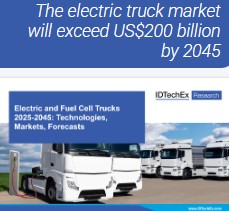
More than 11 million van sales are expected by 2045, while figures for trucks and buses are 1.7 million and 160,000 respectively.
“In the EU, manufacturers are not permitted to exceed an emission average across all their vehicles, with the goal for 100% of sales to be electric by 2035.”


Join the conversation