
Electric vehicles a Shaw thing for clean, green New Zealand
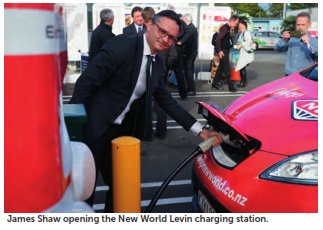
This story first appeared in the October issue of EVtalk – CLICK HERE to download the magazine FREE
No time’s being wasted in sorting New Zealand’s emissions issues by climate change minister and acting associate transport minister James Shaw.
The Green Party co-leader is already pointing the finger at the growth in polluting vehicles undermining gains from zero-emission EVs, shown in recent Ministry of Transport data.
“Despite the record number of electric vehicles being sold, the average amount of emissions produced by fossil fuelled vehicles entering our fleet is staying the same,” Shaw says.
“While we’re seeing growth in EVs at one end we’re also seeing an increasing number of larger, more polluting vehicles entering the fleet at the other.”
Shaw says the data shows the number of EVs in the fleet grew by 3656 in 2017, but the number of large vehicles with engines greater than 3000cc grew by five times that amount.
“It’s disappointing,” he says.
“Our vehicles are becoming more fuel efficient, but we’re being sold cars with bigger engines that require more fuel to run, so we’re not reaping the environmental benefits we might expect.”
Shaw reckons part of the problem is New Zealand lacks strong incentives – which most other developed countries have – to sell more fuel efficient and climate-friendly cars.
“The Productivity Commission has also pointed out that New Zealand risks being left as a dumping ground for larger, polluting vehicles as other countries move ahead of us and start phasing them out.”
Shaw says the Government is investigating a range of options to make EVs easier for Kiwis to buy, including fuel-efficiency standards for imported cars.
That includes a “feebate” scheme where low emissions vehicle buyers are rewarded with a rebate and higher emissions vehicle purchasers are penalised with a fee.

These could be among a range of “decent” EV purchasing incentives coming from the Government shortly, Shaw says.
He says the Government is trying to provide a package encouraging middle-income people to buy EVs while ensuring low income families aren’t left out.
Shaw says New Zealand has 10,248 EVs compared to 210 five years ago, so there is an “exponential growth rate”.
However, it’s still only 0.25% of the four million vehicles on the roads, he adds.
New Zealand’s carbon dioxide emissions are increasing, according to the Ministry for the Environment, with the country unlikely to meet its 2030 and 2050 targets.
“New Zealand’s emissions have been going up rather than down, and like every other country in the world, we’ve got to bend the curve, and the next 10 years is going to be critical,” Shaw says.
EVs represent “the greatest opportunity” to reduce transport emissions, EV advocacy group Drive Electric says.
It’s one of more than 15,000 submitters to the Zero Carbon Bill.
Generally supporting the bill, Drive Electric says there’s a strong opportunity linked to decreased environmental costs in the next decade through the uptake and mainstreaming of EVs.
As well as providing health and air quality benefits, New Zealand also stands to gain from decreased oil imports and increased energy independence, it says.
Other submitters included electricity and energy agencies, Z Energy, EROAD, KiwiRail, automotive representatives, motoring clubs, local government, environmental groups and more.
“The submissions clearly show that the New Zealanders who participated in the consultation support a path to a low emissions economy by 2050, with nearly universal support for an independent Climate Change Commission to advise on and monitor New Zealand’s progress towards emissions reduction goals,” Shaw says.
“The vast majority of respondents want New Zealand to do everything we can to reduce our greenhouse gas emissions as much as possible, and offset the remainder, to reach ‘net-zero’ emissions by 2050.
”
Shaw says there’s also a strong representation from people and businesses who, while supporting the overall direction, expressed caution about the speed and scale of the transition and the pressure it will put their sectors under.”
The submissions will be combined with advice from the Productivity Commission, the Parliamentary Commissioner for the Environment, Maori interests, and consultation with other political parties to help finalise the draft Zero Carbon Bill for introduction to Parliament next year.
Shaw believes New Zealand can lead the world in transitioning to a high-value, clean-tech, post-carbon economy that works for everyone.
In fact, that’s among the reasons he joined the Green Party in 1990.
He entered Parliament as a list MP in 2014 and became Green Party co-leader in 2015.
Shaw previously had a successful career in management consulting, mainly in London where he lived from 1998 to 2010, working with multinational companies across Europe and the world, developing their sustainable business practices.
Living in Aro Valley in Wellington, Shaw uses an electric Hyundai Ioniq when he needs to drive to work – sometimes walking too.
He believes the single most effective thing the Government can do to boost EV uptake is to use its own purchasing power to convert the Government’s fleet to EVs, which will then move into the second-hand market where most Kiwis buy their cars.


Join the conversation