
Fire protection for electric two-wheelers
IDTechEx says 17% of two-wheel sales in 2023 were electric two-wheelers (E2W) which are “hugely popular” in many Asian countries.
Their safety around thermal runaway and fires is a critical topic, says IDTechEx research vice president Dr James Edmondson.
“We have seen much progress on this topic for the car market, but how E2Ws are used and how their batteries are designed is very different from the car market,” he says.
IDTechEx’s report Fire Protection Materials for EV Batteries 2025-2035: Markets, Trends, and Forecasts predicts the market for fire protection materials in E2Ws will grow 12 times compared to its 2024 size.
Most E2Ws are using a battery smaller than 4kWh, compared to that of electric cars, which averaged around 60kWh in 2024, Edmondson says.
“With less energy stored, the overall severity of the fire is reduced, but several kWh is still plenty to pose a significant safety risk, especially if the fire spreads to other vehicles or structures.
“This concern is coupled with the fact that many owners charge two-wheelers within their homes, compared to a car that is often kept outdoors or in a garage. This scenario has unfortunately proved fatal in some previous cases.”
Edmondson says India had a spate of incidents and recalls relating to E2Ws and fires in 2022.
“Following this, the Indian government adjusted the AIS 156 standard with changes taking effect on 1st October 2022. The updates include a thermal runaway propagation test and propagation prevention should be integrated into battery design.
“A warning is required upon detection of a thermal event, only cells certified by the Bureau of Indian Standards (BIS) may be used, and sufficient cell-to-cell spacing must be maintained.”
Edmondson says China has the GB standards that are also relevant for cars, requiring a five-minute time delay between a thermal event and smoke or fire being visible outside the pack.
“Prior to these standards, fire safety was not a primary concern in many battery designs, and these changes have forced battery pack designers to adopt new materials to prevent or delay the propagation of thermal runaway.”
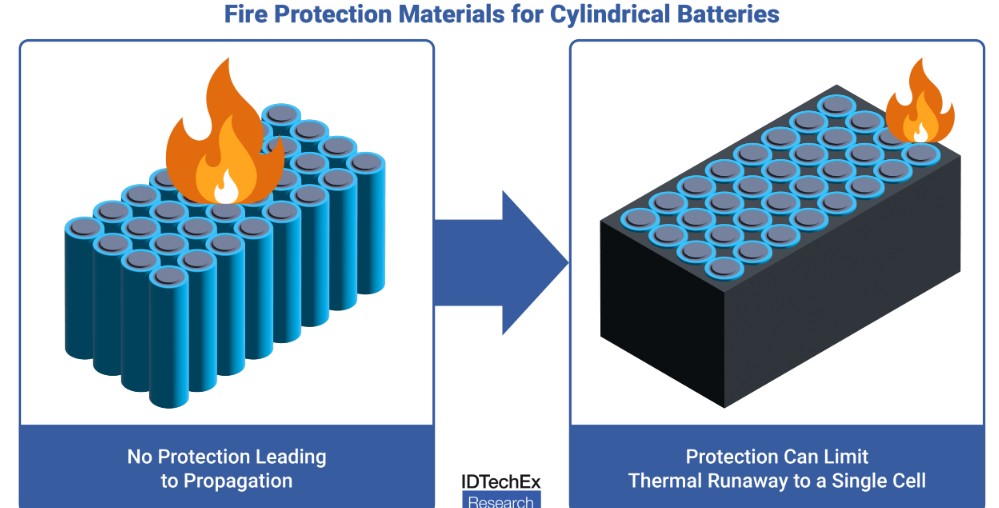
IDTechEx says the use of protective materials around cells can prevent or delay thermal runaway propagation.
“Cylindrical cells are a popular choice for E2W batteries, often in the 18650 format. The cell type/geometry has a big impact on how the pack is constructed and which materials will be used.
It says cylindrical cells cannot be stacked as easily as prismatic cells, and hence typically require some form of encapsulation and/or cell holder.
Edmondson says newer safety standards sees these materials developing and new materials selected.
“A key category is polymer cell holders that have fire protective properties, whilst a polymer solution that encases all the cells in a car battery pack might prove too heavy for the smaller E2W category, they are well suited to the application.”
He says material suppliers have begun developing polymers that can be injection moulded to form cell holders that provide structure for the cells, maintain cell spacing, and prevent thermal runaway propagating across all the cells in the battery pack.
“The polymers can include glass fibres to tune the structural performance needed and some of these polymer solutions also include intumescent properties, expanding and forming a protective layer upon heating.”
Phase change materials (PCMs) are another alternative seeing some application, says Edmondson.
“These absorb excess heat during their phase transition (typically solid liquid) but have to be carefully formulated such that their structure does not degrade significantly during the phase transition and that it still provides fire protective benefits once it has melted.”
The choice of polymer used to encase the battery is also important, regardless of cell type or inter-cell materials, the case is the last layer of protection, says Edmondson.
“This component needs to provide fire protection, but also strong impact resistance in the case of a crash.”
Edmondson says regulations have started to be employed in certain regions but will likely see adoption in other regions and become more stringent over time.
IDTechEx says fire protection materials for micro EVs will exceed US$280 million by 2035, providing opportunities for various materials and suppliers.
Meanwhile, IDTechEx forecasts the flexible batteries market to grow to more than US$500 million by 2035.
Advanced lithium-ion and bulk solid-state batteries can be used as bulkier batteries for flexible applications, mainly in the wearables and consumer electronics markets, says IDTechEx’s report Flexible Batteries Market 2025-2035: Technologies, Forecasts, and Players.



Join the conversation