
Flicking the switch on EVs
Your industry is changing, your chosen corner of the marketplace is seemingly in a race to the bottom, and times are undoubtedly getting tougher. What do you do?
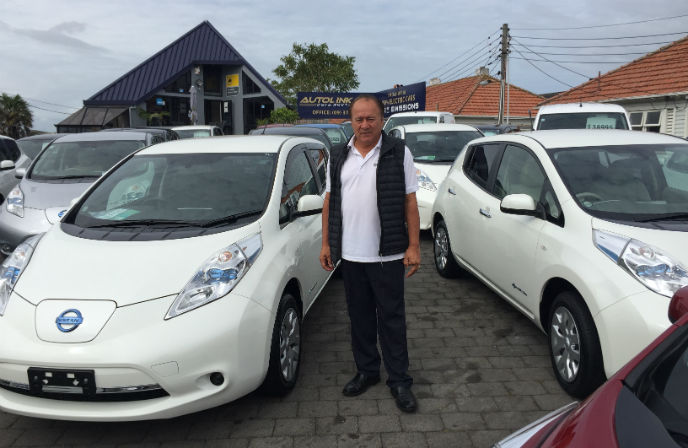
For long-time import dealer Henry Schmidt, the answer was electric. In less than two years, his Grey Lynn dealership has gone from a yard of petrol drinkers into almost exclusively electric. And not just selling the cars.
Schmidt has become well-known for providing full support and making advances in the localisation of chargers.
Such a move might be expected from someone newer to the industry, but Schmidt has been in the trade for nearly 30 years, being one of the originals heading to Japan in the days of passport cars, working for Fred Lewis at Enterprise.
“I used to work for Enterprise Cars in the 80’s. We were having a problem trying to find stock here,” Schmidt says. “I went to Japan and started looking for cars to fill our need, it developed, and in the end we were bringing in about a thousand cars a month.”
Schmidt worked with Enterprise for nearly 20 years, becoming a director and developing the business’s Western Springs yard. In the late 1990s he left to develop his own business, Autolink cars.
His first yard was brought out a few years ago and is soon to be the site of yet another Bunnings Warehouse. He moved further down the road to the current site, but is considering another move as land values continue their rise.
“People still come to Grey Lynn to buy cars, but it is only really the Giltraps that can afford to stay here,” he says. “You are sitting on a three million dollar car yard; no dealer can afford to pay the rent here.”
Schmidt jokes he owns the land he is on and can’t afford the rent he charges himself.
The shift to electric was predicated by a tightening in margins on what he used to sell.
“I used to like European cars – Volkswagen, BMW,” Schmidt says. “But there are now so many people doing it and the prices have become too competitive. There is no margin there.”
Since moving into the EV space, he believes he has sold 200 cars – around 20% of the EVs on New Zealand roads.
He says the transition was not difficult, and he has learned a lot about the vehicles since.
The first discovery was with the charging cables.
“We were just changing the plug, but they were burning out after a couple of months. We learned that we have to modify them to work with New Zealand specifications.”
Schmidt has the units adapted by a marine electronics firm. He has been buying and selling units from other dealers.
“I don’t mind helping them out. There is a fee, and I am making a little money along the way fixing it for them.”
He has also been importing and developing a market for other charging cables, including a high-end unit he brings in from Sweden, and another from Israel.
He has also developed an understanding of the vehicle’s Japanese radio screens and how to set the cars. Buyers are provided with a translated operating manual in electronic format.
“We normally set up the Bluetooth for them before they pick it up, saving them mucking around. We interpret that to English, and we also give them a CD in English.”
They have also developed a way of changing the units to English – and offer it as a cost option to buyers.
There is another advantage as a dealer from selling almost all electric cars.
“It’s amazing. My service bill has gone to almost zero. And there is virtually no comeback. After sale is virtually nil.”
The same, he says, goes for finance and insurance business. He says most of the buyers are enthusiastic, well researched, and don’t finance.
“It’s amazing. They just sit there with their iPad or whatever, and transfer the money in front of you,” he says. “They are well-researched, people that have done all their homework. Their knowledge is unbelievable.”
He offers warranties, but believes in his case most buyers don’t need them, and he stands by his cars.
“I don’t think we have sold one warranty on 250 cars.”
“People worry about the batteries,” he suggests. “They shouldn’t. We haven’t had generation two Nissan Leaf lose one bar (of battery health). The generation one does, but the car doesn’t stop, you just lose distance.”
And that is not an issue for Schmidt; he has found a market selling cars with batteries in less-than-peak condition to Rarotonga.
So without finance and warranty sales, how is profit affected?
Schmidt says the margins are better on the cars and extras such as up-rated charging equipment and English radios assists.
He is importing cars from the United Kingdom as well as Japan, working with the assistance of Joe Barnett from Autohub as well as another supplier.
Leafs are bread and butter, he has had a BMW i3 through the yard and has been selling eNV-200 vans.
He has also managed to secure a small fleet deal for Peugeot Ions, a rebadged Mitsubishi iMiev,
The next market he is keen to develop is in the taxi and Uber trade.
“I think it’d be an excellent Uber or taxi around town. Just doing the town run. No cost for electricity. All these charging stations around town are free at the moment.”
Does he think there is enough charging infrastructure in Auckland to support the growth of the market?
“I think we’ve got plenty of fast charge around Auckland now,” he explains. “I don’t think you need any more fast chargers in the city at the moment, but you do between say Auckland and Tauranga, between Auckland and Hamilton.”
He would like to see the government subsidise EVs to further kick start the trade.
“Maybe, in the beginning, $12,000 for a new one and $6,000 for a used import one,” he suggests. “I think that would really kick-start the electric car market in New Zealand.
“New Zealand is a perfect place for electric cars.”
Join the conversation