
Ford E-Transit hydrogen trial
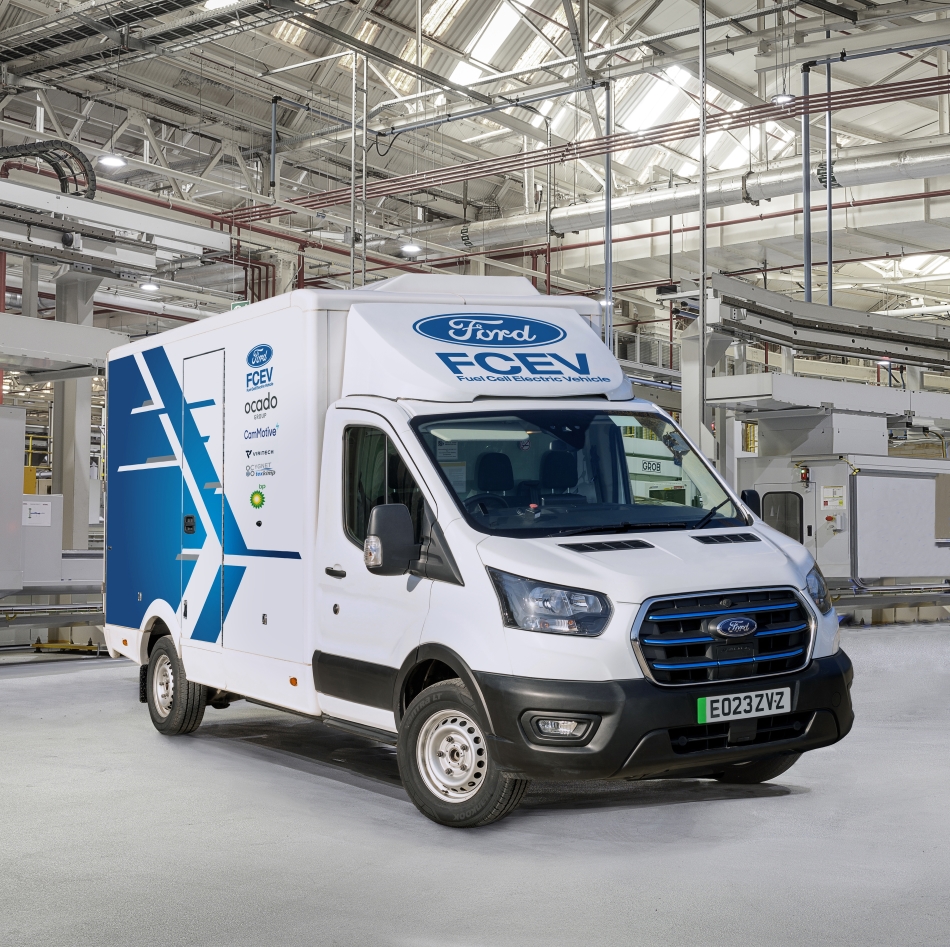
A three-year trial of hydrogen fuel cell technology (FCEV) is planned to gauge the potential for hydrogen as an on-board energy source for Ford’s E-Transit.
The United Kingdom-based project will establish if FCEV technology can deliver more zero-emission range to heavy-use E-Transit customers travelling high mileages, with maximum loads, ancillary equipment such as chillers and with limited charging opportunities in the working shift.
Delivery van operators can benefit from the extended range and quicker refuelling, says Ford.
A small UK-based prototype fleet will run the FCEV trial as part of a wider alternative fuel research project, the company adds.
A low-volume test fleet of eight fuel cell Ford E-Transits will run for six-month periods over the three-year project to 2025, testing current and future needs for the alternative fuel in the Thames Estuary area.
Test fleet data will provide insights into the total cost of owning and operating a large van, with increased range and operating hours to match its diesel-powered equivalent and without the need to charge.
The prototype Ford E-Transits will be fitted with a high-power fuel cell stack, in conjunction with significant hydrogen storage capability, optimised for safety, capacity, cost, and weight.
Efficient and viable recycling for end-of-life components will also be evaluated.
Ford Pro, the company’s commercial vehicle (CV) and services division, will use the pilot to expand its conversion expertise, supported by engineers and E-Transit specialists from Dagenham and the company’s nearby Dunton Technical Centre in Essex, UK.
Part funded by the Advanced Propulsion Centre (APC), Ford’s consortium of six automotive technology leader and fleet operator partners will help to determine the supporting hydrogen refuelling infrastructure required.
“Ford believes that the primary application of fuel cells could be in its largest, heaviest CVs to ensure they are emission-free, while satisfying the high daily energy requirements our customers demand,” says Ford in Britain chair Tim Slatter.
BP, Ocado Retail, Cambustion, Viritech, and Cygnet Texkimp are among those involved in the project.
Hydrogen fuel cells produce electricity by combining hydrogen from an onboard tank with oxygen. Ford has researched fuel cell technology since the 1990s, developing many prototypes and demonstrating the first-generation E-Transit fuel cell vehicle at the CENEX Low Carbon Vehicle Show in 2021.
Ford imports Transits to the UK, which are assembled in Turkey, via its own river jetty at Dagenham – part of the Thames Freeport zone which has received Government go ahead – and is also served by Ford’s own railhead and the adjacent A13/M25 road connections.


Join the conversation