
Government announces sweeping EV assistance – no direct subsidies
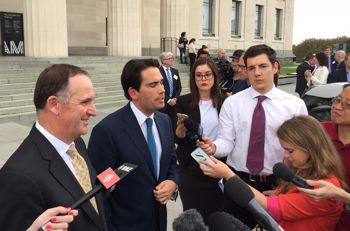 Transport minister Simon Bridges today announced an ambitious and wide ranging package of measures to increase the uptake of electric vehicles in New Zealand.
The changes, which include fleet buying assistance, tax reviews, and changing legislation to allow offering advantages such as access to transit lanes, was announced today.
“It’s clear that electric vehicles are the future. A move from petrol and diesel to low emission transport is a natural evolution, and it is our aim to encourage that switch sooner, rather than later,” Bridges announced this afternoon.
“The benefits of increasing uptake of electric vehicles are far-reaching. They’re cheaper to run than petrol or diesel vehicles, they’re powered by our abundant renewable electricity supply, and they’ll reduce the amount of emissions that come from the country’s vehicle fleet.”
The government have set itself a target, committing to double the number of electric vehicles in New Zealand every year to reach approximately 64,000 by 2021
Bridges says current barriers include the limited selection of models available; a lack of widespread public charging infrastructure; and lack of awareness about electric vehicles.
“The Government can’t tackle these barriers alone. That’s why we’ve been working closely with the private sector and local government over the last year on what measures we can take that will have the greatest impact.
“What we’ve come up with together is a strong package of measures that is ambitious and has real substance,” Bridges says.
The Government’s package includes:
- Extending the Road User Charges exemption on light electric vehicles until they make up two percent of the light vehicle fleet
- A new Road User Charges exemption for heavy electric vehicles until they make up two percent of the heavy vehicle fleet
- Work across Government and private sector to investigate the bulk purchase of electric vehicles
- Government agencies coordinating activities to support the development and roll-out of public charging infrastructure including providing information and guidance
- $1 million annually for a nation-wide electric vehicle information and promotion campaign over five years
- A contestable fund of up to $6 million per year to encourage and support innovative low emission vehicle project
- Allowing electric vehicles in bus lanes and high-occupancy vehicle lanes on the State Highway network and local roads
- Review of tax depreciation rates and the method for calculating fringe benefit tax to ensure electric vehicles are not being unfairly disadvantaged
- Establishing an electric vehicles leadership group across business, local and central government.
The package also seeks to realise the many benefits that electric vehicles offer up.
“This includes annual savings of Road User Charges of $600 a year for the average vehicle owner and much cheaper operating costs. On average, charging an electric vehicle at home is equivalent to buying petrol at 30 cents a litre, compared to petrol which is around $2 a litre.”
Bridges says the package is an important part of the Government’s work to reduce greenhouse gas emissions in the transport sector.
“Electric vehicles will maximise New Zealand’s renewable advantage, with more than 80% of the country’s electricity coming from hydro, geothermal and wind. The increased use of electric vehicles will replace petrol and diesel with clean, green, locally produced energy.
“If we start to replace New Zealand’s fleet with electric vehicles, we can begin to significantly reduce our greenhouse gas emissions.”
Bulk purchasing to bring cost down
Bridges noted a way to bring vehicle prices down will be moves to organise bulk-buying across the public and private sector.
“If we can get the big fleet buyers around the country buying electric cars, the price will come down, the volume discounts we can get will be higher, and it is a win win.”
Business welcomes move
The package has found favour with the Sustainable Business Trust
Abbey Reynolds, executive director of the Sustainable Business Council welcomed the whole package, noting her members had particularly been calling for the review of tax rules around such vehicles.
Christopher Luxon, chief executive of Air New Zealand, says electric vehicles make a lot of sense on a business level.
The company has already committed to replacing as many of its vehicles as possible to electric by 2017.
“We are big fans of electric cars,” Luxon says. “Out first cars have started to arrive and they have been well received by our staff.”
The company is also moving its tarmac vehicles to electric, achieving 60% fleet penetration at some airports.
“We do commend the government for the package, it is a no brainer.”
Luxon says EVs work on an economic, social and environmental level for the company.
He also thanked the automotive industry for working with them on the likes of lease arrangements and the types of vehicles into the airline’s fleet.
Mighty River Power chief executive Fraser Wineray, indicates EVs are going to become part of the Kiwi psyche.
“Driving an EV, and filling up on locally made fuel, will become a very kiwi thing,” Whineray says.
“If you are doing a whole lot of sustainable activities and walking past the electric vehicle, Kiwis will start to notice.”
EV group look to take part
Chairman of industry group Drive Electric Mark Gilbert welcomed the announcement.
“It’s positive,” Gilbert told AutoTalk at the announcement. “The things that have been announced include recommendations Drive Electric has put to the ministry and minister.”
Gilbert says the group would like to be involved in the reference group announced as part of the package.
He is not surprised there are no direct subsidies involved.
“It would have surprised me – we have never suggested cash incentives. New Zealand used to be an incentive based economy but we have moved away from that.”


Join the conversation