
Hyundai to accelerate hydrogen development
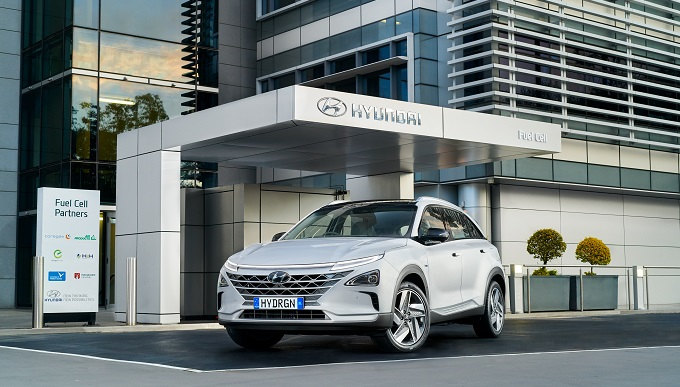
A long-term hydrogen roadmap has been announced by Hyundai Motor Group.
Its FCEV Vision 2030 plan reaffirms the group’s commitment to accelerate the development of a hydrogen society by leveraging its global leadership in fuel-cell technologies.
The group will drastically boost its annual fuel-cell systems production capacity to 700,000 units by 2030.
That’s while also exploring new business opportunities to supply its world-class fuel-cell systems to other transportation manufacturers of automobiles, drones, vessels, rolling stocks and forklifts.
Demand for fuel-cell systems from sectors such as power generation and storage systems is also expected to emerge quickly.
“We will expand our role beyond the automotive transportation sector and play a pivotal role in global society’s transition to clean energy by helping make hydrogen an economically viable energy source,” group executive vice-chairman Euisun Chung says.
“We are confident that hydrogen power will transcend the transportation sector and become a leading global economic success.”
The FCEV Vision 2030 roadmap will help Hyundai Motor Group and its suppliers invest about South Korean Won 7.6 trillion in research and development and facility expansion, expected to create some 51,000 jobs by 2030.
The group plans to secure a 500,000-units-a–year FCEV production capacity by 2030, including passenger vehicles and commercial vehicles, in anticipation of high demand for global FCEVs expanding to around two million units a year within that timeframe.
As the first step, the group’s fuel-cell system manufacturing affiliate Hyundai Mobis Co. held a ground-breaking ceremony on December 12 for its second fuel-cell system plant in Chungju, South Korea.
The second factory will help Mobis increase annual fuel-cell system output to 40,000 units by 2022, up from the current 3000 units.
Hyundai Motor earlier this year launched the Nexo second-generation commercialised FCEV, improving upon the ix35 FCEV introduced in 2013.
The group plans to further advance the fuel-cell system used in Nexo models to upgrade and diversify its fuel-cell system line-up, so it can respond to demands from various industry sectors.
In December, Hyundai Motor Group established a dedicated division to develop and support fuel-cell system businesses.
Its proprietary fuel cell system combines hydrogen fuel with oxygen taken from the air to produce electricity.
The system only emits water as a by-product while also purifying polluted air.
With high energy density and ease of stack refuelling, hydrogen would help reduce the comprehensive ownership costs by about 10% for all possible transportation means, including rolling stocks, vessels and forklifts, according to a study by McKinsey & Company.
The study also estimates that about 5.5 million-6.5 million fuel cell system units will be required by 2030 globally.
The Hydrogen Council, a global initiative of leading energy, transport and industry companies including Hyundai Motor, predicts the annual demand for hydrogen will increase tenfold by 2050.

Join the conversation