
World’s largest electric ship leaves Tasmania, piggy-backed on a giant heavy-lift vessel
The world's largest battery-electric ship, Incat's 40MWh Hull 096, has left Tasmania aboard the heavy-lift vessel Black Marlin for a 40-day voyage to its Buenos Aires ferry route.
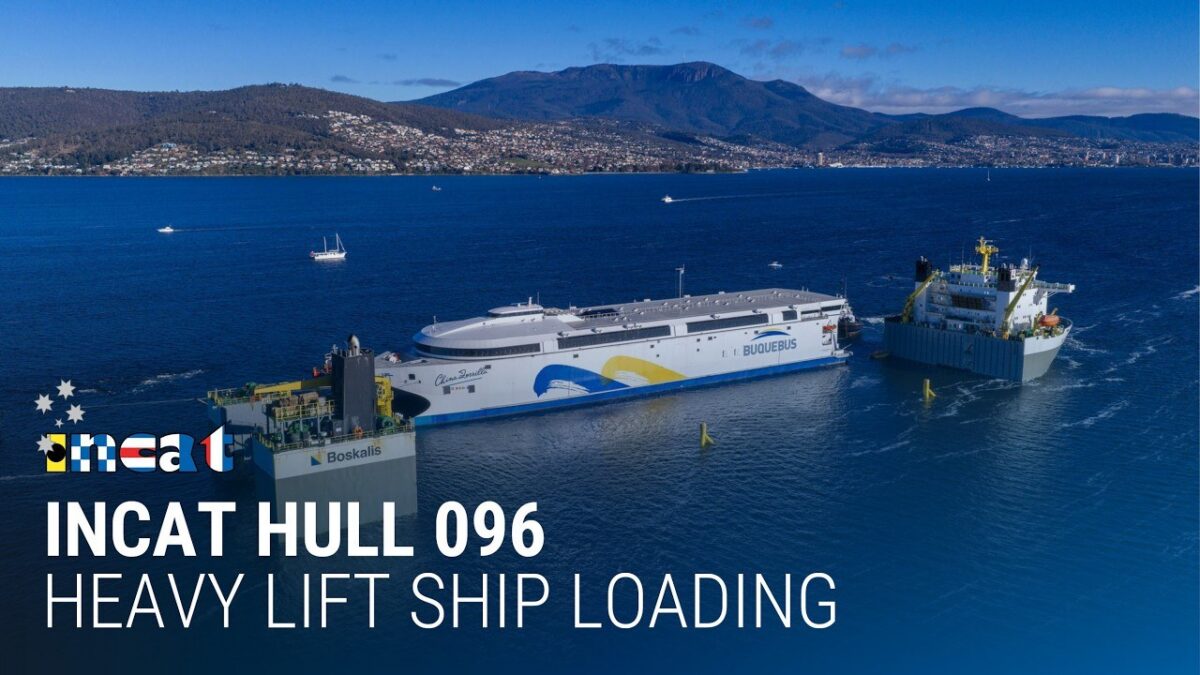
The world’s largest battery-electric ship has left Tasmania, though not under its own power: the 130-metre Incat-built ferry known as Hull 096 departed last week piggy-backed aboard the giant heavy-lift vessel Black Marlin, bound for South America.
Loading the catamaran was described as one of the most complex maritime operations ever undertaken in Tasmania. The Black Marlin, one of the world’s largest heavy-lift ships, partially submerges to let its cargo float into position above the deck, then pumps out ballast to lift the vessel clear of the water for transport.
The 40-day voyage delivers Hull 096 to the River Plate, where it will be unloaded, commissioned and prepared for service with ferry operator Buquebus between Buenos Aires in Argentina and Colonia in Uruguay.
Built by Incat Tasmania in Hobart, the ferry carries more than 250 tonnes of batteries, with over 40MWh of storage, making it comfortably the largest battery-electric vehicle of any kind yet built. It is designed to carry around 2,100 passengers and 225 vehicles on the busy trans-Plate crossing. Remarkably, it began life specified as an LNG-powered ship, before Buquebus switched the order to full battery power in 2023.
“Today is a proud day for everyone at Incat,” says chairman Robert Clifford, describing the departure as a defining moment for the company and for sustainable maritime transport. “Hull 096 has been the biggest and most ambitious project in our company’s history, and its departure is a testament to the skill, dedication and innovation of our entire workforce.”
“We now look forward to seeing the world’s largest battery-electric ship arrive in South America and demonstrate the enormous potential of large-scale battery-electric technology in commercial ferry operations.”
The departure was months later than planned, with the Black Marlin’s arrival delayed by the blockage of the Strait of Hormuz, a small illustration of how the conflict that upended global fuel prices has rippled through even the delivery schedules of the ships built to move past oil.
With Hull 096 gone, Incat turns its attention to a five-vessel electric shipbuilding programme announced late last year, which will see large aluminium battery-electric ships built at the Hobart yard.
The milestone will be watched with interest on this side of the Tasman, where battery-electric passenger ferries are already running on Wellington Harbour and larger electric vessels remain part of the long-running conversation about the Cook Strait fleet.


Join the conversation