
Key trends shaping EV charging in 2024
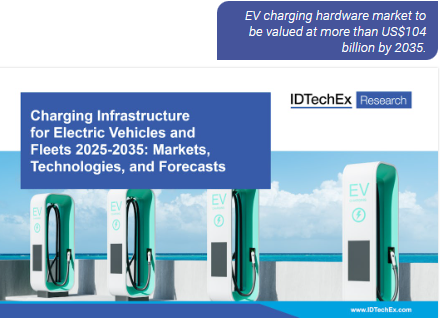
The EV charging market is seeing rapid growth in public charging networks, driven by substantial investments in infrastructure expansion.
The focus is on deployment of high-power DC chargers exceeding 150kW, says IDTechEx senior technology analyst and technical sales lead Shazan Siddiqi.
These high-power chargers reduce charging time and increase vehicle throughput, meeting the growing demand from EV owners who rely on public stations for on-the-go charging, he says.
IDTechex’s new report Charging Infrastructure for Electric Vehicles and Fleets 2025-2035: Markets, Technologies, and Forecasts finds about 72% of existing public chargers globally were in China by the end of 2023, with around 77,000 new public charging units being installed every month.
Charging has expanded enormously, but utilisation is low – around 5% for public chargers in 2024, dropping from 10% in 2023, says Siddiqi.
The average Chinese charging post has a charge rate of 30kW, charges 39kWh per day, for around 77 minutes per day – this implies about two or three customer sessions daily, he says.
In the US, L3 (DCFC) utilisation is up 32%, growing from an average of 13% in July 2023 to 17% in June 2024, says Siddiqi.
“After rapid growth at the end of last year, utilisation appears to have stabilised at 16-17% in the first half of 2024.”
Siddiqi says the EV charging market is characterised by high capital expenditure (CapEx) and low profit margins, creating a challenging environment for smaller players.
“Building and maintaining charging infrastructure require substantial investment in hardware, grid connections, and ongoing operational costs, which can be difficult to sustain without significant financial backing.
“As a result, the market is ripe for consolidation, with larger companies acquiring smaller, less profitable entities to scale up operations.”
IDTechEx’s report examines more than 20 recent acquisitions in the market and categorises them to provide clarity on the state of the market.
Innovations such as smart charging, which balances grid demand and integrates renewable energy sources, are becoming more prevalent, enabling more sustainable and reliable charging options, says Siddiqi.
“Vehicle-to-grid (V2G) technology is also gaining traction, allowing EVs to feed energy back into the grid, thus providing additional value to both consumers and energy providers.”
The IDTechEx report covers other promising advancements, including off-grid solar charging, battery-integrated DC charging, and robotic systems.
Other trends to watch for within are increasing overall system efficiency to minimise power loss and developing thinner, lighter, and more flexible liquid-cooled cables that can still handle high power levels.
“ABB’s new A400 all-in-one charger uses a closed-loop two-phase liquid-cooled connector (but an air-cooled cable), which is unique,” says Siddiqi who will present a free-to-attend webinar on EV charging market trends on Thursday October 24, 2024.
Click here to register.


Join the conversation