
Making EVs in a materials crisis

The past two years have been extremely turbulent for many industries with production lines shutting down, chip shortages, and a host of general supply chain issues.
EVs have been a shining light, IDTechEx says.
In 2021, EV sales globally grew by around 80% over 2020 which in turn was 44% up over 2019.
In the midst of all of these shortages, the demand for EV components has been drastically increasing, and while much news is focused toward the battery pack (and rightly so), the electric motors are equally critical to an EV’s operation, IDTechEx explains in its report Electric Motors for Electric Vehicles 2022-2032.
EV motors rely on a host of materials including rare earths, copper, aluminium, and steel. These materials have seen sharp rises in price over the past two years and this impacts the margin that a motor manufacturer can obtain, says IDTechEx which also includes interviews and projects with motor manufacturers through its “Future Mobility” platform.
Motors widely used in EVs can largely be categorised into permanent magnet (PM) motors, induction motors, and wound rotor motors.
These motors generally use copper wire in the stator (stationary component) – the difference is in the rotor (rotating component).
PM motors utilise rare earth magnets on the rotor, induction motors feature copper or aluminium cages or windings, and wound rotor motors have copper windings on the rotor.
Each design has inherent pros and cons, but just considering the materials there are some significant differences in cost between designs, compounded by materials price volatility during the past two years.
The price of neodymium (the main rare earth for magnets) in January 2022 increased by more than 200% compared to its 2019 value, copper by 59%, aluminium by 62%, and steel by 24%.
This sort of volatility can be a serious issue for motor manufacturers and OEMs, IDTechEx explains.
“In fact, Japanese motor manufacturer Nidec reported a drop in operating profit in the final quarter of 2021, with one of the stated causes being the increase in copper prices.”
The choice of materials used in an EV motor is critical to the bill of materials and hence the profit margin that can be obtained, IDTechEx says.
In 2021, 83% of electric motors in EVs were PM motors, a figure which has risen 6% since 2020. Typically, they provide the best power density and efficiency and the prices of rare earths have remained fairly stable over the past 10 years (until 2020/2021).
A significant reason for the increasing PM motor share has been Tesla’s adoption of a PM motor replacing an induction motor in the Model 3 and subsequent models.
However, due to the high cost and severe price volatility of rare earths in 2011/2012, several manufacturers have opted for alternatives.
Audi’s e-tron uses induction motors with aluminium rotor segments and Renault uses a wound rotor design. More recently, BMW’s 5th generation drive system also uses a wound rotor design with copper windings on the rotor.
Aluminium is lighter and cheaper than copper, but the trouble is it is less electrically conductive, requiring a greater volume of metal.
UK-based manufacturer Advanced Electric Machines uses a compressed aluminium winding technology to not sacrifice the volumetric performance and avoid the use of any rare earths or copper windings.
As the EV market ramps up and if material prices continue to be volatile, it would not be surprising to see more OEMs and tier 1s adopt magnet free designs in the near future, IDTechEx adds.
“Thanks to China’s current control of the rare earth supply, they are likely to largely remain with PM motors and hence a very large portion of the global market remaining with that technology. In other regions, it will be interesting to see how the market and designs of electric motors evolve.”
Meanwhile, IDTechEx has recently released Mobile Robotics in Logistics, Warehousing and Delivery 2022-2042, a market research report exploring the technical, regulatory, and market factors that are shaping the emerging industry around logistics mobile robotics.
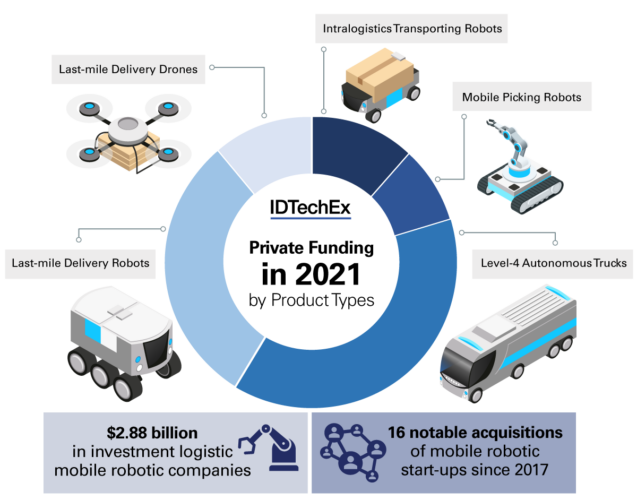
The mobile robotics industry has grown quickly in recent years, spurred on by advances in robotics technology, autonomous navigation, and artificial intelligence (AI), and may efficiently and cost-effectively alleviate many of the labour issues threatening the global logistics industry.
The market revenue of mobile robotics in logistics is forecast to exceed US$300 billion by 2042 (including level four autonomous trucks).


Join the conversation