
‘Massless’ carbon fibre battery likely for wind blades, EVs and aircraft
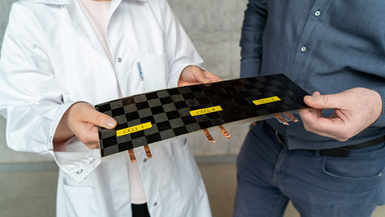
A Swedish university spin-off company says it’s nearly ready to commercialise energy-storing carbon fibre technology that may produce a structural battery.
Sinonus has appointed Markus Zetterström as chief executive, an executive from bearings manufacturer SKF Group, to lead the commercialisation project, says RenewEconomy.
The company launched in 2022, a year after researchers from the university found a way to apply its carbon fibre battery to the real world.
The technology, which uses the crystalline structures within carbon fibre to store energy, has been proposed for aircraft, EVs, and now in wind turbine blades.
“Sinonus has developed an amazing carbon fibre composite that doubles as a battery,” Zetterström says on LinkedIn, RenewEconomy reports.
“By substituting part of the structural material in systems/applications to our multipurpose composite, it’s possible to add electrical storage capacity at sustained weight and volume, or to decrease system weight and volume at sustained battery capacity (and of course some combination thereof).”
Sinonus uses technology developed at Chalmers University of Technology in Gothenburg where researchers have been studying for years a structural battery concept using carbon fibre.
Massless batteries have been something of a holy grail for energy storage since 2007, because the weight of the battery effectively disappears once it is part of the load-bearing structure, says RenewEconomy.
Meanwhile, Eatron and Syntiant will demonstrate an AI-BMS-on-chip at The Battery Show Europe 2024 from June 18-20 at Messe Stuttgart, Germany.
The new chip integrates Eatron’s Intelligent Software Layer into Syntiant’s low-power NDP120 Neural Decision Processor, offering a low-power solution to unlock latent battery capacity (10%), extend longevity (by up to 25%), and enhance safety,” says Eatron, adding it’s suitable for e-bikes, micro light commercial vehicles and forklifts.


Join the conversation