
Mercedes-Benz Vision EQXX does 1000km on single charge
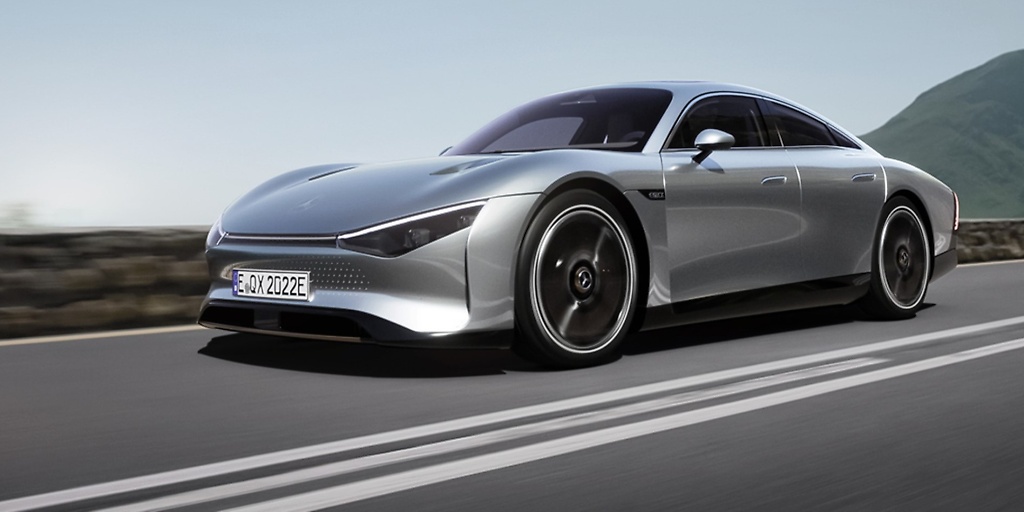
A road trip around Europe has demonstrated the Mercedes-Benz Vision EQXX can do more than 1000km on one battery charge in real world driving, with an average consumption of 8.7kWh/100km.
Travelling from Sindelfingen across the Swiss Alps and Northern Italy, to Cassis on the Côte d’Azur, it covered 1008km in everyday traffic on one charge.
The journey started in cold and rainy conditions, and was undertaken at regular road speeds, including prolonged fast-lane cruising at up to 140km/h on the German autobahn and near the speed limit elsewhere, says the brand.
The battery’s state of charge on arrival was around 15%, amounting to a remaining range of about 140km.
The long-distance drive was completed with the charging socket sealed and accompanied by an independent expert from certification body TÜV Süd.
Technology used in the Vision EQXX will be deployed in upcoming series-production Mercedes vehicles.
“The Vision EQXX is the most efficient Mercedes ever built. The technology programme behind it marks a milestone in the development of electric vehicles. It underpins our strategic aim to ‘Lead in Electric’,” says Mercedes-Benz Group AG management board chair Ola Källenius.
“The Mercedes-Benz Vision EQXX is how we imagine the future of electric cars.”
The EV is the product of a holistic approach with innovations in all technical areas that have an impact on energy consumption.
“The Vision EQXX is the result of a comprehensive programme that provides a blueprint for the future of automotive engineering,” says Mercedes-Benz Group AG management board member development and purchasing chief technology officer Markus Schäfer.
“Many of the innovative developments are already being integrated into production, some of them in the next generation of modular architecture for compact and midsize Mercedes‑Benz vehicles.”
This software-defined research prototype combines the latest digital technology with Mercedes’ pioneering spirit, the agility of a start-up and the speed of Formula 1.
The technology vehicle gains further efficiency benefits from its tyres, with their extremely low rolling-resistance rating of 4.7 which Bridgestone developed specifically for the EV in partnership with Mercedes-Benz, the dimensions 185/65 R 20 97 T meaning they have a large diameter and a narrow tread.
The EV’s lightweight design includes sustainable carbon-fibre-sugar composite material used for the upper part of the battery, which is also used in Formula 1, and the BIONEQXXTM rear floor, manufactured using an aluminium casting process.
The light metal structural component replaces a much heavier assembly of several interconnected parts and has gaps in places where structural strength is not required, thus saving material, resulting in a weight saving of up to 20% compared to a conventionally manufactured component.
At 100kWh, the power storage unit developed for the Vision EQXX has almost the same amount of energy as the battery of the EQS. However, it has 50% less volume and is 30% lighter.
The Vision EQXX recuperates energy from regenerative braking using new types of aluminium brake discs, mainly on downhill runs.
A solar roof comprising 117 solar cells feed the 12-volt battery, which supplies power to auxiliary consumers such as the navigation system, which allows a more than 2% increase in range, adding up to 25km over 1000km.
The EV’s compact, lightweight and average 95% efficient electric drive unit has a peak output of 180kW, meaning 95% of the battery’s energy ends up at the wheels.
Total losses in the drivetrain (motor, inverter and transmission) were reduced by 44% compared to a conventional e-drive, amplified by the battery energy density of almost 400Wh/l and more than 900-volt high operating voltage.
Since the electric drivetrain generates little waste heat thanks to its high efficiency, passive cooling is sufficient throughout the journey with the cooling plate in the underbody using the airflow to ensure even cooling, increasing range by 20km.
The efficiency assistant provides information on energy flow, battery status, topography and even the direction and intensity of wind and sun.
Artificial intelligence (AI) is used, opening up new digital possibilities by reacting instantly to the driver’s needs and bringing the real world into the vehicle.
The Vision EQXX did the trip in 12 hours and two minutes at an 87.4km/h average speed.


Join the conversation