
Mercury lifts half-year profit, doubles down on renewables
Mercury has reported a jump in first-half earnings and reaffirmed full-year guidance, as above-average hydro generation and lower operating costs boosted performance.
For the six months to December 31, Mercury posted EBITDAF of $537 million, up $119m on the prior corresponding period. Net profit after tax rose to $20m, an $87m improvement on HY25, reflecting stronger operating earnings partly offset by movements in unrealised gains and losses on unhedged electricity derivatives.
The board declared an interim dividend of 10 cents per share, up 4% on a year earlier. Full-year dividend guidance of 25cps remains on track, with the dividend reinvestment plan continuing.
Mercury maintained full-year FY26 EBITDAF guidance of $1 billion, supported by strong renewable generation volumes, disciplined delivery of new projects and tight cost control. The company said guidance remains subject to hydrological conditions and other material events.
Renewables push
Mercury said half of its HY26 earnings ($270m) had been reinvested into new and existing generation assets, as it progresses a $1 billion pipeline of major renewable developments.
All three of its flagship renewable projects are tracking on time and on budget. The fifth unit at Ngā Tamariki Geothermal Station came online in January following a $220m expansion that will deliver an additional 390GWh a year — enough to power around 55,000 homes.
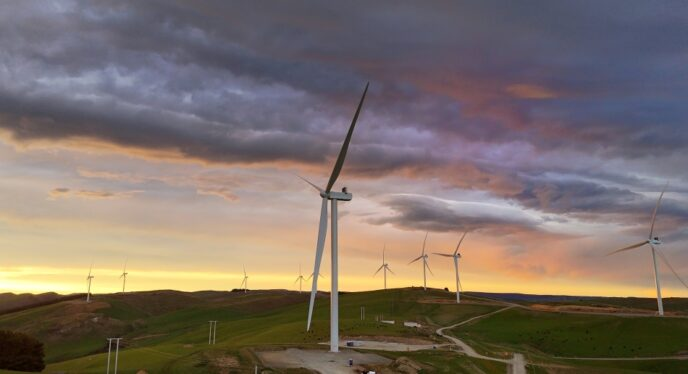
Construction is advancing on the $486m Kaiwera Downs Stage 2 Wind Farm, with first generation expected in FY26 and full output by the end of HY27. The $287m Kaiwaikawe Wind Farm is also under construction, with first and full generation due in HY27.
Mercury chief executive Stew Hamilton says the company is building for the future.
“Our disciplined strategic execution is delivering a strong performance today, while enabling us to invest significantly in new renewable generation for New Zealand, helping meet future demand growth and build resilience.”
He says Mercury is on track to add 3.5 terawatt hours of new generation by 2030 — equivalent to powering about 430,000 homes — leveraging its wind and geothermal pipeline.
“Our contributions are supporting the fastest rate of renewable generation development in history, helping power economic growth over the next two decades.”
The company is also investing in its existing assets, having completed the Karāpiro Hydro Station upgrade and committing $590m to hydro refurbishment over the next decade.
Managing transition and demand
Mercury said it continues to shape solutions around gas supply and firming capacity, including supporting Huntly firming options and boosting transparency in the gas market.
It is targeting a final investment decision on the proposed Whakamaru battery energy storage system by mid-FY27.
On the retail side, Mercury has commenced a 10-year electrification contract with Fonterra for its Waitoa site, with a further contract for Edgecumbe to begin from July 2026. Long-term contracts have also begun with Visy and Whakatāne Mill.
The company is progressing its smart hot water control programme and expects to have 50,000 cylinders — equivalent to about 20MW of flexible demand — under management this winter.
Hamilton says enabling customers to shift consumption and lower costs remains a priority.
“Enabling our customers to shift consumption and lower their costs is another key focus and we continue to provide additional support to our customers in need.”
He says Mercury is facing energy system challenges “with confidence”, including contributing to solutions around gas and firming while supporting a more renewable energy future.
Outlook
Mercury said its balance sheet remains strong, providing capital headroom to fund high-quality renewable projects while delivering sustainable shareholder returns.
“Our balance sheet remains strong, with capital headroom and prudent risk settings. This enables us to continue investing in high quality renewable generation assets and provides flexibility to deliver sustainable shareholder returns, value for our customers and New Zealand,” Hamilton says.
The company is targeting FY26 operating costs of $370m and says it remains focused on disciplined cost management as it continues its earnings transformation.



Join the conversation