
Mercury transforms

A period of significant change for Mercury – including becoming New Zealand’s largest wind generator – shaped half year results to December 31, 2021, Mercury chief executive Vince Hawksworth says.

Settlement of the Tilt Renewables transaction and the Turitea North wind farm reaching full generation, as well as the legacy Norske Skog contract close out, all contributed as the company positions itself for growth.
“Within the last six months, Mercury has transformed from a company with no wind generation to the largest wind generator in New Zealand,” Hawksworth explains.
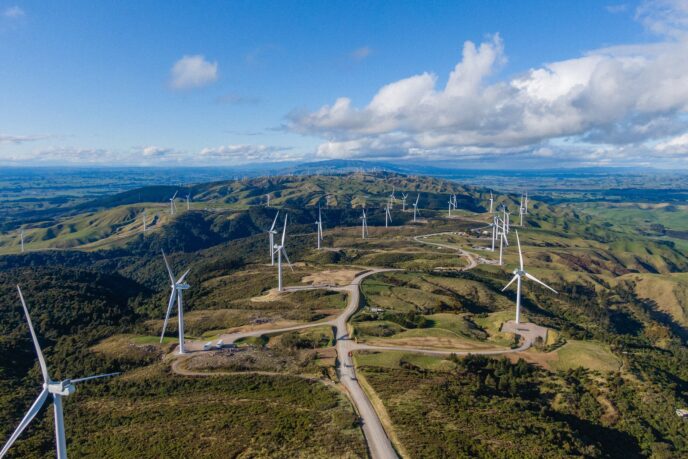
In August, Mercury completed the acquisition of Tilt Renewables’ New Zealand wind farms (generating 482GWh over the period), and within the remaining period progressively brought the Turitea North wind farm in the Tararua Ranges near Palmerston North on stream (adding another 105GWh over the period).

“Together these significantly diversify our revenue streams and position us well for an exciting period of growth as we head into an ever-accelerating pace of change with decarbonisation front and centre,” Hawksworth says.
The Turitea South wind farm is scheduled for completion mid-2023, which will make Turitea New Zealand’s largest wind farm.
Meanwhile, the acquisition of Trustpower’s retail business will provide another significant milestone.
The High Court approved the Tauranga Energy Consumer Trust restructure in December with the transaction expected to be completed in the last quarter of FY22.
During the period Mercury also negotiated the early exit of a foundation hedge with Norske Skog. The settlement of the wider transaction and its associated accounting impacts reduced HY2022 EBITDAF by $50 million. Exiting this contract allows Mercury to recontract this volume at a price more reflective of the current market.
While positioning Mercury well for the future, collectively this activity has impacted the HY2022 result. HY2022 EBITDAF is $242m, $48m down on the prior year, recognising acquisition accounting for Tilt and the close-out of the Norske Skog legacy contract.
Net profit after tax was $427m, up $297m on the previous year largely due to the $367m net gain on sale of Mercury’s 19.9% Tilt Renewables shareholding. Underlying earnings which normalise net profit after tax fell 23% to $89m.
Mercury acquired Tilt’s New Zealand operations including future development options for an enterprise valuation of $797m in August 2021, funded from the sale of its Tilt shareholding and a cash cost of $634m. This contributed to $685m of growth investment in the half.
Challenging operating conditions have continued for Mercury.
“Sustained dry conditions across the Waikato catchment reduced hydro generation,” Hawksworth says.
Hydro generation was 91GWh down on the prior comparable period (where conditions were also dry) as a result.
A 44-day unplanned outage at Kawerau geothermal power station also extended into the start of the financial year (ending on July 20) and coincided with high spot prices.
Hawksworth says it’s pleasing to see Mercury’s Thrive programme, focussed on building operational excellence as a mindset, continue to deliver value, tracking well against the $30m EBITDAF benefit signalled for FY22.
Mercury chair Prue Flacks says ensuring the transition to a renewable future is equitable is essential. “Balancing affordability and security are a key consideration for the electricity sector’s contribution to the decarbonisation challenge.
“The market must continue to evolve for the next phase of the transition, keeping what is good but adapting to address new challenges including the need for rapid response peaking capacity,” Flacks adds.
“However, regulatory uncertainty facing the sector is a challenge.
“We agree with the Government’s position that climate change must be a priority but are increasingly concerned about the potential for policy or regulatory change that unintentionally undermines this position and jeopardises New Zealand’s decarbonisation goals.
“A good example of this is our resource management system, which needs to support renewable generation development if we are to decarbonise at a pace that becomes more urgent by the day.”
A fully imputed interim dividend of 8.0 cents per share has been approved by Mercury’s board, representing an 18% increase on the HY21 dividend, and Mercury has a newly established Dividend Reinvestment Plan.
Mercury’s full year EBITDAF guidance remains at $570m.
Join the conversation