
New Batt-mobile in town
This story first appeared in the October issue of EVtalk – CLICK HERE to download the magazine FREE
The caped crusader might not be on it, but there’s a new Batt-mobile out.
Batt (short for “battery”) is the name of a new electric scooter store in New Zealand.
E-scooters are expected to surpass electric bikes in popularity in urban areas.
They’re ideal for commutes of around 10km or less, or as a first or last mile transport alternative.
Batt NZ director Morgan Guinness was in Los Angeles when he first tried the Xiaomi M365 scooter.
Impressed, he bought one here and, with wife Ellie, set up their business.
“We refer to the scooters as Batt because it’s easier to remember than Xiaomi,” he says.
“It kind of resembles a bat when folded, and is battery powered.”
The Batt is so popular the couple intend opening a retail scooter store this October in Beresford Square, Auckland.
Batt will offer demos, servicing, maintenance, spare parts and free tune-ups for Batt customers there.
“We care a lot about customer service and feel it’s an important part of introducing a new product and ensuring people get the most out of their e-scooters,” Guinness says.
He sees the scooters as a sustainable transport form and says they’re the ultimate small vehicle to nip around the city on.
The Batt e-scooter sells for $999 and comes with guarantees, including a one-year warranty.
The 71W/280Wh battery under the scooter deck ensures weight is evenly distributed.
It’s switched on by pressing the power button on the centre piece between the handlebars.
Four lights come on when fully charged, gradually winking out over about a 30km range.
To get the 250W electric motor powering the front wheel, the rider must push off a couple of steps as with an unpowered scooter until reaching about 5km/h before engaging the thumb throttle.
Maximum torque is around 16Nm.
A Segway-Ninebot app will pair with the scooter through a smartphone’s Bluetooth when both are switched on.
The app allows the rider to monitor stats about the scooter, such as battery level and distance travelled.
Cruise control is also app activated.
When the rider reaches the desired speed and the throttle is held down for five seconds, a beep tells the rider to let go the throttle and the scooter will continue until the throttle or brake is touched – handy for longer distances.
The app also enables locking of the scooter.
It will beep and activate its ABS brake if anyone tries to wheel it away.
Pushing the power button switches on the front and rear lights, with two pushes of the button switching between two power modes – economy and normal.
The sole brake on the left handle-bar ensures a rapid stop.
The rear mudguard cannot be used as a brake.
The Batt converts and stores kinetic energy during acceleration.
It is also fitted with regenerative braking.
The front wheel has an E-ABS anti-lock system, while the rear wheel uses a mechanical disc brake.
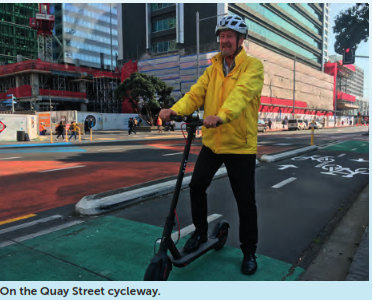
The Batt easily completed 23km along cycleways and footpaths between downtown Auckland and Swanson in West Auckland with battery power to spare, using economy mode shown by a green light at the bottom of the four lights.
Using normal power would have given more speed and torque, but not the same guarantee of making that distance.
One trip was even done with added weight – a laptop.
That included a long climb up the Nelson Street bike path in eco mode.
A scoot with one leg was needed for the steepest sections, while cruise control kept it moving.
It took about 1.5 hours for 23km compared with an hour on a normal road cycle, the scooter reaching around 25km/h.
It’s more comfortable to ride shorter distances.
A two-kilometre hop to the train station was a breeze, taking under 10 minutes compared with a nearly 30-minute walk.
The Batt can be folded with the handlebars latching onto the rear mudguard for ease of carrying and stowing on the train, bus, or in a car.
It weighs about 12.5kg but you wouldn’t want to carry it too far, although you can also wheel it on one or both inflatable puncture-proof 21.6cm tyres.
Newer models are likely to have solid but flexible wheels.
It’s OK to ride in the rain, but the maker suggests avoiding puddles deeper than about 2.5cm.
The manufacturer’s recommended weight limit is 100kg, although customers up to 110kg have few issues if riding with care, Guinness says.
He recommends reducing speed over rough surfaces and kerbs to avoid damage or bolts loosening.
“Always wear a helmet and footwear while riding,” Guinness says, even though a helmet isn’t legally required.
He also recommends reducing speed and giving way around pedestrians, using the scooter’s bell.
Search Xiaomi M365 online, contact Morgan Guinness on 021 425 192 or email mg@batt.nz for more information.


Join the conversation