
New consenting rules to support EV charger rollout

The Government has removed consenting barriers for electric vehicle charging infrastructure, aiming to speed up the rollout of chargers across New Zealand.
RMA Reform Minister Chris Bishop says changes to the National Environmental Standards for Electricity Transmission Activities will introduce nationally consistent permitted activity rules for EV chargers. The amendments come into force on May 7.
“Under the current system, anyone wanting to install EV charging infrastructure has had to navigate a confusing patchwork of local rules, creating uncertainty, delays and unnecessary costs for infrastructure that is typically small-scale,” Bishop says.
“These changes cut through that red tape. By setting clear national rules, we’re making it much quicker and easier to get chargers in the ground, while still managing effects appropriately.”
The new rules cover the full lifecycle of EV charging infrastructure, including construction, operation, upgrades and replacement, and apply to private chargers, chargers in transport corridors, those linked to existing sites such as service stations and supermarkets, and standalone charging hubs.
Bishop says a lack of public charging infrastructure remains a barrier for EV uptake.
“Many New Zealanders have thought about getting an EV, even before the fuel challenges we’re currently facing. But a lack of public chargers is still holding people back,” he says.
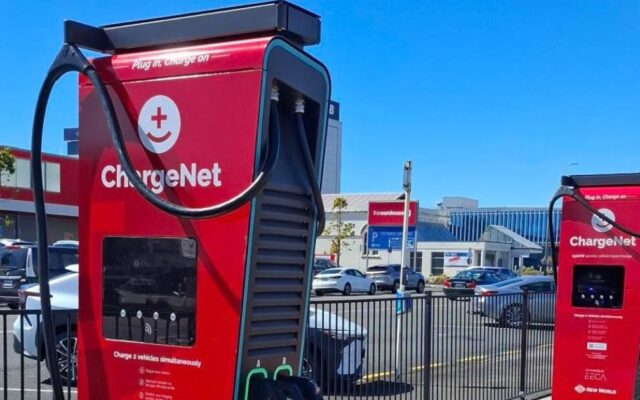
The regulatory changes sit alongside a previously announced $52.7 million package of zero-interest loans and co-investment from ChargeNet and Meridian to expand the charging network.
New Zealand currently has just over 1800 public EV charging points. With projects under way and new investment, that number is expected to rise to about 4550, with a target of 10,000 chargers by 2030.
Bishop says the present number puts New Zealand among the lower-ranked countries in the OECD for chargers relative to the number of EVs on the road.
“Making it simpler to consent new chargers will help us get there faster.”
Bishop says EV uptake is already increasing, with registrations in 2026 up 96.4% compared with the same period last year, driven in part by rising fuel prices.
“In a world where international fuel markets are uncertain, that matters,” he says.
The new standards include conditions to manage effects such as noise, earthworks, size, setbacks and traffic impacts. Where these are not met, a restricted discretionary consent will still be required.
Councils will not need to update district plans, with the national rules applying directly from May 7.
Bishop says the changes are part of broader reforms to make the resource management system more enabling for infrastructure development.
The amendments apply to four types of EV charging infrastructure:
- Private EV chargers
- EV chargers in a transport corridor
- EV chargers associated with other infrastructure or buildings, such as service stations or supermarkets
- Standalone EV charging facilities, including charging hubs

Join the conversation