
Nissan accelerates electrification
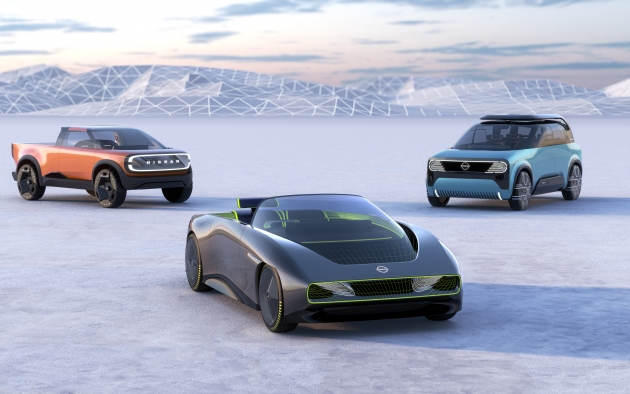
Nissan will launch 15 new EVs among 23 electrified models by the 2030 financial year.
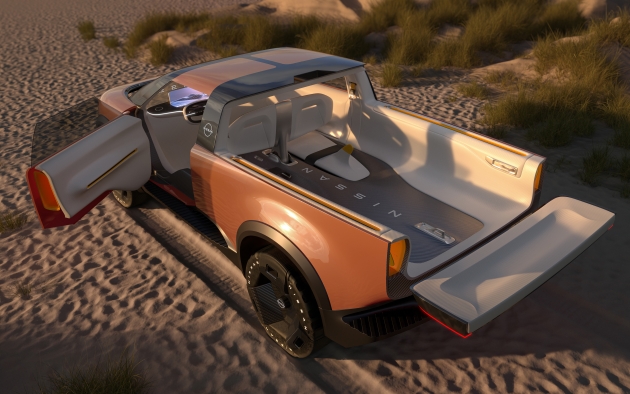
It has unveiled three new concept cars that offer enhanced experiences through sophisticated technology packaging and will build an electric crossover SUV model at Nissan’s UK Sunderland factory as a Leaf hatchback replacement in about 2025 – its fifth electrified SUV.
Nissan is investing two trillion yen (NZ$25 billion) during the next five years aiming for a 50% electrification mix by 2030, and to introduce all-solid-state batteries (ASSB) in the 2028 fiscal year.
ASSB will enable Nissan to expand its EV offerings across segments and offer more dynamic performance, reducing charging time to one-third.
Nissan expects ASSB to bring the cost of battery packs down to US$75 per kWh by fiscal year 2028 and aims to bring it further down to US$65 per kWh to achieve cost parity between EV and internal combustion engine (ICE) vehicles.
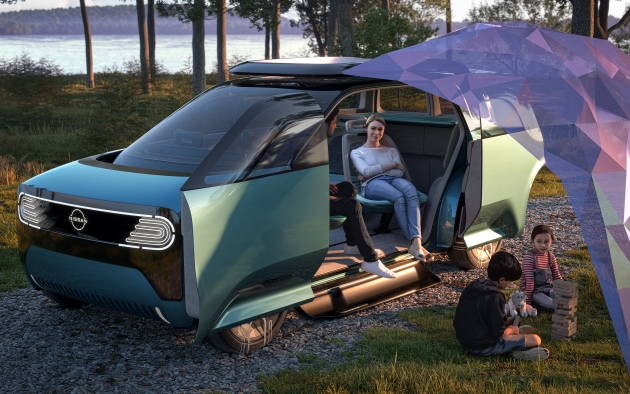
That’s all part of its newly unveiled Nissan Ambition 2030 long-term vision for empowering mobility and beyond, aiming to become “a truly sustainable company, driving towards a cleaner, safer, and more inclusive world”.
Nissan will also prepare a pilot plant in Yokohama as early as fiscal year 2024 as part of its goal to be carbon neutral across the life cycle of its products by fiscal year 2050.
“The role of companies to address societal needs is increasingly heightened,” Nissan chief executive Makoto Uchida says.
“With Nissan Ambition 2030, we will drive the new age of electrification, advance technologies to reduce carbon footprint and pursue new business opportunities. We want to transform Nissan to become a sustainable company that is truly needed by customers and society.”

As an EV pioneer, Nissan seeks to establish a global battery supply system to meet growing customer vehicle demand and support the growing number of EVs in use.
Working with its partners, Nissan intends to increase its global battery production capacity to 52GWh by fiscal year 2026, and 130GWh by fiscal year 2030.
Nissan aims to expand its ProPilot technology to more than 2.5 million Nissan and Infiniti vehicles by 2026 and will also further develop its autonomous vehicle (AV) technologies, aiming to incorporate next generation lidar systems on almost every new model by 2030.
The company says it will localise manufacturing and sourcing to make EVs more competitive.
Nissan will expand its EV Hub concept, EV36Zero - a fully integrated manufacturing and service ecosystem connecting mobility and energy management launched in the UK to core markets including Japan, China and the US.
And it will continue to evolve its lithium-ion battery technologies and introduce cobalt-free technology to bring down the cost by 65% by fiscal year 2028, collaborating with suitable partners to realise new mobility services for more efficient mobility in cities, as well as more sustainable mobility in rural areas.
Ensuring vehicle batteries remain sustainable will continue to be a priority for Nissan based on its decade of repurposing and recycling expertise with 4R Energy. The company intends to expand its battery refurbishing facilities beyond Japan with new locations in Europe during 2022, and in the US in 2025.
Nissan’s refurbishing infrastructure will support a circular economy in energy management, and the company aims to fully commercialise its vehicle-to-everything (V2X) and home battery systems in the mid-2020s.
In addition, the company will invest up to 20 billion yen by 2026 towards charging infrastructure.
It intends to hire more than 3000 employees in advanced research and development globally while continuing to upskill its workforce.
The company will also build on collaboration across the Renault-Nissan-Mitsubishi Alliance to enable cost-savings and shared expertise in areas such as carbon-neutral technologies, electrification, software and services.
Nissan also doesn’t plan to invest in hydrogen technology, focussing on battery electric vehicles (BEVs) instead.

Join the conversation