
Nissan e-vision for multiple EV battery uses
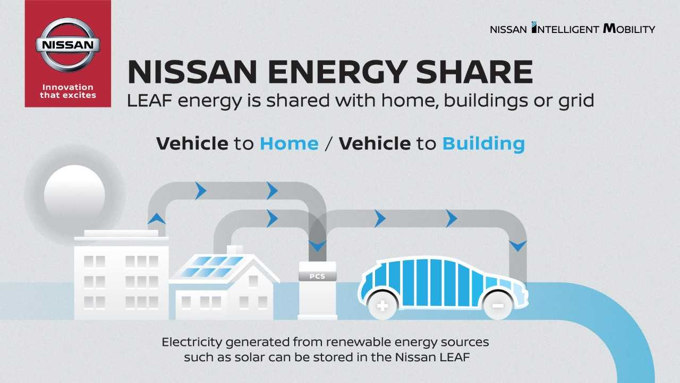
Nissan has created a vision to make electric vehicles even more useful to customers by introducing convenient ways to utilise their batteries’ ability to store and share energy.
Under the plan, called Nissan Energy, owners of Nissan’s EVs can easily connect their cars with energy systems to charge their batteries, power homes and businesses or feed energy back to power grids. The company will also develop new ways to reuse EV batteries.
Nissan has begun projects in the US, Japan and Europe aimed at creating an “ecosystem” around its EV range, including the popular Nissan Leaf.
“Nissan Energy will enable our customers to use their electric cars for much more than just driving – now they can be used in nearly every aspect of the customer’s lives,” Nissan marketing, sales and EVs global head Daniele Schillaci says.
“Our Nissan Intelligent Mobility vision calls for changing how cars are integrated with society, and Nissan Energy turns that vision into reality.”
Nissan Energy will establish new standards for connecting vehicles to energy systems through three key initiatives.
These are Nissan Energy Supply, Nissan Energy Share and Nissan Energy Storage.
Nissan North America will pilot use of Leaf vehicles to assist in powering its headquarters facilities during peak electrical demand times, anticipating significant cost savings.
Leaf vehicles will be used as a reserve for the German electricity grid, and in Japan Nissan is working with partners on field tests of vehicle-to-grid and virtual power plant systems.
Nissan’s efforts to assist customers includes verifying whether charging equipment, such as electrical sockets or wall boxes, can be connected to Nissan EVs safely (market-dependent).
Away from home, customers can make use of the fast-growing Chademo charging network with more than 22,000 quick-charging points globally.
Finding charging locations and hooking into the network is possible through the revised Leaf navigation system and NissanConnect app.
EV batteries can also serve as mobile energy storage devices, able to share their high-capacity battery power with a connected home or building.
They also allow the cars to link to the local energy grid to act as virtual power plants – supplying the vehicle’s power to the grid and contributing to efficient energy management.
All this without compromising mobility.
The battery can also be recycled and refurbished for different uses – from powering electric forklifts and generators to supplying energy to a sports arena.
Join the conversation