
Nissan launches third-generation Leaf, not yet confirmed for New Zealand
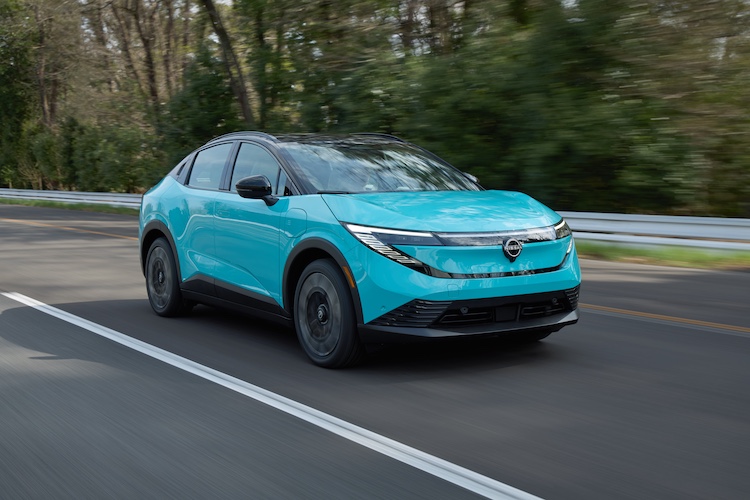
Nissan has launched the third-generation Leaf which offers up to 600km of range from the cars fitted with a 75kWh traction battery.
It will begin sales in the USA in August 2025 with other markets to follow, but Nissan New Zealand says the all-new Leaf is yet to be confirmed for sale here.
The new Leaf embodies Nissan’s timeless futurism design with a distinctive Japanese aesthetic.
Both the exterior and interior feature a distinctive “ni-san” geometric symbol, combining two vertical rectangles with three horizontal ones. The pattern pronounced “ni” and “san,” phonetically creates the name Nissan and signals a new era for Nissan design and the Leaf, which has been completely reimagined for this new generation.
A fastback-like silhouette and features such as flush front door handles, aero-tuned wheels and a flat underbody combine to ensure the new Leaf offers a 0.26 drag coefficient for U.S. and Japan models, and an even more impressive 0.25 for European variants.2
At the front, the daylight running lamps accentuate an evolved V-motion fascia. On select grades, a lightbar spans the length of the hood, which in some regions is positioned above an illuminated Nissan brand logo. At the rear, available 3D holographic tail lamps delivering a futuristic “digital Zen” element.
The 19-inch alloy wheels amplify the EVs bold street appeal.
The interior is spacious with an almost entirely flat floor courtesy of Nissan’s CMF-EV platform and the wide horizontal instrument panel appears to be floating.
A monolith-style display features either dual 12.3-inch or dual 14.3-inch integrated screens depending on grade and region.
Select variants feature Bose® Personal® Plus premium audio with speakers integrated into the front headrests, providing a truly immersive audio experience.
A Nissan-first Dimming Panoramic Roof featuring heat shielding with embedded Polymer Dispersed Liquid Crystal (PDLC) technology allows owners to enjoy natural light and year-round comfort at the touch of a button.
The all-new, 3-in-1 EV powertrain with an integrated motor, inverter and reducer is 10% smaller than its predecessor and features Nissan’s unique motor control, which enhances refinement.
The new motor, paired with a new, high-rigidity motor-mount bracket, supports a 75-percent reduction in motor vibration compared to the outgoing model.
For select regions, newly available Intelligent Distance Control Assist helps intuitively maintain a set distance from the vehicle in front while driving in city traffic and also optimizes regenerative braking.
It is available with two liquid-cooled lithium-ion battery options, both of which offer thermal conditioning functionality.
Select models are powered by batteries with 52 kWh of usable capacity, supporting an output of 130 kW and 345 Nm of torque. Larger 75 kWh batteries are also available, providing 160 kW and 355 Nm of torque.
An enhanced thermal recovery and management system harvests heat created by the onboard charger (OBC) to warm up the battery, increasing its regeneration potential in cold weather.
Additionally, on applicable grades a new intelligent navigation-linked thermal conditioning function optimises battery cooling based on the selected drive route.
When connected to a fast charger, owners can replenish 10-80% of their charge in as little as 35 minutes.4
An available Intelligent Route Planner also enhances EV ownership by providing real-time route information, state of charge and identification of convenient charging stations.
The new Leaf features a suite of advanced and innovative driver assist technologies to make daily driving easier and more intuitive. These include 3D Intelligent Around View® Monitor, Invisible Hood View and Front Wide View functionality.The third-generation Nissan Leaf will be assembled at the Tochigi Plant in Japan, as well as at Nissan’s production facility in Sunderland, northeast England

Join the conversation