
Port company going electric
This story first appeared in the June issue of EVtalk – CLICK HERE to download the magazine FREE
Electric vehicles are catching on at the Ports of Auckland.
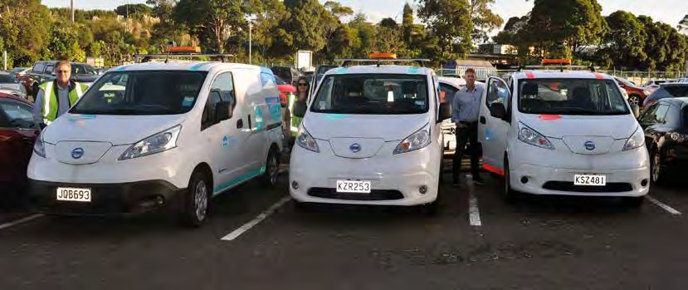
It has five Nissan ENV 200s on site, with another due to arrive in June, plus one Fuso hybrid truck.
The ENVs are used for a variety of purposes, from driving staff around the site, to carrying safety equipment.
One is equipped to carry oil drums, so the team can do oil changes on the port’s tug fleet.
Of 50 fleet vehicles at the port, about 12% are electric so far.
The ultimate aim is for the port to be emissions free by 2040, with the vehicles it uses set to play a major part in achieving that goal.

Procurement manager Mark Wray says a huge variety of vehicles are used at the port, from trucks, vans and utes to the standard pool car.
“Our biggest problem right now is finding suitable vehicles in the marketplace,” he says.
“You can’t move to EVs when there’s no suitable option available.”
It is particularly difficult to buy bigger electric vans or utes that would work in the port environment, Wray says.
One problem with some of the commercial EVs on the market is they are restricted by how much weight they can carry.
“Some of the vehicles are restricted in terms of what you can put on them because of the battery packs,” Wray says.
The ENV 200s purchased by the port are near-new vehicles with 2000 to 4000 kilometres on the clock and are sourced from Japan and the United Kingdom.
Wray says even those vehicles are “getting very, very hard to find”.
Each business unit has one EV to get them used to the vehicles, with many staff now converted fans of the technology.
“Some staff had been guarded about getting EVs, but once they’re in you can’t get them out.”
Converting some of its fleet to EVs is providing a variety of benefits for the port.
Short journeys are pretty hard on diesel engines, leading to higher emissions and maintenance costs, Wray says.
“But the EVs are perfect for those type of trips. A charge lasts three or four days. You just push the button and go.”
There’s a lot of administration that goes into Road User Charges, in terms of paying the tax and claiming an appropriate part of it back.
That isn’t the case with EVs, which aren’t subject to the charges.
Maintenance costs have also dropped.
“With EVs it’s basically brakes, tyres and windscreen wipers.”
The big picture
The move to electric vehicles is part of the port’s goal to be more environmentally friendly, particularly by reducing emissions.
Sustainability manager Rosie Mercer says in 2016 the port developed a long-term vision about where the company is headed.
“We developed a sustainability framework under which we’re aiming to build closer links with the city, to be a successful business long-term and to lessen our environmental impact.
“Our vision is to leave the environment in a better state than how we found it. Reducing emissions is a critical component of that.”
Along with the electrification of its auxiliary vehicle fleet, heavy equipment will also eventually be electrified.
“Our big container cranes are all electric, but our heavy container moving equipment and tugs are not and they are much harder to convert.”
“As an example, the port’s straddles weigh 60 tonnes and have to be able to lift their own weight in containers – turning that electric is a big ask. Tugs need to be able to pull 70 tonnes, so the task is similarly difficult” says Mercer.
“However, setting a target has been key. That’s enabled us to have conversations with suppliers that we haven’t had before, and it’s at least got people thinking about what’s possible. Our goal is to have electric alternatives in place by 2030-2040.”
Another option for reducing emissions is harnessing shore power by plugging the ships in.
“When the ships are berthed, they run the main auxiliary engines using heavy marine fuel oil, a thick, tar-like substance. If we could plug some ships in, we can significantly reduce the emissions associated with the port.
“In other countries where shore power is used, electricity is often generated by coal or gas, so there are still emissions, they are just not generated on the waterfront. In New Zealand, 85% of our electricity is generated by renewables, so shore power can make a real difference to emissions.”
Not all ships are equipped for shore power, but a feasibility study by the port last year showed that there were enough to make the idea of shore power worthwhile.
The next step is to build a detailed business case.

Join the conversation