
Record EV sales as governments up support
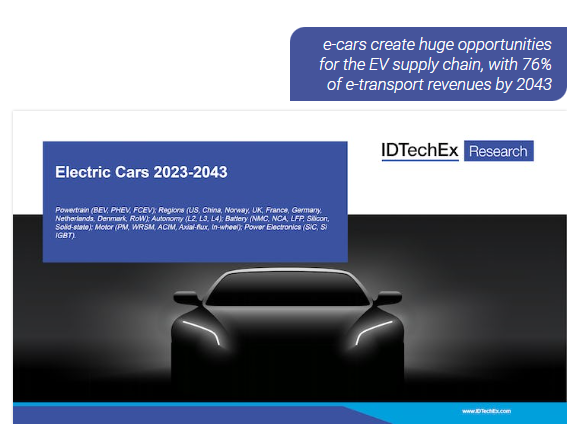
While 2022 continues to add to the challenges EV makers face, markets are still growing with electric car sales for the first half of 2022 reaching about 3.5 million, suggests IDTechEx research.
The new IDTechEx report Electric Cars 2023-2043 dives into future automotive markets with granular forecasts. Regional coverage includes the US, China, Norway, the UK, France, Germany, the Netherlands, Denmark, and the rest of the world.
Technology coverage includes battery-electric (BEV), hybrid (PHEV and HEV), and fuel cell (FCEV) cars; autonomous vehicles (L2, L3, L4; lithium-ion batteries (NMC, NCA, LFP, silicon, solid-state); electric motors (PM, WRSM, ACIM, Axial-flux, In-wheel); power electronics (SiC, Si IGBT), and more.
IDTechEx has underestimated the growth of electric car markets in the face of uncertainty from global events and changes (often u-turns) to government policy in recent years.
Under the Biden administration the US has seen much greater support for electrification, says the report.
In 2021, a 50% by 2030 EV target (new sales) was introduced, representing nearly eight million annual sales using today’s figures. In addition, new emissions standards are to be introduced from 2023 with average carbon emissions from cars and light trucks set to decline from about 224g CO2 per km to about 161g CO2 per km in 2026. The new standards bring the US more in line with Europe and, for the first time, will be national, not determined by individual states.
In August 2022, plans to modernise the EV federal tax credit, first introduced in 2009, have narrowly been passed, making a tax rebate of up to US$7500 per EV available to market leaders such as Tesla and GM for the first time in years.
IDTechEx forecasts for the US market have greatly increased since 2019 (today’s forecast is about 80% greater by 2035), reflecting some of these policy changes. The key difficulty is now not targets and commitments but ensuring battery supply, the report adds.
In Europe, emissions standards of 95g CO2 per km (WLTP), fully enforced since 2021 with a transitional year in 2020, are underpinning current EV sales. Since 2019, annual sales have more than quadrupled to 2.2 million in 2021, and IDTechEx predicts three million sales for 2022.
In June 2022, the EU further increased targets to reduce carbon emissions for vans and cars to 55% by 2035 (up from 50% previously) and confirmed a combustion engine ban for new cars by 2035.
The EU target represents around nine to 10 million passenger cars annually using today’s figures, which is about in line with the IDTechEx forecast by 2035.
Current policy in China dictates that 20% of the market must be ‘new energy vehicles’ by 2025 (about four million vehicles) with the country selling more than 3.3 million in 2021.
As China’s EV purchase subsidy has gradually stepped down, its dual-credit system – where fuel efficiency credits (CAFC) and EV credits (NEV) are accumulated to avoid penalties and can be traded – has come to the forefront.
Over time, credits are more difficult to obtain whilst more are required. The trade prices of credits are also determined by the market and have risen since 2018, often with volatility. Generally, credit price increases are positive for EV markets, but there are issues. Too high a trade price and automakers are incentivised to make A00 class vehicles (micro cars) in a strategy to profit off credits, not vehicles.
Overall, though, the policy is a strong driver and has significantly boosted the market.
China remains the largest regional electric car market in IDTechEx forecasts during the next 20 years.


Join the conversation