
FIRST DRIVE BYD SEALION 7 UNDERCUTS Y WITH BIGGER BATTERY

BYD New Zealand launched the new all-electric Sealion 7 in a rather unique setting, hundreds of metres beneath Southland – in the generator hall of the Manapouri Power Station.
In a market where it seems a new electric vehicle is launched every week, it was certainly one way to grab attention. Not to mention the obvious tie-ins of unveiling an EV in a place that generates relatively clean, green electricity. Consented to produce up to 800 megawatts, the station could power over 600,000 homes – although at this stage it sends most of its output to Bluff’s aluminium smelter.
Useless maths: One hour of maximum output from the station could run a Sealion 7 for around 4.3 million kilometres.
The Sealion 7 is offered in two trims: a rear-wheel-drive Premium and an all-wheel-drive Performance. The Premium model starts at $67,990, while the Performance begins at $79,990. BYD is keen to point out that the Premium undercuts the updated Tesla Model Y by $5000, and for that, you get a far larger battery. It also roughly matches the price of the entry-level Kia EV5.
Both models use an 82.56 kWh BYD Blade Battery. The Premium manages a WLTP-rated range of 482 km, while the Performance offers 456 km. These might not be record-breaking figures, but they are realistic. Charging supports up to 11 kW on AC and 150 kW on DC fast chargers, so the Sealion 7 won’t necessarily set charging-speed benchmarks. Unlike the Tesla, though, you do get Vehicle-to-Load (V2L), with the adaptor included.
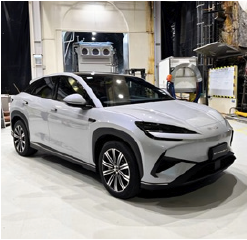
In terms of exterior styling, the Sealion 7 leans towards an SUV-coupé look, with a modern, fastback-like roofline and sleek proportions. There are hidden door handles and a panoramic glass roof. The Premium runs on 235/50 R19 tyres, while the Performance gets 245/45 R20 tyres, giving it a slightly more aggressive stance. Continental tyres replace the Chinese brands fitted to early BYDs.
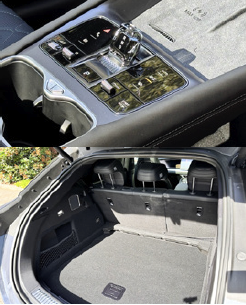
An electric tailgate reveals 500 litres of cargo space. While that figure is okay, it’s not best-in-class due to the slanted hatch, but it’s still reasonable, with a Model Y-like tub underneath the two-stage load floor There’s also a 58-litre front trunk for charging cables or smaller bags.
You get the option of opening the car with a tap of your iPhone on the wing mirror, or through the BYD app.
Inside, BYD appears to have chosen a more classic, relaxed style compared to the hyper-modern designs seen in the likes of the Leapmotor C10 and Tesla. Yes, there are buttons, plenty of soft-touch surfaces, and a bit of a statement piece in the form of a large piano-black, colour-backlit panel facing the passenger. On first inspection I thought it was a secondary screen.
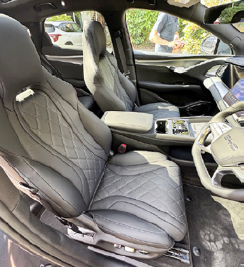
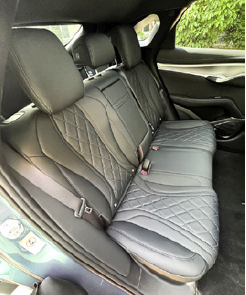
Similarly, the steering wheel and seats are wrapped in—shock—genuine leather. (Sorry, cows, but nothing synthetic feels quite this good yet.) The front seats are big and cosseting, but don’t seem to eat into the excellent rear seat space, rear seat passengers benefitting from excellent back rake angle and a surprising amount of headroom.
You still get plenty of tech, including a 15.6-inch rotating touchscreen – which uses the same updated interface as
the Shark – controlling everything from climate settings to driver assistance systems and navigation. This is internet connected, with a three-year package part of the price. You also get a 50W wireless charger, plus wireless Apple CarPlay and Android Auto. Rear-seat occupants aren’t left out either, with dedicated USB-A and high-power USB-C ports alongside air vents for extra comfort.
For even more comfort, there’s automatic dual-zone air conditioning with PM2.5 filtration, a heated steering wheel for cold mornings, and power-adjustable front seats with lumbar support and memory functions. BYD seems well aware that many buyers want a refined, upmarket interior that feels at home in everyday life.
On the lengthy safety list, you’ll find front, side, far-side, and curtain airbags, along with a 360-degree camera system that gives you a full view of your surroundings. It also comes with front and rear parking sensors, adaptive cruise control, and lane-keeping control. Automatic emergency braking, blind spot detection, traffic sign recognition, and intelligent speed limit control further boost driver confidence. BYD’s systems aren’t market-leading yet (you’ll have to wait for ‘God’s Eye’ for that), but they’re solid offerings and have their ‘bongs’ mostly under control.
The Premium version of the Sealion 7 dishes out 230 kW and 380 Nm of torque to the rear wheels, sprinting from 0–100 km/h in 6.7 seconds. The Performance trim takes things up a notch with 390 kW and 690 Nm of torque in an all-wheel-drive layout that catapults you from 0–100 km/h in just 4.5 seconds. Both models use a double-wishbone setup at the front and a multi-link at the rear.
We only got to drive the Premium, and it feels very, very good on New Zealand’s challenging roads – soft enough for comfort, but well controlled to feel planted through corners. We already liked the way the Seal Premium rode; this is better. The steering also earns praise: it’s accurate and has noticeable heft, especially when switched to Sports mode. Road noise remains subdued.
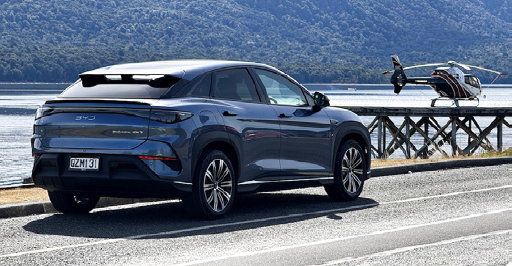
It will tow, but not much. The Sealion 7 is rated to two 750kg in two-wheel drive format and 1500kg braked for the all-wheel drive.
BYD also backs the car with a strong warranty, six-years and 150,000km for the car, 8-years and 160,000km for the battery.
The Sealion 7 is impressive, but its biggest strength might be that it doesn’t shout, “Hey, look, I’m a flashy new EV!” It does everything the more attention-grabbing competition does—often better—while offering a more classic look, a comfortable interior, excellent quality, and an incredibly strong price-to-battery and feature ratio.
Join the conversation