
Kia PV5 first drive: from concept to cargo
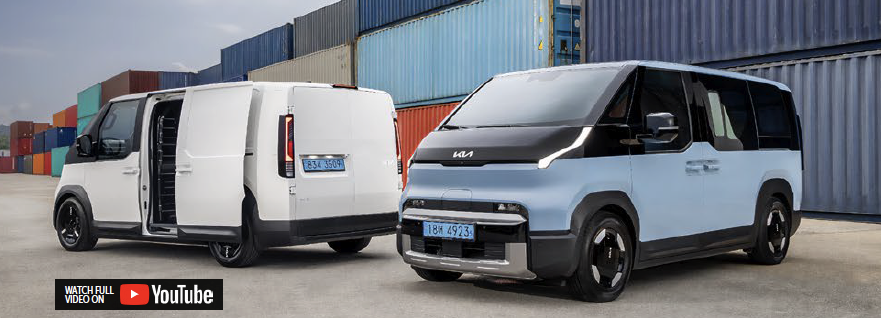
Kia’s been talking about its Platform Beyond Vehicle concept for a few years now, promising a modular electric-vehicle ecosystem capable of transforming from cargo hauler to passenger mover with minimal effort. The PV5 is the first tangible result of that vision. The idea of rolling into a dealership and swapping body types isn’t quite reality yet but the vehicle itself is a significant and impressive start.
FROM CONCEPT TO CARGO
The PV5 is the first model in Kia’s dedicated PBV range and the first destined for New Zealand. Local deliveries are expected in the first quarter of 2026, beginning with a cargo variant, before expanding into passenger and specialist versions once right-hand-drive production ramps up.
A flat-deck truck has already been spotted, while smaller and larger PBVs—the PV1, PV7 and PV9—have been previewed or hinted at.
Under the skin, the PV5 rides on a stretched and simplified version of the E-GMP platform, dubbed E-GMP.S, using a front-mounted 120 kW motor and 250 Nm of torque paired with (most likely for the NZ market) a 71.2 kWh NCM battery. Kia claims 416 km of WLTP range, a figure that holds up in practice: at 61 per cent charge, our test vehicle showed 278 km remaining, projecting to around 450 km on a full battery. Efficiency is strong too. With three occupants aboard the passenger version, roughly equivalent to a moderate cargo load, the PV5 averaged under 16 kWh/100 km across city and motorway routes. Smaller battery options from 43.3 kWh will exist for some markets, but they’re not expected in New Zealand.
RIGHT SIZE
Dimensionally, the PV5 fits neatly between the two Volkswagen ID. Buzz variants. It measures 4,695 mm long, 1,895 mm wide and 1,900 mm high in standard-roof form, with a 3,000 mm wheelbase. The High Roof version keeps the same footprint but rises to 2,200 mm. The ID. Buzz, by comparison, measures 4,712 mm (SWB) or 4,962 mm (LWB) in length, 1,985 mm wide, and about 1,930 mm tall, with wheelbases of 2,989 mm (SWB) and 3,239 mm (LWB). The PV5 is shorter and narrower, but similar in height, perfect for urban use.
Kia hasn’t published weight figures yet but claims a drag coefficient of 0.29, unusually low for a van. There is significant use of composites, such as the bonnet, and lighter interior trims so we don’t expect it to be a heavyweight in its class.
BUILT LIKE LEGO FOR GROWN-UPS
While the body swap system has yet to be achieved, Kia uses a system of add-on panels and extensions for the base vehicle to allow for multiple sizes at a lower cost. The 3,000 mm wheelbase is fixed, but Kia can build up to 16 configurations, from standard and high-roof vans to long-body cargo haulers and cab-chassis models, on the same roboticised production line.
The single streamlined production setup, which we visited during the launch, is designed for high automation and easy scalability.
CARGO THINKING
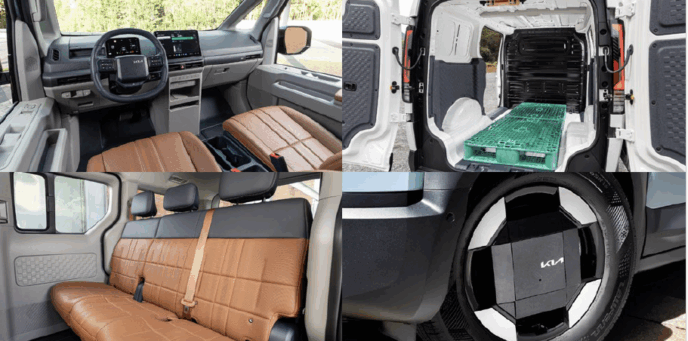
The Cargo Long (L2H1) variant will likely spearhead the New Zealand launch. It mirrors the passenger van forward of the B-pillar but trades plush trim for hard-wearing practicality. The load floor sits low, just above knee height, which makes constant loading and unloading effortless. The trade-off is a raised extensions behind the wheel arches of the wheel arches, though a flat optional add-on is confirmed, and local suppliers already plan raised-floor kits with underfloor storage. Crucially, a Euro pallet fits neatly between the wheel arches. Roof height isn’t wonderful despite the low floor, so if you need to stand in your van, order the high roof option.
Dimensions are key in this market: cargo length 2,255 mm, height 1,520 mm, and width 1,330 mm between arches (1,565 mm max). The rear door opening measures 1,343 mm wide (narrowing to 920 mm) with a step height of 419 mm, while the side door opens 775 mm wide and has a boarding height of 399 mm. Total load volume is 4.4 m³ (VDA), with a payload of 690 kg for the 71.2 kWh battery variant and 750 kg towing capacity.
Customers can choose between barn doors or a lift tailgate, and both passenger and cargo models can be specified with dual sliding doors.
We have spoken to local fleet fit out service Sortimo and they are ready to offer factory-ready racking and flooring options.
PASSENGER COMFORT
Inside, the PV5 sets a new standard for electric vans. The five-seat passenger model features a flat floor, wide electric sliding doors, and an open, airy cabin far removed from the drab interiors of traditional work vans. The front seats are power-adjustable, heated and ventilated, wrapped in soft synthetic leather. The squared-off steering wheel adjusts for both rake and reach, and there’s ample storage under the floor and between seats, though the dash lacks the upper storage trays popular with couriers.
Instrumentation consists of a 7.5-inch digital cluster paired with a 15-inch central screen running Kia’s Android-based OS, allowing fleet operators to load custom apps for deliveries or passenger management. Digital switch panels replace physical toggles, letting drivers control add-ons such as chillers or light bars through the main interface.
The second row features a broad, comfortable bench with air vents, small sliding windows and USB-C ports in the seatbacks. Unfortunately there is no rear ventilation controls and the seat split is on the driver’s side, which may remain unchanged for right-hand-drive markets. Kia also confirmed a third row will join the lineup, limited to two seats due to weight restrictions.
There’s even a pet mode, though this writer is not a fan of any pet being left in a car. Perhaps best used for husbands?
The massive load area in the five-seater features underfloor storage and clever load rails, that with specialist hooks can carry 10kg each. Rails for these attachments can be found around the van, including for a phone holder on the dash.
ON THE ROAD
Kia’s PBV drives with genuine polish. Steering is light but accurate, the ride is supple, and overall refinement rivals mid-size SUVs. The low-mounted battery gives the van a planted feel through corners, while the suspension easily copes with Korea’s endless speedhumps.
Performance from the 120 kW/250 Nm drivetrain is modest but usable—0–100 km/h in around 10 seconds—and the instant torque makes it feel livelier than the numbers suggest. Regenerative braking is adjustable via paddles and includes a smart automatic mode. The front-wheel-drive setup maintains good traction, and even the cargo version feels quiet and refined.
A safety barrier behind the seats leaves generous space for seat travel—something not every van manages.
Driver-assist technology is top-tier for a commercial EV. The Level 2 suite, including adaptive cruise and lane-keeping assist, feels intuitive and confidence-inspiring.
CHARGING AND CONNECTIVITY
The front-mounted charging port
is convenient for public use. The 150 kW DC rate is among the best in the segment, while 11 kW AC charging allows multiple vans to recharge overnight using affordable depot infrastructure.
Kia’s connected-car app integrates with the PV5’s tech stack, supporting over-the-air updates for infotainment and energy systems.
Every PV5 includes proper vehicle-to-load capability, supplying 250 volts at 16 amps ( around 4 kW) through outlets in both cabin and cargo area. It’s strong enough to power tools, laptops or even a small coffee machine, effectively serving as a portable generator for worksites or weekend adventures.
Safety kit includes seven airbags, blind-spot and collision avoidance systems, adaptive cruise, and a reinforced structure engineered for upcoming Euro NCAP standards. Kia expects a four-star result, possibly higher once passenger models are tested.
NEW ZEALAND PROSPECTS
Kia New Zealand hasn’t confirmed final pricing, but expects the PV5 Cargo to arrive early in 2026. A likely starting figure sits in the mid- to high-$70k range before on-road costs, putting it alongside Ford’s e-Transit Custom and LDV’s eDeliver 7. Those rivals may carry heavier payloads but offer smaller batteries and weaker V2L performance.
Initial demand will likely come from fleet operators seeking lower running costs and emissions. The private market for electric vans is small, but growing—and potentially the passenger version will widen appeal.
VERDICT
The PV5 is great, and its concept car looks means it runs a close second – closer than it should – to the ID. Buzz in the cool stakes.
But beyond the looks it is a competent electric vehicle. It drives well, efficiency is exceptional, and charging decent. From the functionality side it is neither perfect at being a people mover or cargo van as more dedicated options, but overall it is 99% there.
The next step is to see if we are right about what Kia will bring to NZ, and to find out the price.
Join the conversation