
Second-life EV battery market worth $11.26b by 2033
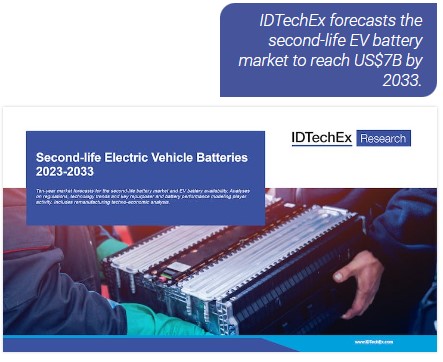
The second-life EV battery market has great importance for many reasons, says a new IDTechEx report which expects the market to reach US$7 billion (NZ$11.266b) within 10 years.
Reasons include adding value to future energy infrastructure, creating a circular economy for EV batteries, and providing a lower levelised cost of storage compared to new batteries, according to IDTechEx’s Second-life Electric Vehicle Batteries 2023-2033.
The report highlights advancements in the second-life industry ranging from regulatory and technology developments to player activity in battery diagnostics and repurposing.
The bulk of EVs currently use lithium-ion battery chemistries, and once their eight-to-10-year initial lifetime has expired they are usually unsuitable for future EV use, the report suggests.
Battery second use (B2U) extends the lifetime of the EV battery, it adds.
Depending on the state of health (SOH) and residual capacity of the battery, second-life batteries can be further utilised in less demanding applications, such as stationary energy storage and lower-power electromobility applications.
“This brings value to cross-sector stakeholders, including EV/battery manufacturers, EV customers, utilities, grid operators, energy companies, and electricity consumers.
“Stakeholders must make key decisions regarding the end-of-life management of retired EV batteries.
“Second-life batteries created through a remanufacturing process offer benefits of maximising battery value and extending battery life, whereas recycling results in batteries losing this value prematurely,” the report says.
“If remanufacturing is chosen, second-life BESS (battery energy storage system) developers must make further decisions to ensure that the creation of their second-life systems is techno-economically feasible.
“Remanufacturers must consider several process operations, such as battery procurement, depth of disassembly, testing/grading, and reassembly procedures.”
The new IDTechEx report assesses how these processes impact the final pricing of BESS to be competitive with new li-ion BESS.
“Within this young yet competitive market, key players are involved in both second-life battery repurposing and retired EV battery health and performance grading.
“A growing number of repurposer and battery diagnostician start-ups are starting to establish robust supply chains with automotive OEMs,” says IDTechEx, adding the lack of battery standardisation is one of the key barriers in the second-life market.
Procuring a larger volume of similarly designed batteries can help simplify both data-driven battery modelling and repurposing processes, it explains.
Base station backup energy in China is the dominant market for second-life EV batteries at present, says IDTechEx.
“These are replacing lead acid batteries, which have historically provided this service. However, IDTechEx has observed that the US and Europe are key regions with players making great advancements in deploying second-life BESS,” says the report, adding that some players who have commercialised these second-life BESS will soon be looking to scale their technologies to be suitable for large grid-scale applications, including the front-of-the-meter (FTM) battery storage market. ‘Large’ second-life BESS deployments in China are unlikely to be seen over the next few years amid a ban from China’s National Energy Administration in 2021, IDTechEx adds.
“As repurposers in the US and Europe look to deploy more second-life BESS, the regional distribution of total second-life battery deployments could shift over the next decade.”

Join the conversation