
Skoda Vision 7S reveals e-mobility focus
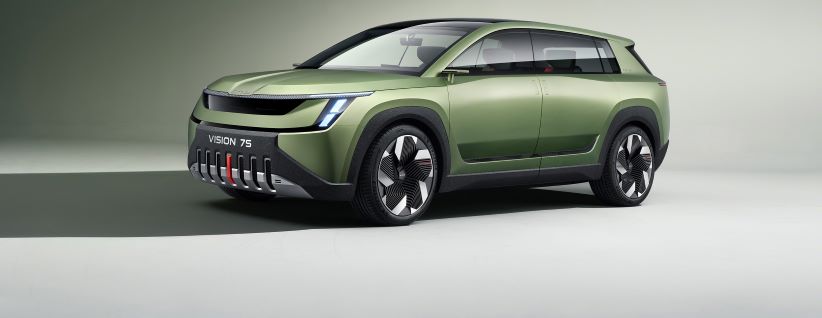
Skoda’s latest EV shows the Czech brand’s new design language and new logo.
The Vision 7S SUV is a herald of change and highlights a focus on e-mobility, says Skoda.
Based on the Volkswagen Group’s MEB platform, the Vision 7S is the first to receive a new design language that will become the hallmark of future Skoda vehicles.
“With the Vision 7S, we are offering a concrete view of a completely new Skoda model that will expand our product portfolio and our customer base. We are thus significantly accelerating our e-mobility offensive – we are going to launch three new pure electric models by 2026,” says Skoda board of directors’ chair Klaus Zellmer.
In addition to a seven-seater family car based on the Vision 7S, there will also be a compact SUV and a small car.
By 2030, Skoda wants to achieve a share of more than 70% of all-electric models in Europe.
In the transition to e-mobility, however, Skoda will introduce a new generation of Superb and Kodiaq models in the second half of next year, followed in 2024 by a modernised Octavia.
Skoda’s upcoming new EVs will all share the Vision 7S design language characterised by robust looks, functionality and authenticity.
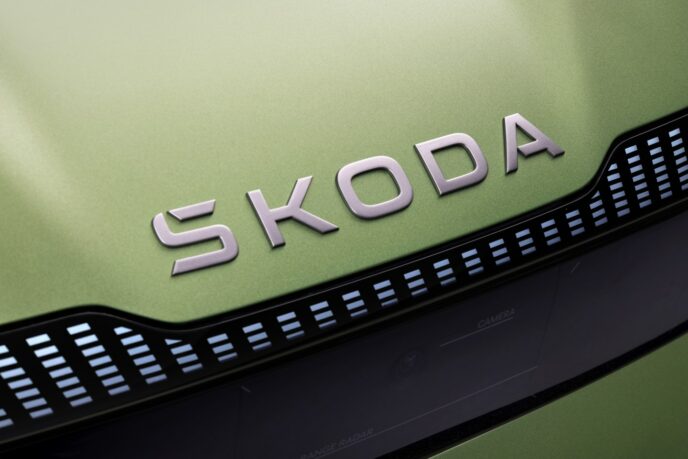
Distinctive features include a new logo and the Tech-Deck Face, a modern reworking of the traditional Skoda radiator grille with the new one flatter and wider, its ribs replaced by dark glass that covers the car’s sensors.
The Vision 7S study has a redesigned cooling system, an 89kWh battery, an estimated range exceeding 600km (WLTP), and fast charging with a maximum supported charging power of just under 200kW.
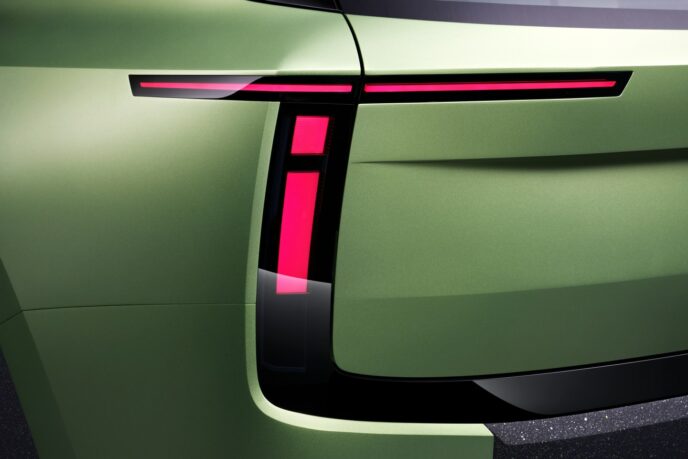
It has large 22-inch wheels, an orange control element that serves to safely disconnect the car’s high-voltage circuit, T-shaped headlights and rear lights – all enhancing aerodynamics.
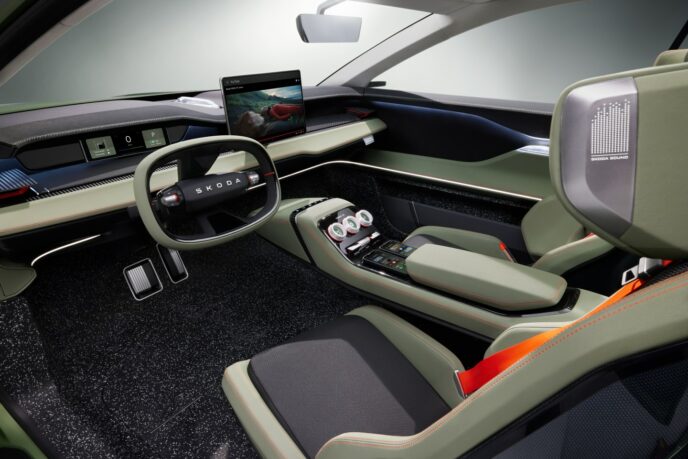
The infotainment system has revised graphics and control logic, a 14.6-inch touchscreen dominating. The Virtual Cockpit comprises an 8.8-inch display and a redesigned steering wheel with a flattened top and bottom, an augmented-reality head-up display, two large spokes in the steering wheel – the lower one incorporating a touchpad that can be used to control some functions when the car is stationary.
On the centre console below the large screen are six buttons that take the user into the infotainment, phone, vehicle settings, navigation and app menus, with a sixth button that can be configured at will.
There are also three rotary dials, the outer two for climate control and the middle one for controlling the main screen (zooming the map, scrolling through lists). Two buttons are used for selecting the car mode, and there’s a volume control as well.
Above this set of controls is an ergonomic armrest that makes it easier to operate the large infotainment screen. The screen can be divided into sections for greater efficiency and to ensure the driver has all the information needed. The navigation map can be placed in the upper section, for example, while the configurable section can be used to place various functions – such as the image from the child camera above the rear seats – using widgets.
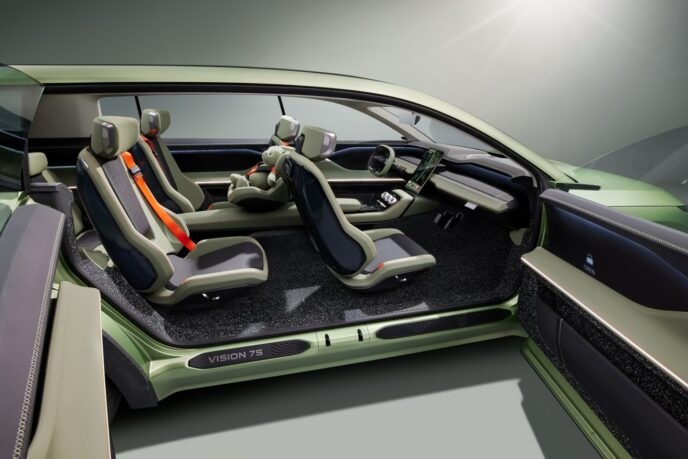
At the press of a button the car can be switched from Drive mode to the special Relax mode for when the car is parked, such as during charging.
In Relax mode, the screen and dashboard slide further away from the occupants and the display is rotated to landscape, for watching movies and TV shows. To give rear seat passengers a good view of the screen, the driver’s and passenger’s seats swivel inwards and recline. Second row seats also recline.
In this mode, the car’s infotainment can be operated by a smartphone – mobile devices magnetically secured in dedicated places.
The seven-seat interior with three-row seating is packed with an array of Simply Clever features.
A child car seat is integrated into the centre console, which extends to the second row of seats – considered the safest place in the vehicle and allowing monitoring, including via a camera.
Lighting elements are used throughout the EV – for practical purposes as well as ambience.
Sustainability and new colours are included, the floor made from recycled material for instance.

Join the conversation