
Uber test vehicle didn’t have emergency braking on – report
The Uber self-driving vehicle involved in a fatal collision with an Arizona pedestrian did not have its emergency braking system on, a report says.
The preliminary report into the crash between the Uber test vehicle and a woman pedestrian pushing a bicycle in Tempe shortly before 10pm has been released by the US National Transportation Safety Board.
“The modified 2017 Volvo XC90, occupied by one vehicle operator and operating with a self-driving system in computer control mode, struck a pedestrian on March 18, 2018,” the report says.
 The NTSB says its report does not contain probable cause.
It states the pedestrian wore dark clothing, didn’t look towards the vehicle until just before impact, and crossed the road where there was no direct lighting.
The report says the pedestrian was pushing a bicycle without side reflectors, and with its front and rear reflectors plus the headlamp not facing the oncoming vehicle.
The pedestrian was crossing where signs warn pedestrians to use a crossing, the nearest nearly 110 metres away, it says. The report also notes the pedestrian’s post-accident toxicology results were positive for methamphetamine and marijuana.
In its report the NTSB says Uber equipped the test vehicle with a developmental, self-driving system, consisting of forward and side-facing cameras, radars, light detection and ranging, navigation sensors and a computing and data storage unit integrated into the vehicle.
“The vehicle was factory equipped with several advanced driver assistance functions by the original manufacturer Volvo Cars, including a collision avoidance function with automatic emergency braking as well as functions for detecting driver alertness and road sign information. The Volvo functions are disabled only when the test vehicle is operated in computer control mode.”
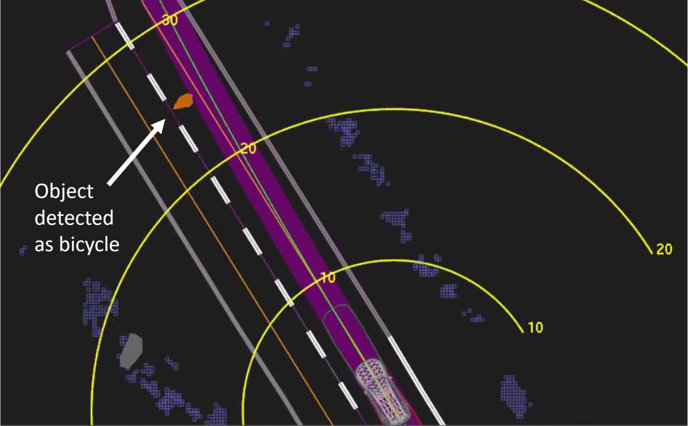
The report states data from the self-driving system shows the system first registered radar and Lidar observations of the pedestrian about six seconds before impact, when the vehicle was traveling at 69km/h. It’s impact speed was more than 62km/h.
As the vehicle and pedestrian paths converged, the self-driving system software classified the pedestrian as an unknown object, as a vehicle, and then as a bicycle with varying expectations of future travel path.
At 1.3 seconds before impact, the self-driving system determined that emergency braking was needed to mitigate a collision. According to Uber, emergency braking manoeuvres are not enabled while the vehicle is under computer control to reduce the potential for erratic vehicle behaviour. The vehicle operator is relied on to intervene and take action. The system is not designed to alert the operator, the report says.
The NTSB says the self-driving system data showed the vehicle operator engaged the steering wheel less than a second before impact and began braking less than a second after impact.
The board says the vehicle operator told it she had been monitoring the self-driving interface and that while her personal and business phones were in the vehicle neither were in use until after the crash.
All aspects of the self-driving system were operating normally at the time, and there were no faults or diagnostic messages.
The NTSB continues to investigate.
Uber says it’s stopping self-driving operation in Arizona.
The company says it’s doing an internal review of the self-driving project, that it has worked closely with the NTSB and that it has brought in former NTSB chairman Christopher Hart “to advise us on our overall safety culture”.
Click HERE
for the NTSB’s report.
Join the conversation