
Urban eTruck could start production in 2020
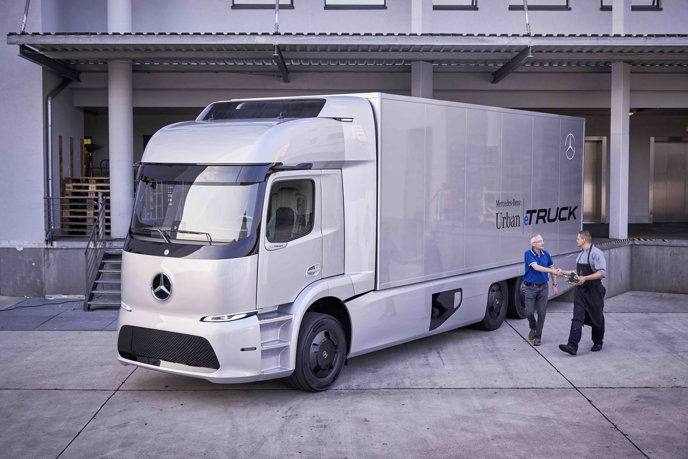
Mercedes-Benz has launched it’s revolutionary designed Urban eTruck concept electric vehicle at the IAA Hannover Commercial trade fair, announcing that a production version could be in the build cycle as early as 2020.
The fully electric Urban eTruck offers a permissible laden weight of 26 tonnes, and it not only provides up to 200km of battery range for small range distribution in urban areas, it also provides efficient delivery through the Fleetboard telematics network.
Mercedes-Benz says that stationary battery storage units will make the overall costs competitive for users of the Urban eTruck.
Electric motors adjacent to the wheel hubs drive the Urban eTruck, with power supplied from a modular battery pack.
Standard-production vehicles of this type would be conceivable from the start of the next decade says Mercedes-Benz.
The styling of the Urban eTruck is as innovative as its electric drive. The contours of the driver’s cab are sleek and fluid with minimal detailing, and no visible joints say Mercedes-Benz.
Across the roof, a three-dimensional spoiler connects the cab with the body of the truck. It has a deep vent at the front, which acts as an air inlet for the cooling unit concealed behind the spoiler.
The aerodynamic skirting panels on the side of the cab fit almost flush with the body. The windscreen extends downwards, and mirror cameras replace the current outside mirrors.
Because of the electric drive, Mercedes-Benz is omitting the standard air inlet from the Urban eTruck, replacing it with a black panel grille as the branding element. It is transparent and back-lit by high-resolution LEDs.
The futuristic-looking driver’s cab is not a radical design study, but a derivative of the cab on the Mercedes-Benz Antos truck.
The three-axle truck carries a 7.4 m long refrigerated body for use in fresh food distribution to supermarkets and retailers. The side paneling adds to the smooth feel of the vehicle and improves its aerodynamics.
Communication between the vehicle and its environment, the telematics system and the drive control, and also between the driver and the dispatcher, results in a fully interconnected system.
Because of its drive monitoring and energy control, the truck can achieve maximum performance and the best possible range for short-radius distribution in urban areas.
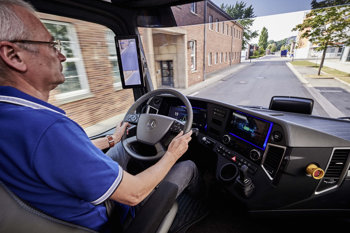
Instead of conventional instruments, the Urban eTruck features an entirely new display and control system consisting of two screens. The central 12.3-inch display shows the driver a wide range of information in an easily assimilated form.
Instead of the usual data for controlling and monitoring the vehicle, the Urban eTruck gives detailed information about the route using a road sign recognition system and on three-dimensional maps with all the essential information about the journey, including the physical features and bends.
The middle section of the display shows the speed on the left-hand side.
The central display shows a visual representation of a road and combines lots of information, starting with the route. The shape of the intended path on the display reflects the actual course of the road ahead, including any bends. It also shows the vehicles in front, their distance from the truck and their current speed.
Thanks to the stored map data, the automatic drive control also receives prior warning of braking and acceleration phases and road features such as traffic lights. The Urban eTruck automatically adjusts its speed in line with the road sign recognition system.
A new graphic is known as the ‘range potato,’ showing the driver the maximum range based on the current level of battery charge. This dynamic display is continually updated based on real-time road conditions and the terrain. As a result, the driver will know how far the truck can travel based on the current power reserves.
The third graphic presents a dynamic forecast of the energy required during the delivery run. It shows a target range marked by two lines.
As long as the electricity consumption level moves between these two lines, the Urban eTruck will have sufficient energy to complete the journey.
If the truck stays within the green area, it means there are no risks. Should the actual power requirement move outside this band, the driver sees a red coloured warning.
These calculations are being made continuously based on the current operation strategy, the three-dimensional map, the route schedule and the traffic conditions.

Join the conversation