
V2X vehicles set to exceed 60m annual sales by 2034 – IDTechEx
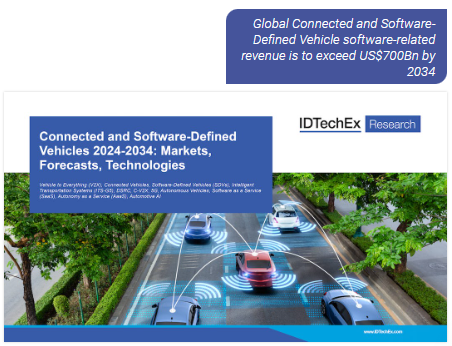
China is set to add 30 million new vehicle-to-everything (V2X) enabled vehicles to the road every year by 2034.
So says IDTechEx’s report Connected and Software-Defined Vehicles 2024-2034: Markets, Forecasts, Technologies which will see V2X technology become the standard in most vehicles.
The future connected vehicle does not just use a standard smartphone cellular connection but also takes advantage of dedicated ‘V2X’ safety communication channels, the report says.
V2X uses either wifi or cellular-based technology to facilitate communication with other vehicles and traffic infrastructure, it explains.
If regulation or safety standards mandate this technology, then V2X is set to become the ‘digital seatbelt’ of the future, promising to reduce accidents, improve congestion, and reduce emissions globally by allowing vehicle safety systems to talk to each other and to city traffic infrastructure, even in the pouring rain, dense fog, or busy carparks, says IDTechEx.
The two most popular technologies for V2X, DSRC, and C-V2X, both require different hardware.
DSRC is based on wifi protocols, and C-V2X is based on 4G or 5G protocols, IDTechEx explains.
“Currently, there are approximately one million V2X-connected vehicles on the road globally, with those mainly concentrated in Europe and China.
“About half the market is using DSRC-based technology (the Volkswagen Golf 8 and ID.X vehicles are equipped with ITS-G5 (EU DSRC equivalent) in Europe, known as Car2X), and the other half of the market is using C-V2X technology, with most of these vehicles being available in China.”
IDTechEx forecasts a significant market shift towards C-V2X technology, with more than 90% of the market expected to be using 5G-based C-V2X technology by 2034.
“The biggest contribution to this shift is regulation – the two largest vehicle markets in the world, the US and China, both have governmental organisations actively pushing for C-V2X adoption and have formally abandoned DSRC technology.
“India, Korea, and Japan are all likely to follow international trends set by the US and China.
“The EU is a region that is officially technologically neutral but has a strong existing DSRC/ITS-G5 base.”
Some C-V2X module providers are offering ‘Dual RAT’ systems that support both C-V2X and wifi based V2X technology, meaning DSRC will maintain some market share globally, says IDTechEx.
DSRC+, based on newer wifi technologies, may impact the market, but IDTechEx’s analysis concludes that technology improvements may be too little, too late, and that DSRC is a technology that has much less momentum compared to C-V2X.
If a technology is included in a New Car Assessment Program (NCAP), OEMs aiming to achieve a high safety rating must include it to pass certain tests, says IDTechEx.
“China has announced V2X inclusion in the CNCAP from 2024 onwards, which is set to result in significant growth for the technology in China.
Some regional regulators could potentially mandate V2X technology in all new vehicles, IDTechEx says, adding autonomous vehicles (AVs) could see the largest V2X impact, possibly before 2026.
“Using either DSRC or C-V2X, autonomous vehicles can transmit information at a dedicated frequency (~5.9GHz), with V2X acting as an extra sensor that works in all weather conditions and can go through walls and obstacles, effectively solving the line-of-sight problem.
“The main feasible method for achieving this is to use V2X to broadcast the location-related information of each car.
“A connected vehicle receiving the information can calculate the possibility of collision with the other vehicle using onboard compute.
“If the risk is high, the driver (or passenger of an autonomous vehicle) will be immediately warned, and the system will adjust accordingly to avoid a collision safely and effectively.”

Join the conversation