
Video: Double-decker bus converted from diesel to electric wraps up Auckland trial
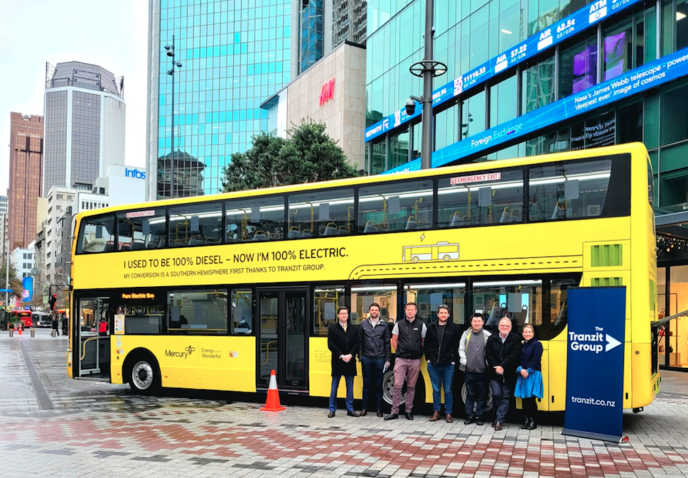

A double-decker electric bus that was converted from diesel has returned to Wellington to resume services on the Metlink network following trials on a series of Auckland bus routes.
New Zealand family-owned transport company Tranzit Group converted the bus from diesel to electric in its Masterton workshop in a Southern Hemisphere first in 2021.
After transporting passengers in Wellington since January, the “Repower Bus” received a temporary bright yellow make-over and new livery thanks to Mercury and was driven north to Auckland earlier this month.
The bus then spent a week doing trials on Auckland’s widely used bus routes such as along the Northern Busway to Albany, the Hibiscus Coast and inner-city routes.
Tranzit transport and operations director Keven Snelgrove says the company was keen to understand how it would perform in a different environment to Wellington and see if the trials could show that repowered electric double-decker 3-axle buses could be a viable public transport option for Auckland in the future.
“At Tranzit we operate a fleet of 2000 vehicles throughout New Zealand including more than 100 BCI diesel single and double-decker buses.
“By successfully converting one of these to 100% electric in a Southern Hemisphere first in our Masterton workshop, we have found a solution to keep this fleet running, even when diesel-powered public transport is planned to be phased out.
“By trialling our Repower Bus in Auckland, we wanted to demonstrate its technical and operational viability, which may allow government agencies or regional councils to balance environmental and financial considerations when making future fleet decisions and show that this type of retro-fitting can be done and can provide an alternative to convert relatively new diesel buses to zero emissions,” Snelgrove says.
The Auckland trials showed the Repower Bus reliably achieved 230km in service and when using the dual plug charging at 240kW it enabled a charge of around 45 minutes.
A range of 230km equates to 115 litres of diesel savings and 299kg of carbon emission savings. When in Auckland, the Repower Bus had only 16% brake regeneration which is lower than what is achieved in Wellington (30%) due to the capital city’s hilly topography.
Tranzit is now working on identifying more charger locations to maximise the vehicle use.
Snelgrove says the trial in Auckland also highlighted how valuable dedicated bus lanes are.
“We trialled the Repower on the Northern Busway at several different times during the day. What a great piece of infrastructure this is for Auckland city as it provides an opportunity to avoid congestion on the motorway and with the Repower being double deck means we could carry 85 seated passengers and 17 standing thereby removing 102 vehicles off the road during one trip.
“In addition, with half price public transport available now until 2023, a passenger could travel on the NX2, for example, for around $2.70,” he says.
Metlink general manager Samantha Gain welcomed the Repower Bus or “3501” back into service.
“It’s great to have 3501 back in Wellington’s fleet of electric vehicles.
“After returning to Wellington on Saturday it was out in service on Sunday covering 445kms on rail replacements as well as doing a few late night urban runs.
“We’re proud to have this innovative diesel conversion in the mix alongside our purpose-built electric buses, our fully electric Airport Express service and our electric harbour ferry.
“It’s a testament to the ingenuity we have here in New Zealand and the options Metlink and Greater Wellington have as we head to our goal of reaching carbon neutrality by 2030,” Gain says.
Metlink is the Wellington region’s public transport network of bus, train, total mobility and harbour ferry services. The Metlink network has 2248 weekday rail services operating on five rail lines, over 3600 weekday bus services, 180 school bus services, and 24 weekday harbour ferry services serving 4 harbour ferry wharves.
*Click here to read more about the bus.

Join the conversation