
Wind and geothermal help Mercury
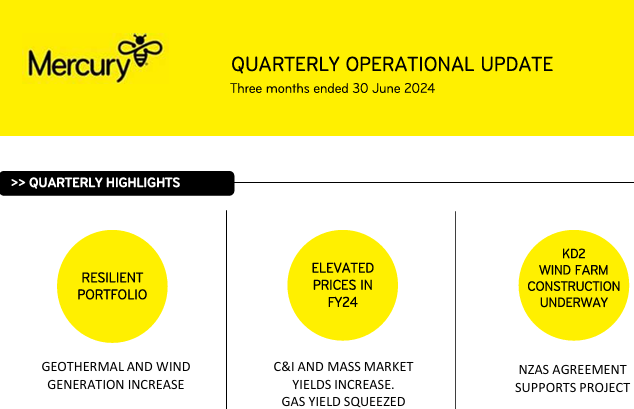
Mercury says geothermal and wind generation increased to provide a “resilient portfolio” for the three months ended June 30, 2024.
Low national inflows during the quarter contributed to elevated spot electricity prices averaging $265/MWh in Auckland. Full year national inflows were 23rd percentile with spot prices in Auckland averaging $187/MWh for the financial year.
Forward prices remain high averaging $166/MWh in Auckland for financial years 2025 to 2026.
Gas supply uncertainty is reflected in elevated near-term forward prices.
Normalised national demand during the financial year was 0.9% higher than FY23.
Mercury says that in spite of 30th percentile inflows into the Waikato catchment during the financial year, hydro generation was slightly higher than average at 4096GWh but 21% lower than last year’s record hydro generation.
The year end lake level was 103GWh lower than average.
Total generation was 8780GWh (258GWh, 3% lower than PCP). This reflects improved resilience in geothermal generation with 2622GWh of generation for the financial year (264GWh, 11% higher than PCP) and higher wind generation of 2062GWh (591GWh, 40% higher than PCP), supported by new wind generation from Turitea South and Kaiwera Downs stage 1 wind farms, Mercury says.
Financial year commercial and industrial yields (physical and end-user CfDs) increased by $9/MWh (7%) to $131/MWh versus PCP, reflecting repricing of contract renewals into the high electricity forward curve, it says.
“Mass Market yields also saw strong growth, up $9/MWh (6%) versus PCP. Gas supply constraints during the quarter contributed to elevated gas purchase costs, increasing to $25/GJ ($13/GJ, 108% higher than PCP).”
Kaiwera Downs stage two construction started in June with full generation expected by the end of CY26, says Mercury.
“This brings Mercury’s total FY24 commitment to new renewables to over $700 million with the geothermal expansion at Ngā Tamariki announced in September 2023.”



Join the conversation