
24 million EVs this year
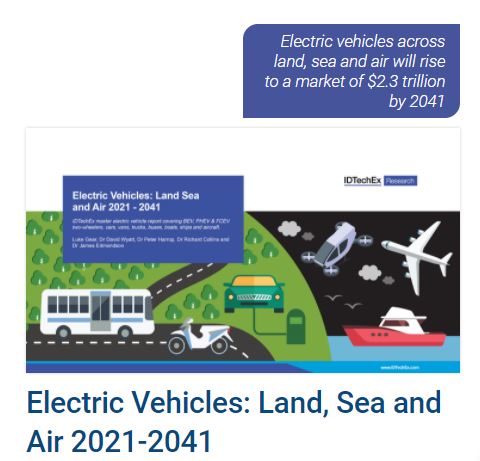
The EV market across land, sea and air will be 24 million unit sales this year.
So says IDTechEX, adding that represents a decline of about 19% year-on-year due to COVID-19’s impact.
Urban vehicles such as electric cars and two-wheelers have the highest unit volume, battery demand and motor demand, and, as consumer-driven markets, bear the brunt of the pandemic’s impact, its report Electric Vehicles: Land, Sea and Air 2021-2041 says.
The volume of the electric two-wheeler market, which is just over 90% of the 24 million sales, may seem surprising, it suggests.
“This volume comes from China, where the market is not growing. In fact, the S- curve is already over – the market peaked at roughly 30 million sales in 2016 after 20 years of growth and has stabilised at a slightly lower level (some 26 million were sold in 2019).”
Since consumer purchasing power has surged, China’s urban mobility preference and future growth is now with the car, IDTechEx explains.
“However, due to the sheer volume of Chinese electric two-wheelers, it will take a while for other motorcycle-dominated regions with a will to electrify (like India) to make a dent in the global market (we predict the 30 million mark will be surpassed again in 2029).”
In spite of making up over 90% of unit sales today, li-ion battery demand from two-wheelers takes only 11% of the market due to small battery sizes per vehicle and the dominance of lead-acid batteries in Asian micro-mobility segments, IDTechEx adds.
“In contrast, electric cars have the second-highest sales volume alongside relatively large battery capacities per vehicle, making up 7% of unit sales but over 70% of the battery demand, a share which increases for the next two decades.“

The chart represents BEV and PHEV cars, vans, trucks, buses and E2W, and BEV, PHEV and HEV boats, ships and aircraft.
So how have plug-in electric cars (BEV and PHEV) fared in 2020?
“The logic is that COVID-19 and a global recession increases consumer price sensitivity, which is a setback for more expensive electric cars,” the report says.
“However, due to a backlog of orders from popular models, less price sensitivity from today’s electric car demographic and the continued commitment of governments to emissions targets, sales have shown resiliency in Europe and the US and were mostly flat during national lockdowns.”
IDTechEx expects hydrogen to show a modest recovery, but uncertainty remains high against the backdrop of a ‘second wave’.
In contrast, China’s growth has been negative, but this was the trend before the pandemic with purchase subsidy reductions of up to 60% from July 2019, the report says.
“COVID-19 amplified but did not set-off this trend.”
Li-ion battery adoption on ships has flourished in recent years as start-ups have capitalised on falling battery cell prices from automotive battery suppliers.
“However, while the industry is used to much longer sales cycles and a decline is less immediately visible, the impact is likely to be less fundamental and isolated to specific subsegments,” says the report.
“For example, the cruise sector has seen passenger demand evaporate due to the risk of being confined out at sea with thousands of passengers.”
IDTechEx says it has learned of some major orders for hybrid cruises being delayed, while other projects have stayed on track.

Join the conversation