
Road EV charging using second-life batteries
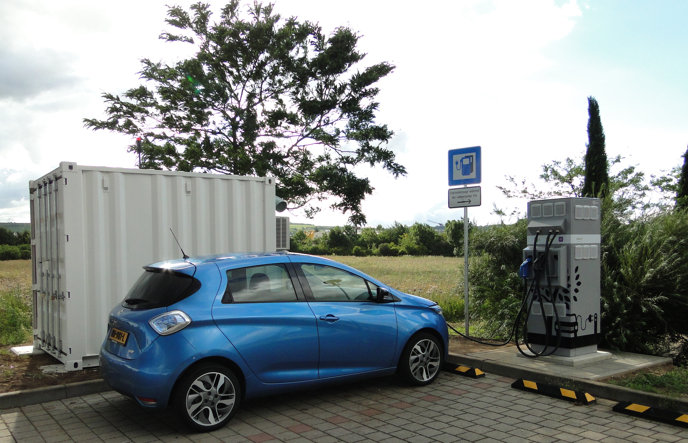
Two quick-charge stations based on the innovative E-STOR energy storage technology have been installed on highway rest areas in Belgium and Germany by United Kingdom-based Connected Energy and Groupe Renault.
Motorists there will be the first in the world to benefit from this service.
The E-STOR technology developed by Connected Energy uses second-life batteries from Renault EVs. Batteries are recharged at low power, and the stored energy is then released at high power. That makes it possible to offer EV charging services in locations where constructing a high power connection to the power grid would be very costly.
Economical and simple to install, E-STOR will contribute to the development of a network of quick-charging stations in Europe.
“We are now talking to several parties about projects in the UK and Europe and look forward to wide scale roll out in coming months,” Connected Energy managing director Matthew Lumsden says.
The partnership supports Renault’s global strategy for the energy storage market.
EV batteries generally have a service life of eight to ten years. However, they still have substantial capacity for further use in stationary applications, thus extending their life before recycling. To optimise this complete life cycle, Renault has set up battery rental with its EV customers.
“Groupe Renault is supporting the development of charging infrastructures to simplify the daily life of electric vehicle drivers,” its EV batteries and charging infrastructures head Nicolas Schottey says.
“Using our second-life batteries in fast EV chargers contributes to progress by providing charging station operators with economical solutions.”


Join the conversation