
New Zealand a world leader in zero emission renewable power
New Zealand leads the world in zero emission renewable grid electricity, now at 85%.
So says Dr Peter Harrop, chairman of IDTechEx which analyses emerging technologies. Harrop was here earlier this month as the evworld NZ conference keynote speaker.
He says New Zealand has a nice balance between geothermal, hydroelectric, unusually continuous wind power and some solar. The country therefore has less intermittency of green power than most, Harrop says.
“Next comes devolution of these sources to off-grid supply on buildings and even on land, water and airborne vehicles.
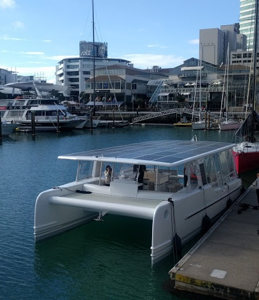
“For example, a 20-person solar boat was recently launched with a ‘perpetual’ six knot speed, that can power three houses on arrival.”
The technology comes from Naval DC in the Netherlands, which presents at the world’s first conference on the subject, Energy Independent Electric Vehicles, at the Technical University of Delft Netherlands, September 27-28.
“This remarkable progress still leaves some requirement for batteries to allow the boat to travel at the same speed at night and allow buildings and the grid to cope with peak demand and any intermittency remaining,” Harrop says.
Building energy storage systems across New Zealand would represent an economic game-changer for the country within the next few years, according to new research by national grid owner-operator Transpower.
The company said its research findings show distribution-connected or community-scale batteries are expected to be economic for homes and business from 2020.
Now Transpower is preparing to hold trials of battery storage systems, while working with industry leaders to push for market and pricing reforms the company says will be needed to “unlock the value of battery systems to maximise their value”.
Transpower grid development general manager Stephen Jay says the company is evaluating opportunities for using new technologies throughout its network.
“Battery projects at lower voltage distribution substations and at a consumer level are forecast to be economic in the next few years, due to the declining cost of battery systems.”
He says they will also become economic for the high voltage transmission grid, providing battery resilience across the whole supply chain.
While Transpower is not planning large-scale high voltage trials with batteries “in the near term” it will seek opportunities to learn from others in joint projects where appropriate.
The functionality of a battery as both a load and a generator at various times will need to be examined, and regulatory and technical barriers to entry addressed.
Long-term, the study says battery storage at any location in the supply chain is expected to delay or replace the need to build additional thermal peaking plant and should, over time, reduce the cost of electricity to consumers.
Container-based battery storage systems can quickly target specific grid constraints in a controlled manner, the report says.
In addition, the report said ramping up battery storage projects would support national plans to boost the take-up of electric vehicles.
“In future, we expect that electric vehicle batteries could have the capability to be part of a battery network, providing services when the vehicle is plugged in to charge overnight,” Transpower says.



Join the conversation