
Scrap the side mirrors to reduce drag
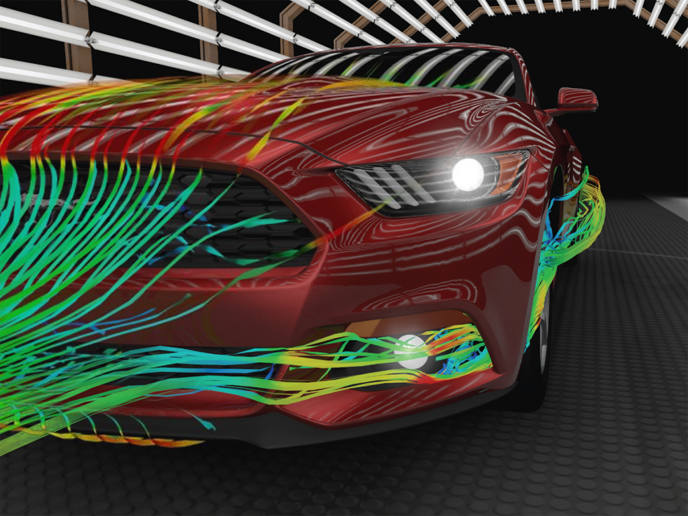
The first thing Ford aerodynamicist Rob Carstairs wants to remove from cars are the side mirrors.
His reason is purely scientific: “They are useless for aerodynamics,” he says.
Carstairs would scrap and change many things on modern cars to create the most fuel-efficient vehicle possible by reducing drag.

An aerodynamicist’s dream is a vehicle that directs the flow of air smoothly all the way over the vehicle, without any disturbances.
In the era of electrification, vehicles are already adopting more aerodynamic shapes.
“On an electric car demands for powertrain cooling are reduced, so the grille openings can be smaller,” Carstairs says. “Things like that are quite handy for us aerodynamicists.”
An aerodynamicist’s dream vehicle shape would look like a teardrop, allowing air to flow smoothly, while a long tail solves the problem of vacuums created as air leaves the roof and the trunk.
A car this shape would easily be the most fuel efficient on the road.
But there are many reasons why these things aren’t solely left to aerodynamicists, not least because most people don’t want to drive a car that looks like a giant teardrop.
Fortunately, the final look of a car is the result of the different demands of Ford teams, including designers, aerodynamicists and safety engineers.
Safety is why Carstairs’ nemesis the side mirror is a non-negotiable fixture on cars – a fact he agrees is only a good thing.
Compromises like this are a key part of the design development process for Carstairs and his colleagues at Ford.
The designers know what customers want vehicles to look like, but this isn’t always good for aerodynamics. Likewise, Carstairs can make suggestions based on aerodynamics, but if the vehicle won’t sell then they can’t be used. Because of this, a lot of his work is done making subtle optimisations, which can have a surprisingly big effect.
“Under the front bumper of the Everest SUV we added wings on the outer parts to direct airflow,” Carstairs says. “It improved aerodynamics by 5%.”
Many Ford vehicles now also have a slight flick in the tail lamps to stop the air flow from wrapping round the vehicle and causing added drag – an ingenious and mostly cost-free improvement in aerodynamics.
Ford aerodynamicists’ work has been greatly improved by computing advances.
While wind tunnels are still a crucial part of aerodynamics testing, complex computer models and simulations now allow Carstairs and his colleagues to easily test design tweaks on Ford’s supercomputer cluster, an additional measure that can replicate hours of testing and unimaginable only ten years ago.
“If we run tests for two days we can easily complete over 50,000 hours’ worth of simulations,” Carstairs says.
A vehicle’s look is also affected by the markets it is destined for. Although lower cars are more aerodynamic, the amount of clearance a car has varies by model, and is also heavily dependent on how flat roads in a region are.
“In India for example, roads can be a bit bumpier so a vehicle might have to sit a bit higher,” Carstairs says. “We have to consider all the different road conditions across the region.”
However, as more car buyers are demanding fuel-efficient vehicles, design changes suggested by aerodynamicists are being prioritised.



Join the conversation