
EVs – the good, the bad and the battery
This story first appeared in the October issue of EVtalk – CLICK HERE to download the magazine FREE
 How secure is power supply forEVs?
EVTalk raised the question after September’s fuel pipeline incident which disrupted supplies from Marsden Point to Auckland.
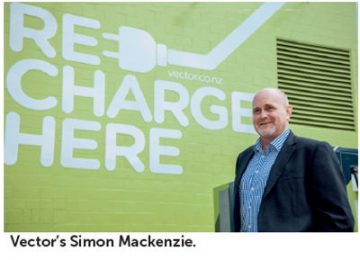
Vector is the national number one provider of electricity. Its chief executive officer Simon Mackenzie covered the supply subject during his talk at the evworld NZ conference in Auckland on September 8, just days before the pipeline problem began.
We asked him to elaborate.
“Increased uptake of EVs globally presents both a massive challenge and limitless potential for utilities and regulators,” he says.
“EVs are poised to become a significant part of New Zealand’s transport mix, as car makers gear up to stay ahead of demand,” says Mackenzie who expects reduced EV prices, improved travel range and increasing product choice will see uptake substantially exceed the current 5000 on our roads.
“It will have a tangible impact on electricity networks, including our own.
“Many EV users plug in to charge around the same time after work, during times of peak demand. This means that while they will help reduce one of New Zealand’s largest sources of greenhouse gas emissions, on current user behaviour trends EVs are set to add strain to networks and create resilience issues as more of the national fleet become reliant on electricity supply.”
Mackenzie says resilience is increasingly important with climate change bringing climate uncertainty and the severity of climatic events, therefore creating a greater risk of dry years affecting hydro-electric dams.
“As the uptake of EVs increases, a dry year will have a much greater impact – affecting how we move, as well as how we power homes and businesses.
“When you consider a national fleet reliant on traditional electricity production and the increasing unpredictability that climate change brings, it is obvious we cannot rely primarily on a hydro system.”
“Resilient renewables” are needed, he says.
“By embracing emerging technology like solar and batteries, we are not only minimising our carbon footprint but ensuring long-term resilience.
“That’s why Vector is pioneering Vehicle-to-Grid (V2G) technology in New Zealand. This is essentially a two-directional charger which allows vehicles to be charged, or reverse the energy flow, allowing EVs to discharge energy.
“V2G is a game-changer for EVs because it transforms them into rechargeable and mobile power sources.”
An EV connected to a V2G charger can introduce extra power to buildings, as a cheaper power source during peak-hour consumption, power homes during power cuts and even release energy back to the network to support customer demand.
“People could charge up their car batteries overnight with cheaper energy and then use them as power boosts when needed, or in the morning and evenings when energy costs more,” Mackenzie says.
“V2G offers increased customer choice and provides consumers with greater control over how they power their lives.”
A Nissan Leaf G2 with a 30kWh battery could power the average household for 10 hours. The new chargers could also integrate with other technologies such as solar and batteries to redefine a truly smart energy home or business.
“V2G will influence not just how owners power their vehicles but how they rethink their whole energy usage,” Mackenzie says.
“As battery technology changes and at-home energy storage capabilities become more mainstream overseas, it won’t be long before consumers here are demanding similar options – particularly if they have solar and are generating their own power.
“With the right battery, they will be able to make three choices around their energy usage – use it there and then, store it and use it later (for example, to charge their vehicle) or sell some of it on to others.”
Vehicle batteries can also have a second life through innovative recycling.
“We have created a new mobile generator trailer, which utilises recycled car batteries,” Mackenzie says.
“It is used by our crews to maintain or restore power where outages would otherwise be experienced. This extends the lifecycle of EV components, further reducing their impact on the environment.”
Mackenzie says it will be essential to monitor the rate of EV uptake and location because of the pressure they could place on the electricity network without efficient co-ordination.
“Electricity distribution businesses are at the coal face of ensuring sufficient build out and upgrades are made to cope with the increased demand on the network,” he says.
“Vector, and others, are using an array of public information to join the dots and better understand the disruption unfolding, to create a smart, efficient, customer focussed and resilient energy future.”
Christchurch based EVNEX is building intelligent systems to help utilities and end users monitor and control EV charging stations from anywhere in the world.
“We believe that this technology will become crucial to electricity network stability as EV fleet numbers and EV power requirements continue to increase,” chief executive Ed Harvey says.
“Furthermore, as the effects of climate change grow, we’re also going to see more consumers taking an active role in how they consume power and how that power is generated.”
Harvey says reliability of electricity networks, generation and storage will soon underpin the availability of almost all forms of transport.
“EVNEX is looking at how IoT technologies, combined with machine learning, can help lower the stress on electricity networks, and provide network managers and generators with better data to forecast demand and predict possible issues.”
New information from overseas shows projects like OpenLV are opening up electricity use data too, providing information on electricity capacity for EV charging.
Apps are being developed which provide an EV user with masses of information, including best times to charge, supply issues, power sources and more.
The upshot is that with the rapid pace of technology – including EV solar roof panels, better battery range and storage, wind and other alternative power sources – it’s likely EVs won’t face any major power disruption even when they become the norm on our roads.



Join the conversation